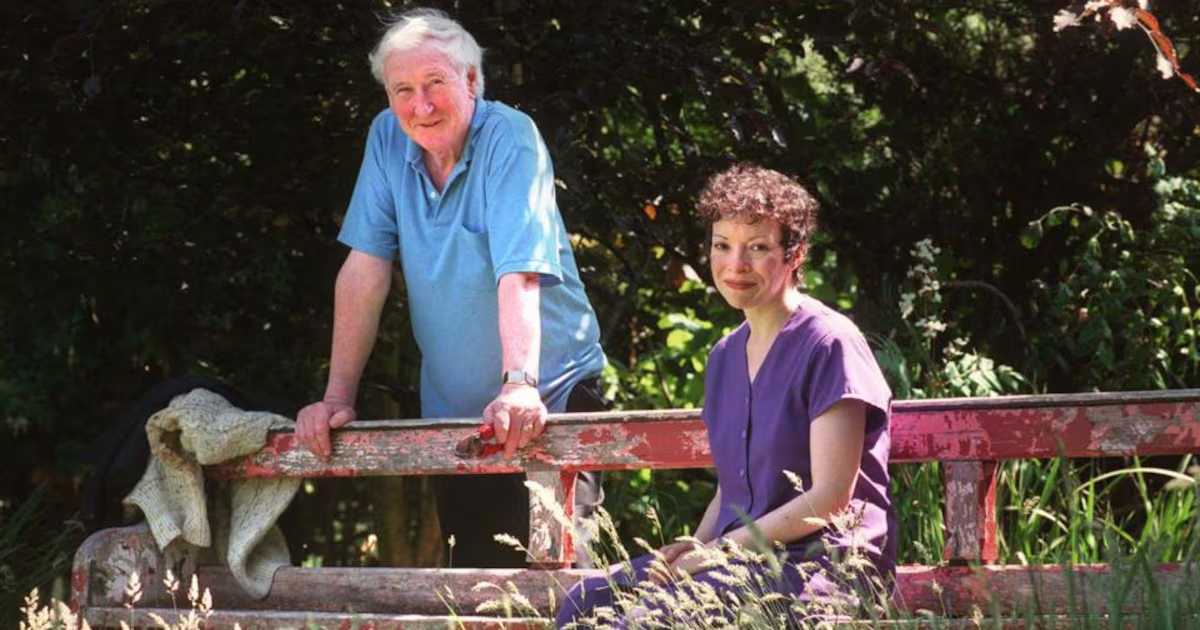
The poet continued to write ardent lyrics full of love for me, his daughters, nature and for our troubled worldJohn Montague and his wife Elizabeth Wassell Montague at home in west Cork. Photograph: Alan Betson Elizabeth Wassell MontagueSat Jul 18 2026 - 06:00 • 4 MIN READJohn Montague was a renowned and beloved poet both in Ireland and internationally. He was also my husband. John died on a bleak night in December 10 years ago. In 2017, my sister and niece came to Dublin, and we decided to travel northwards to Co Tyrone, where he had grown up. Many of his most wonderful poems describe Tyrone: The Water Carrier is a paean to the green places that nourished his imagination, and The Rough Field, a lament for his riven province, stands among the great epics. John is buried in Tyrone, across the road from the house where he lived with his aunts, surrounded by the headstones of his ancestors and by the fields that he explored as a little boy. Yet when my sister, niece and I arrived at the car hire outlet in Belfast, the man behind the desk widened his eyes. "Tyrone? We don’t see many going that way."His astonishment recalled me to John’s forlorn and beautiful poem, Last Journey: “Beragh, Carrickmore, Pomeroy, Fintona – Placenames that sigh / like a pressed melodeon / across this forgotten / Northern landscape."[ John Montague on Seamus Heaney: A friend who realised his destiny in fullOpens in new window ]Yet a new initiative, Arts Over Borders, intends to celebrate the writers who emerged from that forgotten landscape. Brainchild of Sean Doran and the late Liam Browne, the programme is composed of various thematic routes, including The Poetic Way, which will extend from Patrick Kavanagh’s “stony grey soil of Monaghan” northwards to the Tyrone of Paul Muldoon and John.In John’s long poem, Border Sick Call, the poet accompanies his doctor brother on a series of sick calls along the Fermanagh-Donegal border. It is deep winter, and the Border itself (that charged threshold) is so obscured by snow that “demarcations disappear”. The last lines read: “Headlights carve a path through darkness / back through Pettigo, towards Enniskillen… / But in what country have we been?" If Arts Over Borders is an attempt to heal a fractured Ulster by honouring its writers, I can think of no better way than to read and re-read Border Sick Call.As he grew wiser and more tender, he produced elegies for his firebrand father in which he envisages ‘a healing agreement’, and for his lawyer brother, who shows a ‘fragile bravery’ even on his deathbedOn the personal front, I have learned, over the past 10 years, that I cannot control or appease grief, but I can build a life around it so that the grief itself becomes a source. Of love, of hope. And last year, the Lilliput Press published a biography of John, A Poet’s Life, by Adrian Frazier. This book so thoroughly explores the depth and breadth of John’s achievement that scholars will be compelled to recognise his stature as a major poet from now on. Such literary immortality heartens me, yet during our 24 years together, spent largely in Nice, John and I were seldom apart. Even if I went out shopping on my own, I was alert to how the light touched a particular house, or how the mendicant crouched in his usual position outside the Monoprix was wearing a funny hat, so that I could describe those things to John on my return. And I still describe my day to him.During our Dublin years, we befriended a circle that included novelist Christine Dwyer Hickey and her husband Denis, actors and writers such as Katherine Lynch, David Herlihy and his wife Reg, along with Anthony Cronin, once John’s poetic rival, later a pal. John was always passionately curious about people, and generous in his nature, and so he responded warmly to this diverse, talented group. We spent rollicking hours with them in Dublin and Nice, at literary festivals and an Italian wedding. In other words, John had fun, perhaps some of the most fun of his life. And in this period, he grew even deeper as a poet. He found that Robert Graves’s ideal of “the muse” (a firefly brightness embodied briefly in a woman) no longer moved him. He had realised that the muse can be anyone, or even anything. WH Auden was drawn to the disused lead mines of Northumberland, for whom they held an almost religious power as places of wreckage, but also the possibility of renewal. John observed to me, “Those mines were Auden’s muse”.[ Another high tree felled: Irish poets salute John MontagueOpens in new window ]It was in this later period that John wrote Border Sick Call. And as he grew wiser and more tender, he produced elegies for his firebrand father in which he envisages “a healing agreement”, and for his lawyer brother, who shows a “fragile bravery” even on his deathbed. John maintained his searingly prophetic voice, as well, in poems such as A Response to Omagh: “As history creaks on its bloody hinge / and the unspeakable is done again.” Up until his death, John found grace in constancy and friendship; he relished translating his French poet friends into English. And he continued to write ardent lyrics full of love for me, for his daughters, for nature and for our troubled world.When I am blue, I remember John Boorman’s eulogy at John’s funeral in 2016. Boorman had grown frail, but his voice was impassioned. He observed that John had been restive throughout his life, until he was restored “by his ferocious love for Elizabeth”. Those words sustain me now.IN THIS SECTION
I still describe my day to my husband John Montague 10 years after his death
The poet continued to write ardent lyrics full of love for me, his daughters, nature and for our troubled world
956 words~4 min read