Story audio is generated using AI
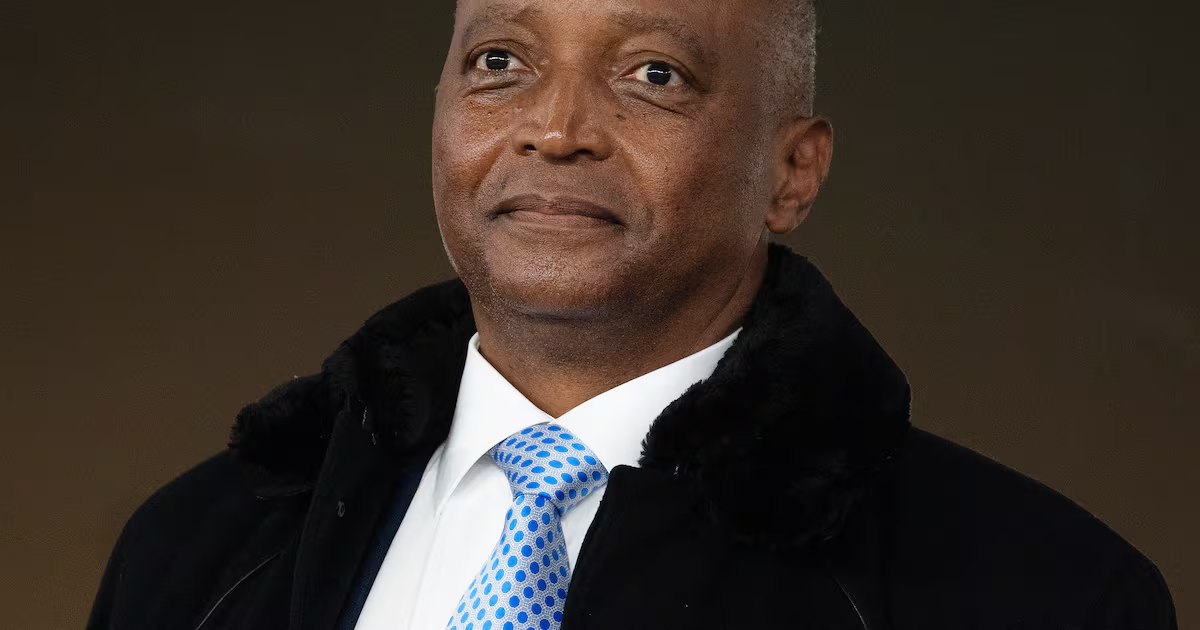
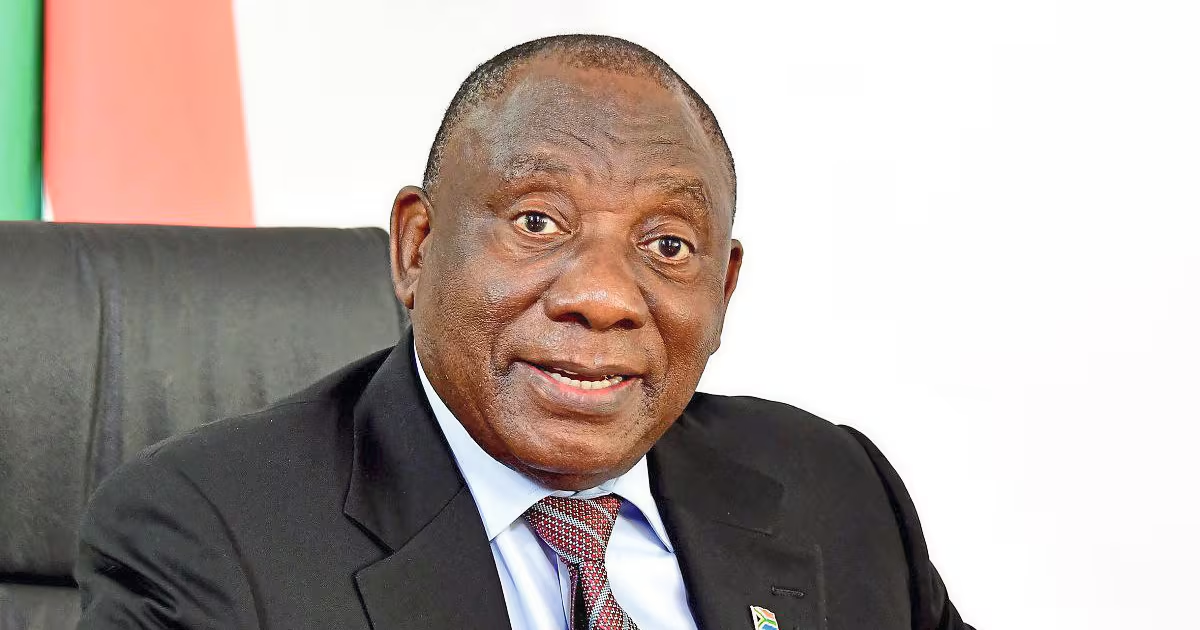
Kuben Naidoo, appointed by President Cyril Ramaphosa to his presidential economic advisory council in 2024, has shown his hand on what he thinks of black economic empowerment (BEE) as debate rages on the policy meant to bring in black people into the mainstream economy.Naidoo, formerly with the South African Reserve Bank and now with Investec, revealed his thoughts in advisory notes carried in the presidential economic advisory council pack ahead of this year’s state of the nation address.The notes, written in January, have not been made public until now. They give insights into the thorny issues the Ramaphosa administration grapples with and the advice coming the president’s way.Naidoo, in his note tackling the polarising topic of BEE, acknowledges that the question about what South Africa should do with the policy has become one the most vexing political debates of the time. He prescribes a remedy that he believes will be win-win. “Drawing on a proposal originally made by a young and well-known tech entrepreneur, this article proposes a simple, voluntary tax surcharge in return for a ‘BEE compliance certificate’,” Naidoo writes.“The detail of the proposal is as follows: “A company can voluntarily pay a 5% surcharge on its corporate income tax. This surcharge will not be tax deductible. Simply put, if a company is assessed as having to pay R100 in corporate income tax, it would voluntarily pay R105.“This proposal has several advantages: there is no need for complex tax calculations. Second, if a company makes a loss, there is no tax to pay. Small businesses often have a lower effective tax rate and hence will pay proportionately less. Companies typically pay little tax during their start-up investment phase.”The tech entrepreneur Naidoo is referring to is Alan Knott-Craig jnr, who has called for companies to pay 3% of gross revenue in exchange for automatic level 3 broad-based BEE status — a neat alternative to the complex scorecard system.On paper, it sounds practical. The model offers predictability, reduces red tape and could channel significant funding into the department of trade, industry & competition’s proposed transformation fund. The fund has been fiercely opposed by those who see BEE as nothing but rent-seeking.Naidoo says that under his proposal, R5bn could be raised annually. “For companies that pay this surcharge regularly, there will be no other BEE obligations or requirements, including reporting requirements. Based on collections of about R320bn in corporate tax in 2024/25 and assuming that about a third of firms opt to pay this tax voluntarily, this surcharge on corporate income tax would raise about R5bn a year in revenue,” he writes.“This money will be split in two, with half given to state-owned development finance institutions to lend to black and women entrepreneurs or entrepreneurs investing in townships or former homelands.“The other 50% will be given to banks who pledge to use the funds (and report on the funds) to lend to black-owned businesses or businesses investing directly in the townships and former homeland areas.”Naidoo’s assessment of BEE in its current form is not without its criticism, as he argues it has raised the cost of doing business — a critique that has been raised several times on many platforms but that has drawn scorn from proponents of the policy.He argues that the South African economy has traded competitiveness, innovation and investment for BEE, and this delicate trade-off needs to be revisited. “BEE has created a class of rent-seekers, not a class of entrepreneurs. BEE has facilitated a corrupt relationship between the state and sections of the black elite. BEE has scared away foreign investments and undermined domestic investments because it is difficult and costly to implement, monitor and sustain,” Naidoo writes.“Even if it is merely the perception that BEE has a high cost of compliance, this perception too will limit investment and hence undermine growth and employment.”BEE has created a class of rent-seekers, not a class of entrepreneurs. BEE has facilitated a corrupt relationship between the state and sections of the black elite.— Kuben NaidooDuma Gqubule, an independent economist, tore into the suggestion that BEE had increased the cost of doing business.“It is difficult to understand how providing shares to workers and communities, employing more black people in management, investing in employees through skills development, diversifying supply chains, investing in black companies through enterprise and supplier development, and empowering communities through the socioeconomic development initiatives that precede BEE can be bad for the economy,” Gcubule said.“Many of the costs attributed to BEE would have been incurred without empowerment policies. They are part of good corporate citizenship, and diversity and inclusion is a global movement.”Despite his criticism of BEE, Naidoo warns against doing away with it as a tool to drive transformation and redress past economic injustices that are still prevalent in South Africa’s economy.“If BEE were to be scrapped, the consequence is not likely to be the growth boom we all yearn for. It is more likely to result in a rise in populism, rising social fragmentation and strife, and people beginning to question South Africa as a viable free market economy,” he says.“If all the capitalists are white and all the poor are black, surely capitalism cannot survive in a country where 91% of the population is black? Surely, if one believes in free markets, then there must be the nurturing of a growing black capitalist class.”Naidoo’s warnings are in line with those made by Joel Netshitenzhe, who held key government communication and policy roles in the administrations of Nelson Mandela and Thabo Mbeki.Netshitenzhe last year launched a spirited defence of BEE, urging critics of the policy to contend with the emergence of the black capitalist class — no matter how uncomfortable.“It is also illogical to expect BEE to have resolved the challenge of slow employment creation. Worse still, BEE cannot be expected to resolve problems of water and other infrastructure, potholes, grass-cutting and public safety,” Netshitenzhe said at the B-BBEE Commission’s strategy session.“This then brings to the fore a frank discussion that some find uncomfortable. And this is that postcolonial class formation has to include, as a core element, the emergence, or creation, of a cohort of black capitalists, the so-called ‘black capitalist class’.”Business Times