The Bank of Japan (BOJ) is likely to consider raising its economic growth forecast at its meeting this month while leaving the policy rate unchanged after last month hiking it to the highest level since 1995, people familiar with the matter said.The central bank would probably discuss raising its growth forecast from the current projection of 0.5 percent for the year ending next March in its quarterly outlook report, the people said, adding that global demand tied to artificial intelligence (AI) has helped keep Japan’s economy resilient.Officials would also consider revising their assessment that risks to the economy are “skewed to the downside,” reflecting emerging confidence that the economy can avoid a serious downturn, they said.
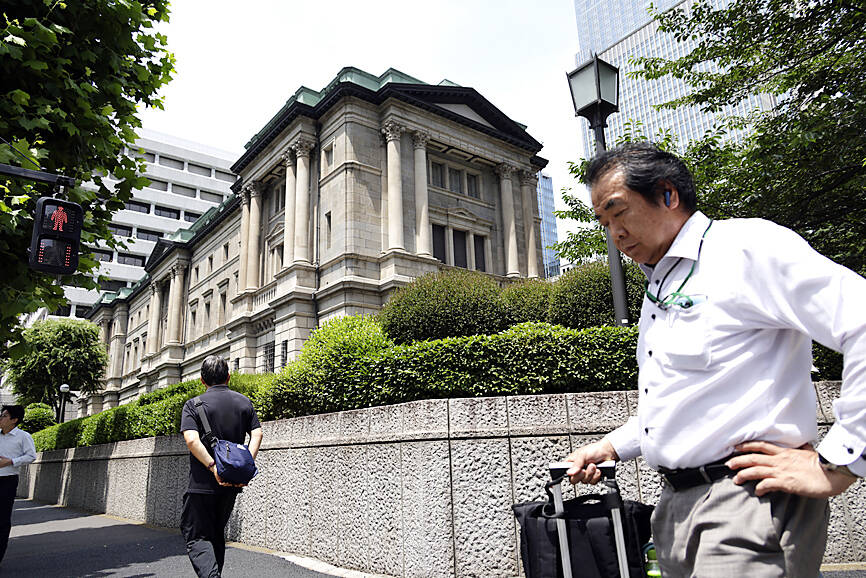
Peaople walk near the Bank of Japan in Tokyo on June 16.
The officials are to make final decisions on policy and the economic outlook after assessing all available data and information up to the last minute, the people said.The yen was largely unchanged following the news, with a back-to-back rate hike this month already viewed as unlikely by economists and market participants.
The improved outlook would mark a notable shift from April, when the central bank warned that the Middle East conflict posed significant downside risks to the economy.Those concerns have eased as major supply-chain disruptions have largely failed to materialize, helped by companies securing alternative sources of raw materials, the people said.Another supportive factor has been rising export prices, driven largely by global demand for AI-related products. That has helped offset the deterioration in Japan’s terms of trade caused by higher energy import costs, supporting corporate profits and household income, the people said.On inflation, officials continue to see upside risks to the underlying price trend, a key reason the bank cited for raising rates on June 16.While crude oil prices have broadly evolved in line with the bank’s expectations, businesses are passing higher costs on to consumers more quickly than in the past, reinforcing inflationary pressures, the people said.The Bank of Japan raised its inflation forecasts significantly in April and now expects its key price gauge to remain above its 2 percent target over the next two fiscal years, after it already stayed above the target in the previous four years.The central bank raised its policy rate to 1 percent in June and already a rate hike by the end of the year has been largely priced in by investors.The focus is on whether the bank might move earlier than that.Traders see about a 69 percent chance for the BOJ to hike again by October, according to pricing of overnight swaps.In a Bloomberg survey conducted after the June rate hike, about a half of economists predicted the next move to take place in December.Another 36 percent said it would be in October.Investor concerns over the bank falling behind the curve is one of the factors analysts are citing for the yen’s recent slide.Japan’s currency is hovering near its lowest level since 1986.Recent concerns over possible government pressure on the bank to go slow on rate hikes is another catalyst cited for yen weakness.