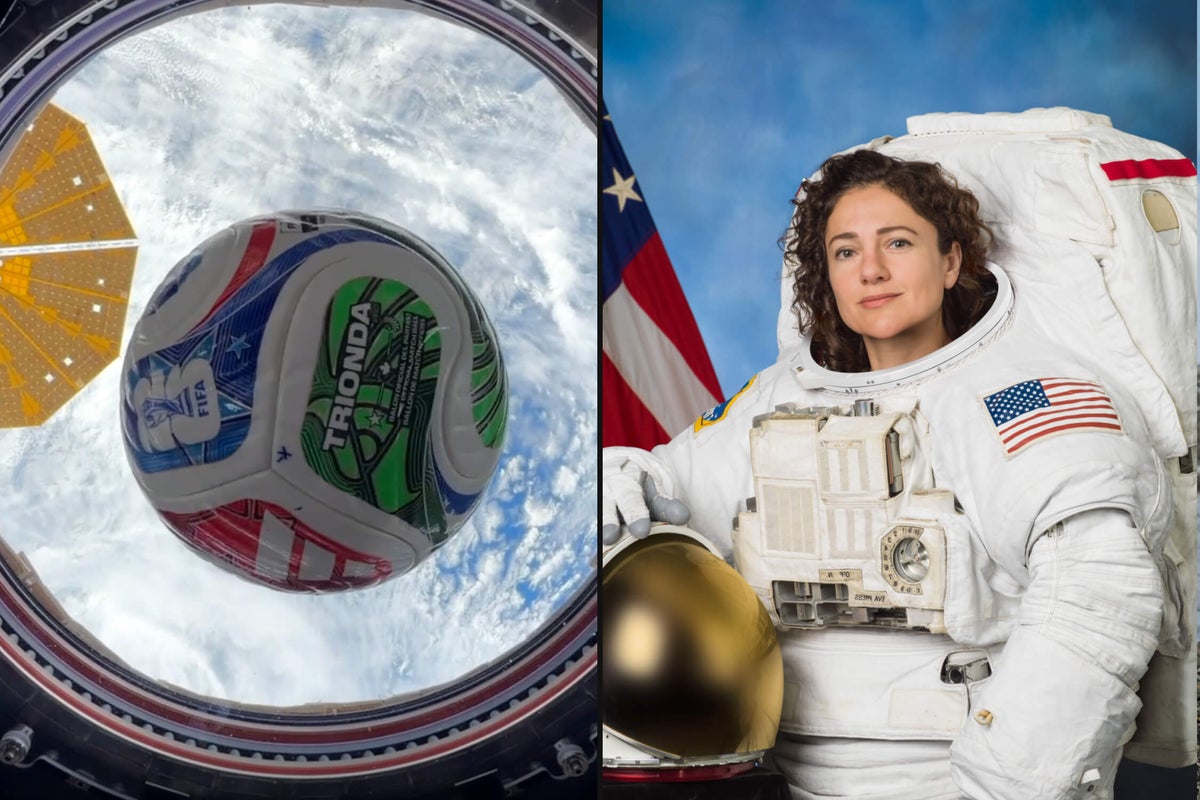
This World Cup has not been short of divisive moments. Beyond on-pitch disputes over refereeing calls, life and politics have spilt into the tournament like never before. On many occasions, it has felt like the unifying power of the ‘beautiful game’ has been hard to find. In a very literal sense, though, the ability to bring people from all around the globe together has not been lost.The Athletic has talked to fans from far and wide — Earth’s most northerly permanent settlement, its remotest community, an Antarctic base, even in space — about what it has been like following the World Cup from the most isolated places on our planet… and beyond.The International Space StationSince Valentine’s Day, Jessica Meir and Chris Williams have worked 250 miles above the surface of the Earth in the International Space Station.Meir, a 49-year-old Swedish-American, completed the first all-female space walk in 2020 (with Christina Koch) and has spent over 350 days in orbit, contributing to research on heart function. She is also a huge fan of “proper football” and has done a bicycle kick in zero gravity. She is joined by Williams, 42, from the U.S., who has a doctorate in physics from MIT and is on his first mission to the ISS.Jessica Meir was one of Time magazine’s 100 Most Influential People of 2020 (NASA)Their days start at 7.30am and consist of 12 hours of activities such as exercise, scientific experiments and repairs.“One of my favourite aspects about life as an astronaut is that each day is different,” Meir says. “Some days are a bit more unique, if we have spacewalks scheduled — such as to repair the station’s robotic arm — or when we capture cargo vehicles.”The pair have weekends off, however, and make time to connect with family and have team dinners, such as the one they held to watch England beat Norway in the World Cup quarter-finals last Saturday.Meir and Williams took off from Cape Canaveral, Florida, in February (Aubrey Gemignani/NASA via Getty Images)“Events like the World Cup definitely make me feel closer to home,” Meir says. “I lived in Vancouver, British Columbia, when it was a host city for the winter Olympics (in 2010), and I’ll never forget how alive the streets were. I was also training in Russia for my first spaceflight during the 2018 World Cup and felt that same energy in the streets of Moscow.“It is always uplifting and refreshing to experience these moments of global unity. This feeling is very similar to the one that we astronauts are so privileged to have when we look down on our shared home planet from above and instantly understand that we are all connected.”Williams is of the same mind.“Watching the World Cup has made me feel closer to home,” he says. “When I look down, I can’t help but imagine people in the cities below cheering for their teams while watching the games, just like I am up on the space station.”Astronauts on International Space Station doing an overhead kickTristan Da CunhaBack on Earth, Tristan Da Cunha is credited as being the most remote inhabited place in the world.It’s a group of islands in the Atlantic Ocean, about 1,500 miles west of South Africa and over 2,000 miles east of South America. There’s no airstrip: the only way to get away is by ship, and it can take anything from seven to 13 days to reach Cape Town in South Africa.
What’s it like watching the World Cup from space – or Antarctica?
From remote islands to the northernmost part of the planet and beyond, the World Cup gets everywhere...
1,520 words~7 min read