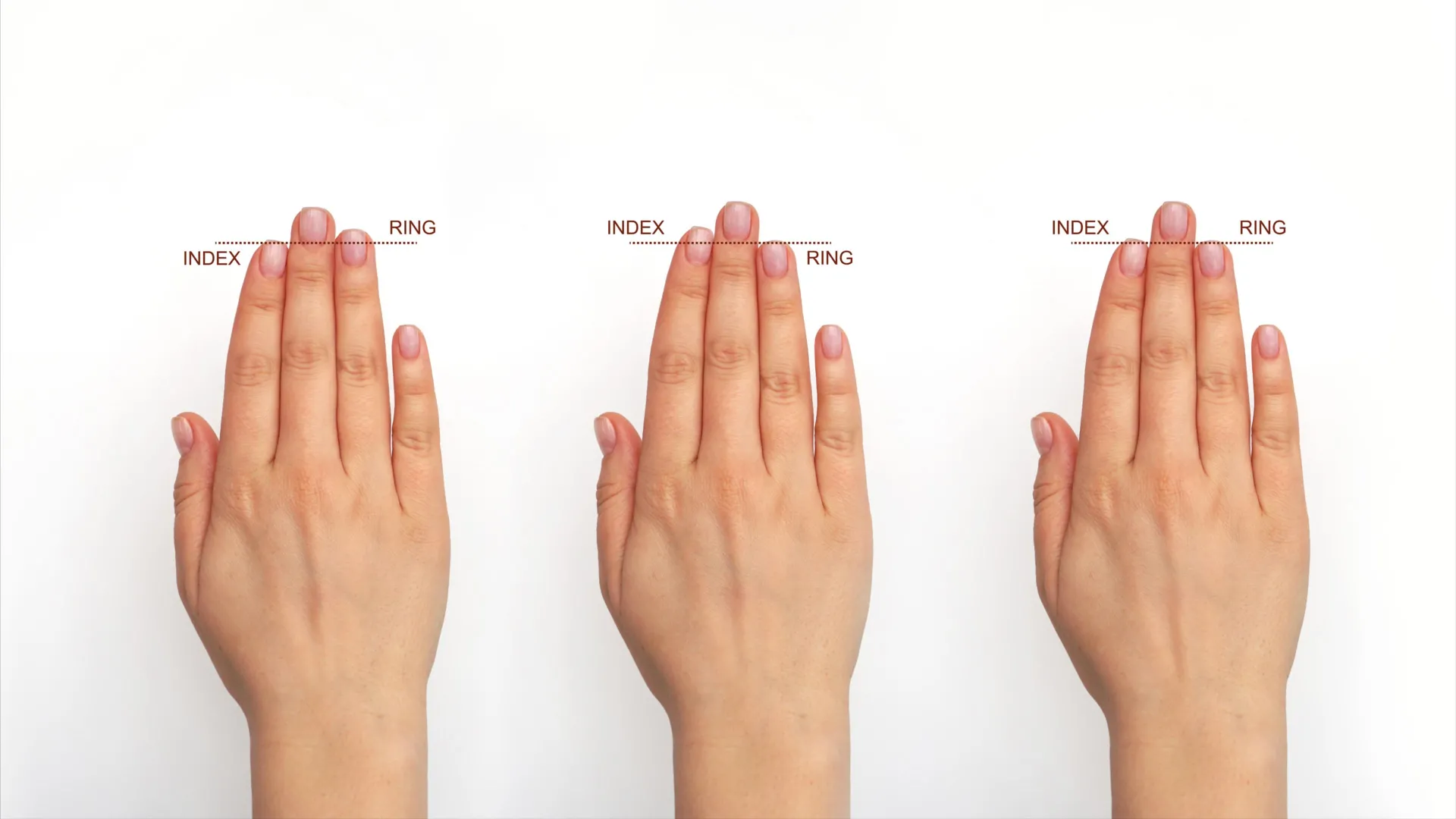
Human evolution is closely associated with the development of a much larger brain. New research suggests that greater exposure to estrogen before birth may have contributed to that expansion, and that a possible trace of this hormonal influence can be seen in the relative lengths of a person's fingers.
Professor John Manning, a member of Swansea University's Applied Sports, Technology, Exercise and Medicine (A-STEM) research team, specializes in the study of digit ratio.
Digit ratio compares the length of the index finger, known as 2D, with the length of the ring finger, known as 4D. This measurement is called the 2D:4D ratio. Researchers use it as an indirect indicator of the balance of estrogen and testosterone a fetus may have been exposed to during the first trimester of pregnancy.
People thought to have had relatively higher exposure to estrogen than testosterone generally have a longer index finger (2D) compared with their ring finger (4D). This results in a higher 2D:4D ratio.
For the latest study, Manning worked with researchers from Istanbul University's Department of Anthropology. Their findings were published in the journal Early Human Development.