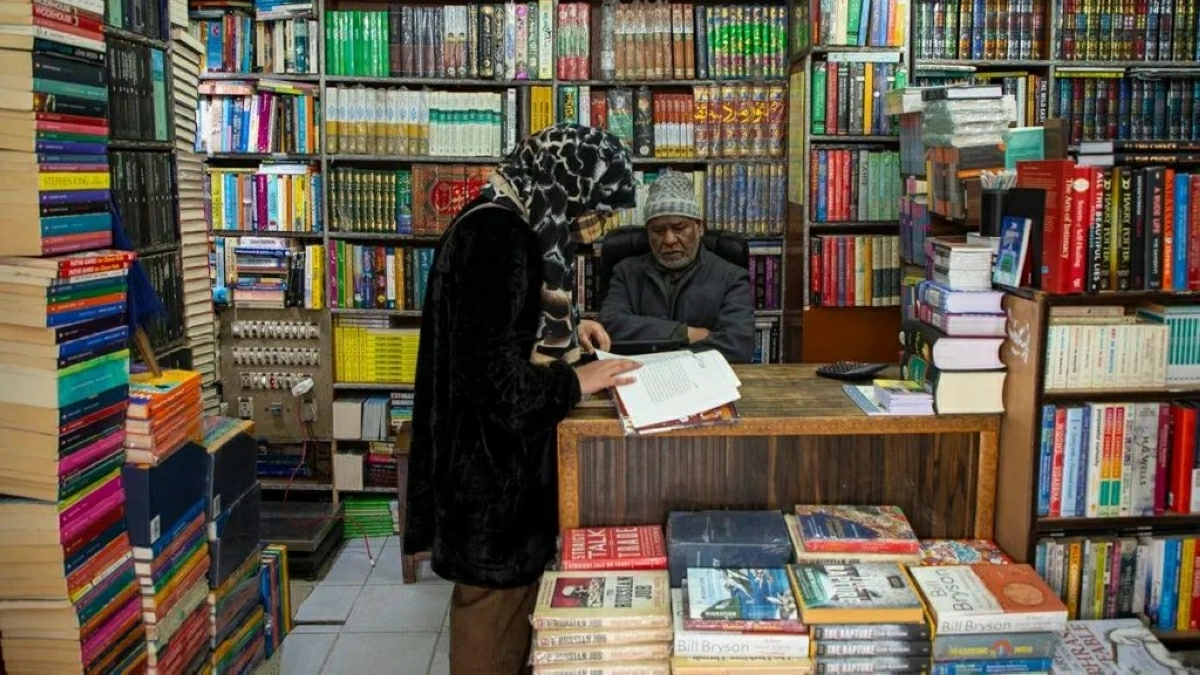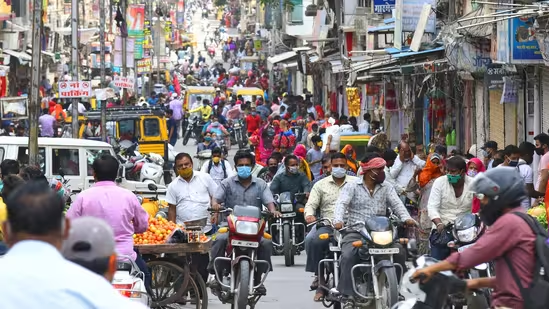
Indian authorities in the restive Himalayan region of Kashmir have ordered all educational institutions to review books for “objectionable content” and have arrested three publishers for allegedly glorifying separatist leaders.The Directorate of School Education has ordered schools, colleges, universities, and tutoring centres in the federally administered territory to review all published material – books, research papers and academic theses – and report content that could be deemed to violate “religious sentiments, laws, educational values and established norms".It has instructed heads of the institutions to submit detailed reports within seven days if they find such material. The reports must include the title of the offending book or paper, its author, publisher, year of publication, and the number of copies held. The directive also instructs district chief education officers to monitor compliance and submit consolidated reports by 19 July.A man looks at a book inside a bookstore in Srinagar, Kashmir, in 2025 (AP)The directive has caused a backlash, with critics denouncing it as an attack on academic freedom, an attempt by the Indian government to whitewash Kashmir’s complex geopolitical history and a bid to silence Kashmiri voices.The move came after prime minister Narendra Modi’s BJP party protested against the procurement of two books for government school libraries that it claimed glorified separatist leaders of the region and promoted “anti-national sentiments”.In the wake of the protest, authorities withdrew the books – Personalities and Legends of J&K and Great Personalities of Jammu and Kashmir – from school libraries and suspended eight officials for procuring them.Police said 251 copies of the books had been distributed to schools across Jammu, Ramban, Udhampur, and Baramulla districts before they were withdrawn. They arrested three people and launched an investigation against them for allegedly helping include "highly inappropriate content" in the two books.A shopkeeper waits for customers at a bookshop in Srinagar, Kashmir (AFP/Getty)Nitasha Kaul, a Kashmiri-origin professor of politics and international relations at Westminster University in the UK, told The Independent the order was not simply about removing extremist material but about expanding state control over what people could study, teach and discuss “Censorship of thought and word combined with attempts to silence knowledge makers is one of the oldest cards in the deck of authoritarians. It is the perpetuation of ignorance that creates consent for repression and indoctrination. Democracies that turn to authoritarianism fear independent thinking and scholarship,” she said.She pointed out that vague and non-specific terms like “objectionable content can be used to censor all academic knowledge that may be inconvenient to the government, blurring the lines between reasoned critique, freedom of expression, and hate speech as applied to an already cornered population”.“While glorification of violence and religious fundamentalism must not be condoned, this extends in all directions and for all religions, Islam as well as Hinduism. The vague language further paves the way for an atmosphere of fear and leverage, augmenting unwarranted state control in academia, and further menacing the capacity of scholars to speak truth to power on questions concerning politics, economy, and society,” she said. Aga Syed Ruhullah Mehdi, a member of India’s parliament from Kashmir, said “reports of books relating to Kashmir’s history and identity being removed from the University of Kashmir, alongside the ongoing audit of educational institutions, are deeply troubling”.“Libraries exist to preserve knowledge, not curate political narratives. Erasing books does not erase history; it only impoverishes scholarship,” he said. “A society that fears ideas ultimately fears the truth. Academic freedom and the right to engage with history must never become casualties of ideological control.”Waheed Parra, a senior member of the Peoples Democratic Party, a regional party, argued that such bans denied the younger generation the right to question, think independently and critically analyse their homeland’s past and present. “The latest ban is an attempt to rewrite Kashmir’s collective memory and erase our history and memory,” Mr Parra told Frontline. “It only promotes selective learning and selective amnesia.”Police in a market in Kashmir (AFP/Getty)Sunil Sethi, a BJP spokesperson, however, argued that the government couldn’t let people "glorify separatists in the name of academic freedom"."Peace has been restored in the region with great difficulty and we can't let things get out of control again," he told the BBC.Last year, authorities banned as many as 25 books in Kashmir that they claimed propagated “false narratives” and “secessionism” in the disputed region. The ban threatened people with jail time for selling or even owning works by authors such as Booker winner Arundhati Roy, constitutional expert AG Noorani, and noted academicians and historians like Sumantra Bose, Christopher Snedden, and Victoria Schofield.Kashmir has long been a battleground of narratives due to its complicated history. The Himalayan region, held in part but claimed in whole by India and Pakistan, has been riven for decades by both political and armed rebellions against Indian rule. The conflict, which has ebbed and flowed over the past four decades, has left tens of thousands dead. India accuses Pakistan of fanning the separatist movement, and particularly the armed insurgency, in Kashmir. Pakistan denies the allegation.In 2019, the Indian government revoked the semi-autonomous status of the region and brought it under direct central rule. Since then, activists say, authorities have since increasingly criminalised dissent and eroded civil liberties in what remains one of the most militarised regions in the world.
India accused of erasing Kashmir’s history after order to review books
Authorities arrest three publishers in restive Himalayan region for allegedly glorifying separatist leaders
878 words~4 min read