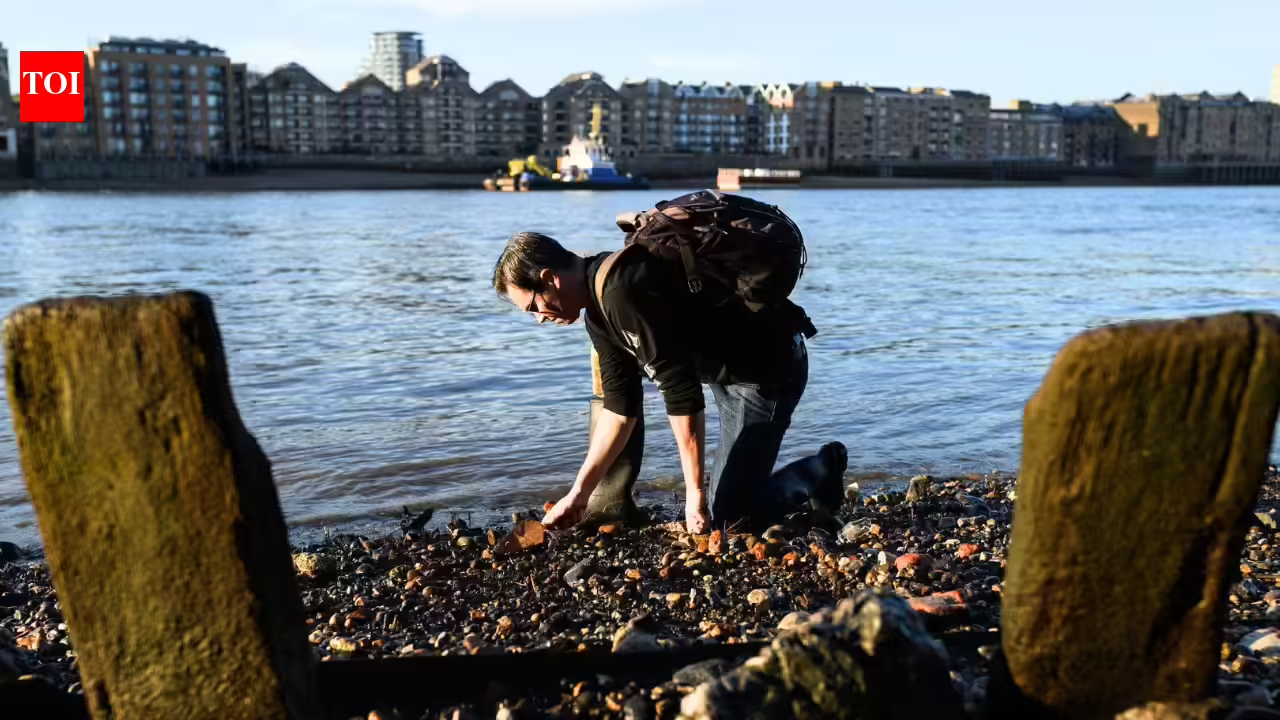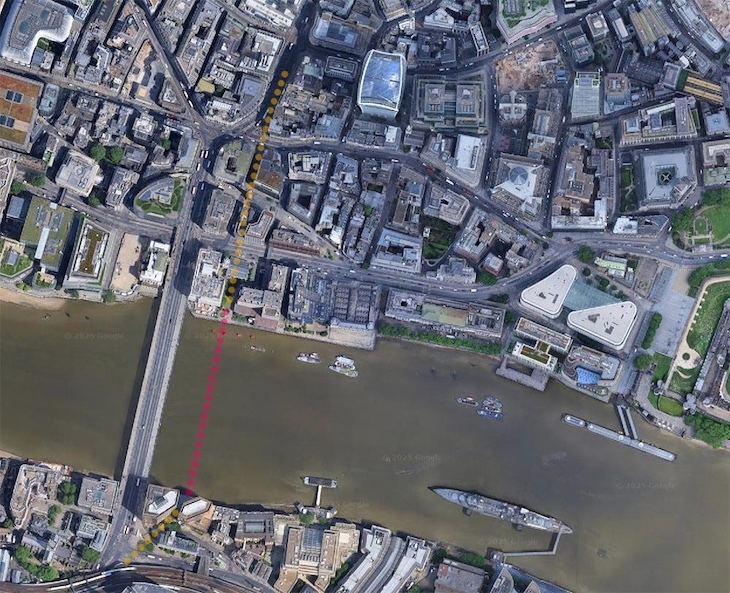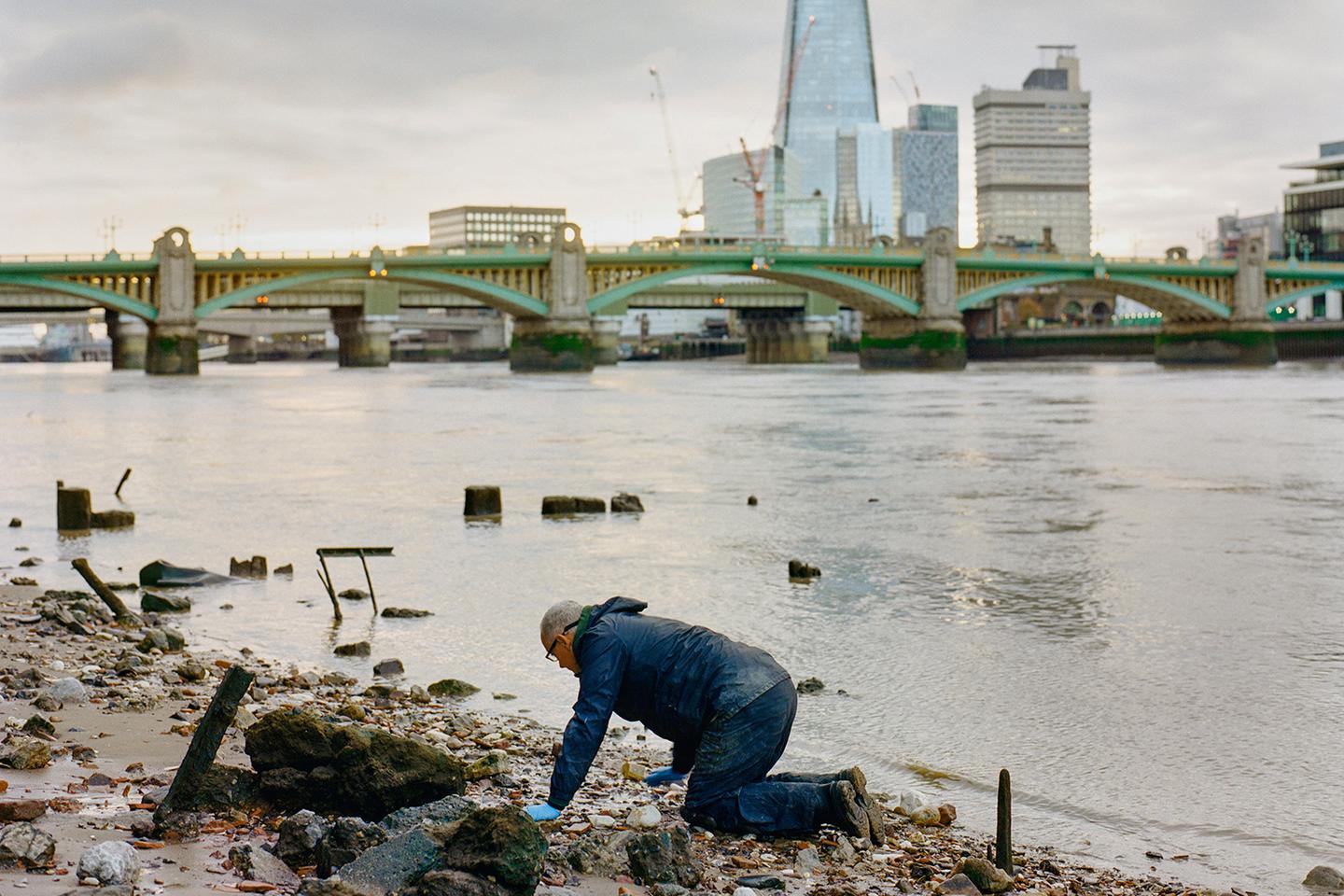
Searching for ancient objects in the Thames used to be a niche pastime. Then came Instagram, permits, and a desperate desire for connection with the past.July 17, 2026Illustration by Fortunate JoaquinShortly before 11 A.M. on a recent Sunday morning, a gaggle of mudlarks—people who find lost and ancient objects on the banks of the Thames—were laying out their wares on tables in the crypt of St. Martin-in-the-Fields, a fine neoclassical church at the edge of Trafalgar Square, in London. Black tablecloths were crammed with two thousand years’ worth of life’s miscellany: post-medieval ear scoops, Tudor scabbards, Roman pottery, Victorian false teeth, Edwardian dog collars, Georgian coins. Jessica Forde, a mudlark who used to work at Christie’s, the auction house, handed me a heavy, dark, rubber object in the shape of a beer bottle, and challenged me to identify it. (It was training ammunition from the Second World War.) “When people say to me, ‘What’s the most valuable thing on your table?,’ I cringe. I’ve got no idea. I’m not interested,” Forde said. “What’s relevant is the stories about how these things were made, who made them, where they came from.”Mudlarking got its jaunty name in the final years of the eighteenth century, when it was used to describe poor wretches—many of them children—who waded into the Thames to pick out rivets, rope, and discarded coal to sell for pennies onshore. In recent years, however, the activity has reëmerged as an addictive and Instagrammable hobby for Londoners of all classes. (Stanley Tucci is a mudlark.) “If you have the slightest bent toward history, it genuinely is the best thing,” Ted Sandling, the author of “London in Fragments,” an influential book about mudlarking, from 2016, told me.Sandling began exploring the foreshore in the early two-thousands. “We were looking for new ways to be in the city, to encounter the city,” he said. Mudlarks often linger on the therapeutic and quasi-mystical dimensions of their visits to the river. (They are generally allowed to keep what they find but must not sell it.) “It’s that unmediated connection to the past,” Sandling said. “You are picking something up that hasn’t been held by another person since it was dropped three hundred years ago.”But, like everything in this life, mudlarking isn’t as fun as it used to be. Until ten years ago, anyone could poke about on the banks of the Thames and see what they could find—wearing boots and gloves, ideally, to ward off Weil’s disease, which is spread by rat urine. These days, mostly because of its popularity on social media, mudlarking is hopelessly oversubscribed. In late 2016, the Port of London Authority (P.L.A.), which owns the vast majority of the Thames riverbed within the city, announced that it would require permits to search and scrape the shore. (Digging has always been another matter: since the seventies, a small group of detectorists and amateur archeologists known as the Society of Thames Mudlarks has been licensed by the city to dig down as far as four feet, three and one-eighth inches.) Between 2019 and 2022, the number of licensed mudlarks in London more than doubled, to five thousand. Startled by the craze, the P.L.A. stopped issuing permits and opened a waiting list instead. When the waiting list reached ten thousand names, the P.L.A. closed that, too.Since 2024, a new system of permits has designated four categories of mudlark, a satisfyingly ornate regime for what is, at heart, a deeply painstaking activity. But, if you want to take up the hobby tomorrow, forget it. There isn’t even a line for you to join. You are welcome to stroll the riverbank, naturally, but not to search it.At the back of the exhibition space at St. Martin, I met Bolly May, the holder of one of fifty rare “creative” mudlarking permits, which allows her to sell jewelry and other art works made from her finds. In the summer of 2024, May found a large gold Tudor ring partly sticking out of the mud. The ring held a pale amethyst, a sign of social status. The foreshore of the Thames consists of anaerobic mud, which preserves objects to an uncanny extent, but it is perturbed constantly by shifting tides and the course of the river, meaning that you are never quite sure what will be exposed and where. May’s ring had been pushed to the surface, in stops and starts, half a millennium after it had sunk to the riverbed from a rich man’s hand. “Two more tides,” May said, and “that would have washed away.”In 2024, the P.L.A. announced that almost all existing mudlarks would lose their licenses and have to go to the back of the waiting list. After an outcry, the organization allowed some permits to be renewed. But the criteria are tough. You have to have mudlarked for four years (this can be waived) and demonstrate a “substantive and recorded history” of both reporting finds to the Portable Antiquities Scheme (P.A.S.)—an archeological service run by the British Museum—and of contributing to “the educational, cultural and historic life of London.” About fifty per cent of applications to renew are successful.The new rules have created an atmosphere of pressure and professionalization among mudlarks, who, like academics everywhere, now grouse about their working conditions and which of their finds are “recordable.” “I feel like I’ve got enough to be O.K.,” Lesley McDonnell, a teacher from North London, said. She was standing behind a pair of horse hooves that she found close to the site of an old glue factory, near Westminster. McDonnell does three or four mudlarking exhibitions a year and has submitted more than fifteen finds to the P.A.S., including a medieval pilgrim’s badge (complete with its original cloak pin) and a tiny Roman die, made of darkened bone, not much larger than a piece of gravel, that washed in while McDonnell was bent over, looking at something else. “It found me,” she said.Liz Anderson, another exhibitor, used to work in education but had always been curious about archeology. One day in 2015, unhappy in her job, she noticed a man on a beach in central London, who seemed to have lost something. She wandered down and asked if she could help. He explained that he was mudlarking. Anderson looked down at her feet and saw a piece of seventeenth-century Delft-style pottery. “I don’t know why. I just had a eureka moment,” she told me. “I thought, This has been waiting for me all my life.”Anderson said that the strictures of the new permit regime were weighing on her. “I can’t just potter around kicking stones, you know,” she said. She had to come up with the goods. “There definitely is more of a pressure, which doesn’t help.” Anderson talked about the importance of fostering a good relationship with your FLO, or finds liaison officer, who decides whether or not something is recordable. Once or twice, I noticed that Anderson used the word “recordable” to describe herself rather than what she found, as if it were her own authenticity and distinctiveness that was being adjudicated.The man who manages the mudlarks is James Trimmer, the director of planning and development at the P.L.A. Trimmer is a surveyor by training. For most of his twenty-seven years at the Port, he has been concerned with things like dredging operations, sewage infrastructure, and the movement of freight along the Thames. (The Port of London is the U.K.’s busiest port, by tonnage.) When talking about mudlarks, Trimmer seems like a seasoned provincial governor who has been dispatched to a small but restive outpost, one full of deeply held beliefs that he does not entirely understand but which nonetheless requires a measure of firm control. “Hobbies ended up being codified, because more people started doing it,” Trimmer said. “And without wishing to portray myself as some sort of Victorian gentleman this couldn’t keep carrying on as it was.”For years, Trimmer explained, mudlarking was a closed world. There were about a hundred hobbyists, whom he and his colleagues knew by name, or by sight—shoulders hunched, eyes fixed on the detritus of the shore. The groundswell, as Trimmer called it, began with the success of books like Sandling’s and, especially, with the rise of mudlarking social-media accounts in the twenty-tens. In 2019, Lara Maiklem, a mudlark with nearly a hundred and fifty thousand Facebook followers, published “Mudlarking: Lost and Found on the River Thames,” a lyrical account of her life on the foreshore, which became a best-seller. During the pandemic, Trimmer and his colleagues watched the numbers continue to increase, and in 2022 he began hearing reports of arguments on the riverbank. “There were these people who were saying, ‘This is our area, you don’t belong here,’ and even reports of altercations,” he said. “It was then, you know, how many is too many?”The maximum number of mudlarks, which Trimmer reached after discussions with Historic England, a government-run heritage organization, and the Museum of London Docklands, was four thousand. “It seemed reasonable,” he said, “in the great British idea of reasonable.” Most mudlarks appreciate Trimmer, even if they kvetch about the permit system. At the exhibition at St. Martin, they referred to him as Trim and gossiped about where he likes to check people’s permits. (At Queenhithe, near St. Paul’s, where archeologists have found the remains of a Roman quay.) Trimmer said that, compared to dealing with government agencies, he has more freedom when supervising the mudlarks, but at the same time more responsibility. “You are intruding on how people see themselves,” he said. The waiting list, which is still closed, stands at around seven thousand.Last June, “London Centric”—an investigative newsletter—reported on rising tensions among mudlarks, including a police investigation into graffiti insulting Maiklem, which was daubed in two places along the riverbank. The graffiti read, in large pink letters: “LARA = FAKER LIES” and “LARA = SELFISH FRAUD.” Maiklem has done more than anyone to give voice to the soulful aspect of mudlarking—its possibilities for escape and discovery at the same time. (In May, on Instagram, she reposted an interview with Tucci, in which he called her the “queen of the mudlarks.”) But she has her detractors, too. For years, Maiklem has been an advocate of “eyes only” mudlarking—finding objects already exposed, as opposed to digging and scraping for them. “I have always had this very, very strong conviction that people shouldn’t be digging up the foreshore,” she told me recently. “Forcing it to give up what it’s not ready to give up.”We were chatting on Zoom. Maiklem was in her home office in Margate, about seventy miles from London. The plan for her next book was laid out in sticky notes on the floor behind her. Maiklem observed that most nineteenth-century mudlarks, searching desperately for goods from the river, were women and children. She found it ironic that most of her critics were men, who accused her of falsifying her finds, or of hoarding her success in what used to be a male-dominated hobby. “The people who are most adamant that they’re true mudlarks are very often men with metal detectors,” Maiklem said.One of her rivals is Jason Sandy, who has more than a hundred thousand followers on Instagram and sits on the board of the Society of Thames Mudlarks. Maiklem and Sandy are both entranced by the story of the Doves Press type, a beautiful lead type, of which some half a million pieces were secretly thrown into the Thames from Hammersmith Bridge during the First World War after a feud between its owners. Since Maiklem wrote about the Doves type, in 2019, she and Sandy have competed to tell the story in their own mudlarking vernaculars. Maiklem was delighted to stumble upon a comma. “It was, as far as I knew, the only Doves Type comma in the world,” she wrote.Sandy, who uses a metal detector and likes to dig at night, recently donated fifty pieces of the type to a museum dedicated to one of the owners of Doves Press, and plans to complete the set. When we spoke, Sandy, an architect from North Carolina, told me he had been up until 2 A.M. that morning, to catch a very low tide, and had found a further twenty-two pieces. Neither Sandy nor Maiklem referred to the other by name, but each was eager to defend their mudlarking practice. “It’s not the way you find it—it’s what you find,” Sandy said. “The most pristine artifacts come out of the deeper, blacker mud,” he said. “They come out as shiny and new today as the day they were dropped.”Sandling, who wrote his mudlarking book ten years ago, has let his permit lapse. In part because of the permit system, which he opposes on principle, and in part because he lost the joy of searching. “I was finding things for Instagram,” he said. Since he left the foreshore, Sandling has watched his fellow-mudlarks bicker and feud like passionate hobbyists do anywhere. “You get it in a knitting circle or a book group—it’s exactly the same dynamic,” he said. Presumably it was similar in the nineteenth century, when mudlarks scrapped over bones and coal and counterfeit coins instead of P.A.S. entries and likes. When I asked Trimmer, who understands the motives of mudlarks better than most, whether he had ever searched the foreshore, he replied more quickly than I was expecting: “I don’t have a permit.”I went down to the shore on a brightly lit Saturday afternoon. The flow of people on the Thames Path, by the south end of Blackfriars Bridge, was constant: an unbroken procession of Londoners and tourists, with their sunglasses and chatter, stretching from Tate Modern to the stores, bars, and theatres of the South Bank. The tide had turned, and the sun was bouncing from office windows on either side of the water.Frank Mnich, a mudlark from Sussex, was standing at the top of a flight of steps down to the river, looking like someone who was there to fix the drains, in cargo pants, rain boots, and kneepads, with pouches fastened around his waist for his finds. I pulled on my boots and followed. The effect of stepping onto the shore was instant and alluring. It was as if we had left the city behind—or at least the living part of it. There were still noises, but they were of boats and gulls and trains. The people, the jostle, were all gone. The sky was so much larger. There was only one other person in sight, crouching at the water’s edge, a few hundred yards upstream—another mudlark.Mnich explained that the river and the tides had a way of sorting artifacts by density and size. (Bits of clay roof tile end up with animal bones.) He looks for metal. The Thames holds innumerable coins, dress pins, and nails from the pre-industrial era. “If you start seeing pins, you’ll get other bits,” Mnich said. He walked bent at the waist, with his eyes about three feet from the ground, before dropping to his knees to examine stones, sand, and hundreds of nondescript shapes that could be anything from a clam shell to a medieval button. “It’s kind of like a painting,” Mnich said, scraping gingerly with a trowel. “You expose all its secrets.” Mudlarks say it takes a year or two to learn how to search properly. As we crouched, I dully noted great big nails and a couple of broken clay pipe stems, while Mnich pulled out an old-looking coin, which he put in his collecting box, along with a fossilized tree fern and a piece of Tudor greenware—sixteenth-century pottery—about the size of a fingernail.We were on the South Bank, less than half a mile from Shakespeare’s Globe and other Elizabethan theatres. Mnich explained that the day’s takings would have been collected in cheap ceramic boxes that were later smashed to retrieve the money. “Occasionally you might get a finial or partial base, which is interesting,” he said. Mnich had already moved on, but I was standing there, touching a piece of early modern London, wondering whose hands had brushed its uneven, fragile surface. When Mnich wasn’t looking, I put the greenware in my pocket.In 1956, Ivor Noël Hume, an archeologist, published “Treasure in the Thames,” in which he described “the strange hobby of mudlarking” and the tantalizing moment when he spotted a mysterious artifact: “As the tide fell, the monster revealed itself as a London Passenger Transport portable bus-stop.” Writing in the atomic age, Hume considered the attraction of the city’s old, lost objects. “It is, perhaps, the fear of what we may do in the future that encourages some of us to look back over our shoulders and find pleasure in the past,” he wrote. By the tide line, Mnich scraped away the sand and the gravel to reveal a huge set of initials—“E.D. 1690”—carved beautifully into the rock beneath. He covered them up again.By this time, Mnich and I had wandered some way upstream and were only a few yards from the mudlark whom I had noticed earlier. She had been searching by the algae-slathered walls of the embankment, and now called us over to inspect a red gem, about the size of a ladybug, on the end of her finger. She asked Mnich if it was a ruby. He said it was probably a paste stone, made of glass, but he wasn’t totally sure. “This one’s quite nice,” he said. “So it might actually be something real.” The woman’s name was Kasia Green. It turned out that she and Mnich were dating. They met because they both liked to search the same stretch of foreshore. “We kept bumping into each other,” he told me later. “I wasn’t kind of outwardly looking for someone. It just happened. It was one of those things.” Now, Mnich explained, he and Green enjoyed finding things, and enjoyed it when the other person found something, too. ♦A scientist with a Ph.D. from Harvard fatally shot three of her colleagues. Then revelations about her family history came to light.
How Mudlarking Became London’s Hottest Hobby
Searching for ancient objects in the Thames used to be a niche pastime. Then came Instagram, permits, and a desperate desire for connection with the past.
3,008 words~14 min read