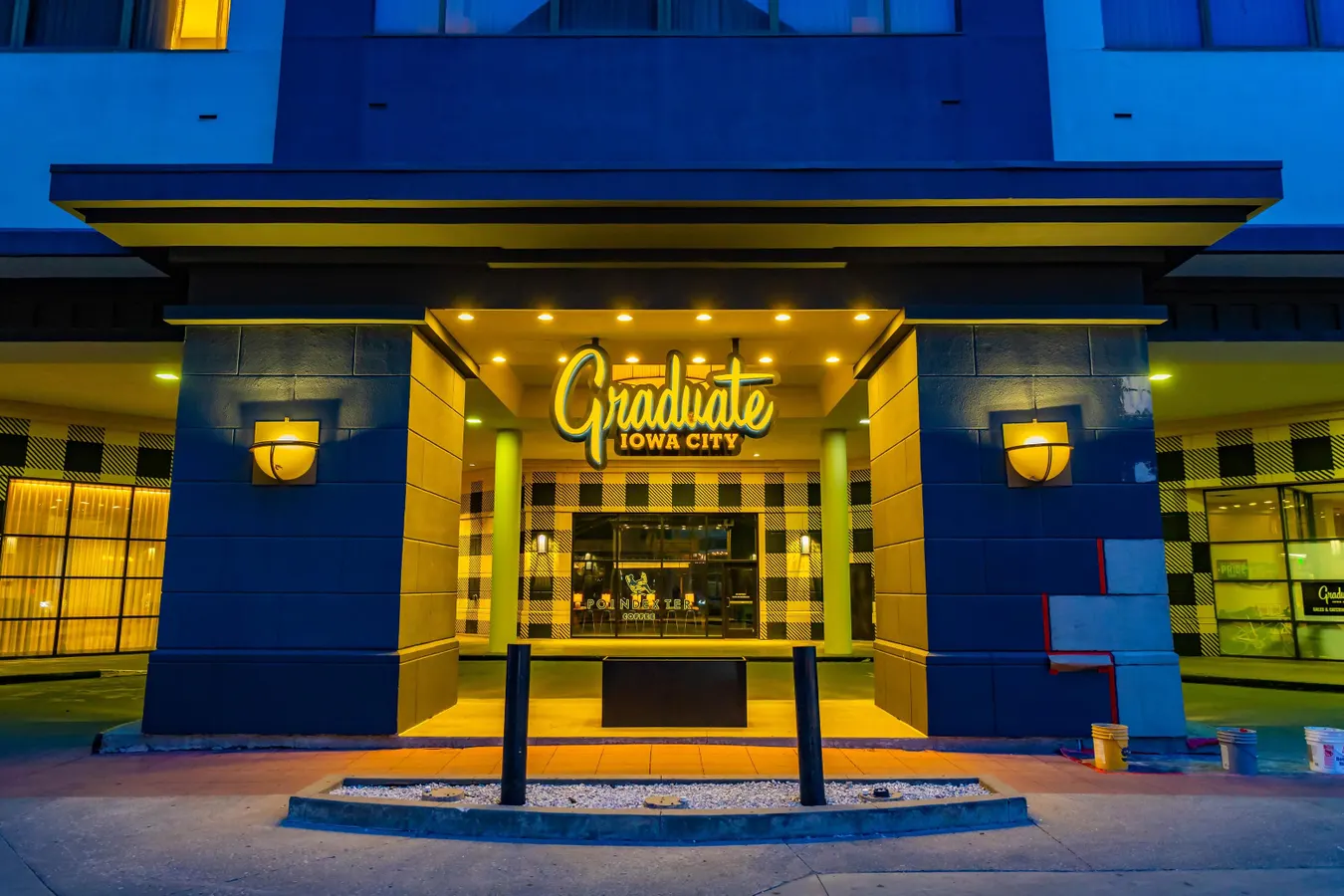
For many parents of college-age children, family weekend is a conundrum. For our eldest son Leo, we visited family weekend of freshman year. But when October rolls around again, do sophomores, juniors, and seniors really want their parents hanging around for the weekend? Last year, Leo’s sophomore year, I squared the circle by turning it into an opportunity for Leo’s grandfather to visit. I’d attend as well to ensure the weekend went off without a hitch. And to keep Grampa comfortable, I booked an absurdly overpriced room at a new hotel a block from campus, The Graduate.Founded in 2014, The Graduate is a chain of high-end boutique hotels in larger college towns. While they’re not on campus or affiliated with the college, they want guests to think they are. (Room rates prove they know the dates of family weekends!) The lobbies are lousy with academic-chic décor like books bought by the yard, oil paintings of dead white men, and displays of university memorabilia. According to Hilton, which acquired Graduate Hotels for $210M in 2024, it’s a “design-forward concept to tell the story of the dynamic markets they exist in through various Easter eggs and layers of meaning.” This new college-hotel category – Graduate and category pioneer The Study – is one of the fastest growing in the sector. Hilton is expanding the chain to 60 hotels and launching a lower cost college brand, Undergraduate by Hilton – for hotel owners a “conversion-friendly model,” for guests an “accessible stay that embraces the energy and spirit of college life” – that it intends to roll out in hundreds of college towns.A design-forward concept to tell the story of the dynamic markets they exist in through various Easter eggs and layers of meaning.gettyWhile Grampa needed extra blankets, he was satisfied with his stay. My family weekend hotel experience couldn’t have been more different. Because I wasn’t certain he’d be able to make it for health reasons, I held off booking another expensive room and, at the last minute, grabbed one at the 2-star Quality Inn West Haven. Located right off I-95 at the edge of an industrial park, it wasn’t much to look at. But Google reported “guests consistently praise this hotel for its fair prices, recently renovated rooms, and good continental breakfast.” The most negative review mentioned they ran out of pancake mix, no microwaves in the rooms, and a “very hostile” front desk clerk. Since I’d be occupied with family and would only be there to sleep, how bad could it be?I learned just how bad when I checked in on Friday night and found it under construction, multiple entrance doors propped open with equipment so anyone could walk in. And apparently anyone did because later that night I was awakened by hostile yelling from the corridor just outside my room. It was hard to follow the thread – not because there were Easter eggs or layers of meaning – but some of the yelling was about drugs while some pertained to prostitution. Behind a triple-locked (albeit flimsy) hotel door – and over the course of nearly two hours of cacophonous criminal disputes – I questioned my safety, my choices, and the definition of Quality. After sharing the experience with my friend Dave, he validated my trauma by forwarding a New Haven Register article with this headline: Hunter Biden says he smoked crack at a West Haven motel off I-95. Turns out it wasn’t just a bad Friday night at the Quality Inn West Haven. According to the Register, “over the previous two decades, [the hotel, previously a Super 8] has been linked to multiple cases of drug dealing and prostitution.” MORE FOR YOUIf I ever attend another family weekend, I promise to spring for a “design-forward” room that “embraces the energy and spirit of college life” in a more salubrious manner.While college hotels are growing, colleges are not. Enrollment challenges are no longer limited to small colleges and each news cycle brings a bevy of new cuts at schools of all shapes, sizes, and selectivity. Last week it was Temple’s turn. Penn West, the new Pennsylvania State System institution formed by the merger of three struggling regional colleges, is eliminating 71 programs. Syracuse shut 93 academic programs and offered buyouts to 175 faculty. University of Minnesota is cutting 230 jobs. University of Akron opted to sell three properties rather than cut programs. Nebraska’s Doane University offered buyouts to 15 employees. Johns Hopkins is cutting over 100 employees. South Carolina HBCU Clinton College keeps missing payrolls. Louisiana State University eliminated 25 positions including its CFO – a creative solution for financial stress. Even one of America’s most selective schools – Brown University, locus of the Graduate by Hilton Providence – announced $30M in budget cuts and saw its financial outlook downgraded to negative by Moody’s. Rather than report on every float in this parade of horribles, the Chronicle of Higher Education, Inside Higher Ed and hirsute higher education observer Bryan Alexander have started cost-cutting trackers.After cuts come closures. In the first half of 2026, 14 small colleges did go gentle into that good night. Following 16 closures last year, the pace is quickening. In Massachusetts, 27 colleges will have closed between 2014 and the end of this year. The U.S. Department of Education produced a webinar for students: What To Do If Your School Closes. (Channeling Hitchhiker’s Guide to the Galaxy, the main message is DON’T PANIC.) We’re not living Clayton Christensen’s infamous 2013 prediction that up to 50% of colleges will close in the next 15 years. But each closure upends hundreds of lives, disrupts communities, and raises hard questions for similarly situated institutions.Perhaps reluctant to add insult to injury, neither Polymarket nor Kalshi has established a market to bet on college closures. But you know who’s never afraid to add insult to injury? Lawyers, who have begun filing lawsuits on behalf of students, faculty, and staff – vying with creditors for remaining assets. Following the closure of Philadelphia’s University of the Arts, law firms initiated three different class actions. So if you’re wondering whether, when a college falls in the forest – and I’m thinking of Wisconsin’s Northland College – does it make a sound? The answer is yes, after lawyers get involved.Dozens more schools are on probation with accreditors or facing show cause or warnings for financial viability. This despite four inconvenient truths:Colleges have only just begun to glimpse the enrollment cliff caused by fewer births during and after the Great Recession;It’s only been one year of declining international enrollment under a federal administration with a hospitality-hostility ratio comparable to the Quality Inn West Haven;They haven’t experienced the new (July 1) limits on federal student loans for graduate and professional students;And they definitely haven’t yet felt the wrath of Republican candidates on a mission to shut down “subpar” universities. No less an authority than Jeff Selingo just declared in Timethat the business model of colleges – the main elements of which are classes and tuition – is broken and about to get worse. Thanks to digital transformation, many of the skills employers are increasingly seeking are harder to learn in a classroom than by doing. And with the shift to digital hiring, employers have hundreds and hundreds of applicants for every open job. How to choose which candidates to look at, let alone interview? The answer has been inflating job descriptions with new skills and industry or functional work experience. In less than one generation, hiring managers have gone from considering high-potential college graduates with no relevant skills or experience for entry-level positions to explicitly or implicitly requiring lots – thereby transforming “good entry-level job” into something of an oxymoron. Now AI has begun to widen this experience gap into a chasm. As Jeff recognizes, college doesn’t have a recruitment problem. College has a product problem.So why would anyone want to start a college? America’s favorite online teacher, Sal Khan, just announced the Khan TED Institute where students will be able to earn a $10K degree with “AI built in.” Once accredited, Khan TED will be the only university with both TED talks and “corporate thought partners.” (As I’ve been called Craig Ryan my whole life, I can’t wait for Khan TED to enroll a student named Ted Khan.) New AI colleges like Saras AI Institute (“the first AI-exclusive, fully online degree-granting institute in the U.S.”) and EON University (“the world’s first fully autonomous and AI-native university”) are popping up like LLMs, some with no faculty. Elon Musk’s foundation is reportedly exploring a new university. Beyond tech, billionaire Joe Lonsdale’s University of Austin – a secular Hillsdale College cloaked in free-speech garb – has raised enough money to cover student tuition until the institution is accredited, or until political drama tears the place apart. The number of Christian leaders attempting to follow the path of Jerry Falwell’s Liberty University by buying closed campuses is too many to fit on the head of a pin. And higher education’s new imperialists – Northeastern and Vanderbilt – are always on the lookout for new campuses to expand their empires.Why? So they can attract a Graduate by Hilton, or – more likely – an Undergraduate by Hilton? Unlike tech billionaires starting K-12 schools, they’re not doing it to have somewhere to send their kids. They’re doing it for four reasons, each successively worse.1. Because they went to collegeAfter generations of college-for-all, everyone looking to start a college attended college. Most attended great schools, or good schools in an era when that was enough. So they know what a good-enough college looked like. Nostalgia for youth transfers to nostalgia for college. And who doesn’t want more of that?2. Because college = permanenceBecause the college they know best – the one they went to – hasn’t closed (yet), like diamonds, colleges are forever. Even with cuts, beautiful campuses persist. So founding a college bestows some measure of immortality, enduring long beyond the life of the founder.3. Because classrooms are easyIt’s simple to situate young adults in classrooms. They’re used to it, having sat there for at least 13 years. And plenty of faculty are available for hire to stand in front of them and dazzle with education magic. Even if there’s no magic, the roles are clear and the tidy arrangement requires little more administration or overhead than curriculum and classroom space, either onground or online. Then get to a favorable teacher-student ratio and you can afford to hire a clutch of deans. Whether college founders are praying to God or AI, when the only work-based learning is homework-based learning, there’s no need to go about the messy business of assessing skills, applying skills outside an academic context, or engaging employers.4. Because passing risk to students is easyThe corollary of the college-for-all ethos is the save-for-college culture – best demonstrated by the 529 plan-industrial complex – because college has always been costly. The unstated assumption is that 18-24-year-olds – old enough and capable enough to work – should pay tuition rather than get paid. And if they can’t afford to pay, they should borrow – increasingly a lot. And it always pays off, right Georgetown? – a school where, as Preston Cooper points out, only 36% of undergraduate students receive any financial aid, leaving 64% to pay over $100,000 each year in tuition, room, board, and required fees. With this backdrop – with students and families still expecting and willing to assume the financial risk (although given enrollment trends, we’re past the peak) – why would anyone turn somersaults and cartwheels to build a different funding model?The result is more new colleges, more classrooms – physical and virtual – more financial and employment risk on students, and not nearly enough attention and effort on building next-generation institutions for the next generation.In 2019, writing in The Chronicle of Philanthropy, my partner and Achieve co-founder Daniel Pianko remarked on how content wealthy Americans were to funnel millions of dollars in donations to traditional colleges and universities. He noted it “stands in stark contrast to the approach taken by an earlier generation of philanthropists who created the very institutions that the benevolence of today’s billionaires sustains.” Johns Hopkins, John D. Rockefeller, and Andrew Carnegie saw the need for new types of institutions and built them.In 2026, new institutions are needed more than ever, but we don’t need to build new colleges. Classrooms and traditional faculty won’t disappear; they’ll remain fundamental to cognitive skill development for career launchers. But they can no longer continue to be postsecondary education’s organizing principle. And once we exit classrooms and the quads they surround, it’s unimaginative and irresponsible to continue to put all the financial risk on students and their families. The challenges of the tuition-based classroom model demonstrate what’s needed aren’t more of what’s led to cuts and closures, but rather new work-based learning, employer-pay institutions or intermediaries. Because they bring an interloper into the teacher-student relationship – the employer – they’re less intuitive and harder to build. But engaging employers establishes the pathway that’s been missing. And with AI transforming entry-level jobs – reducing the relative value of classroom-based learning and increasing the relative value of work-based learning – starting new classroom-based colleges for the age of AI is something Hunter Biden might have come up while smoking crack at a West Haven motel. Although some of these new institutions may adopt the name college, they won't be architected around classrooms and their business model won't be principally tuition-based. And while employer-pay, work-based learning institutions or intermediaries may not have the same cachet in terms of nostalgia, permanence, or simplicity, if that’s what you’re after, rather than launching a college, consider starting a design-forward college hotel festooned with books bought by the yard, oil paintings of dead white men, and displays of university memorabilia. Just don’t put it right off I-95 at the edge of an industrial park.
Why Does Everyone Want To Start A College?
Colleges don’t have a recruitment problem, they have a product problem. So why would anyone want to start a new college?
2,318 words~11 min read