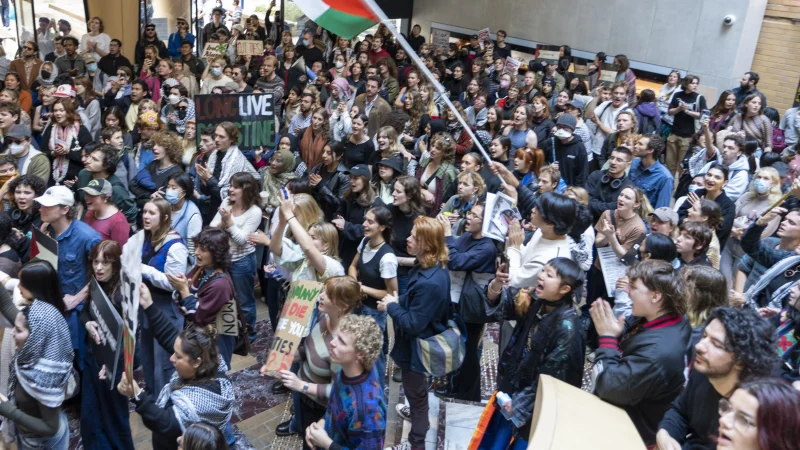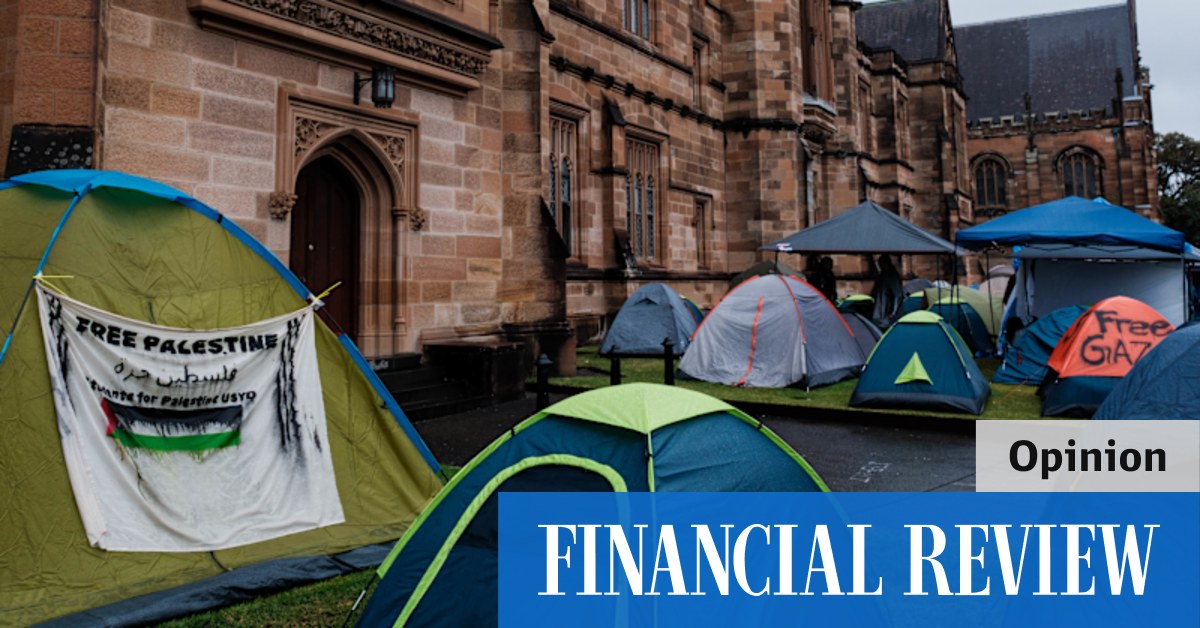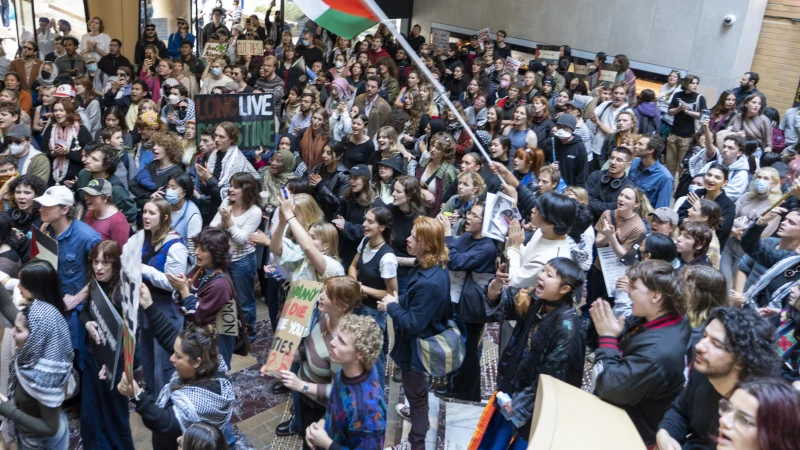
July 17, 2026 — 2:31pmAntisemitism is a symptom of broader polarisation in society, according to the man who helped develop Australian universities’ definition of anti-Jewish hatred, adding that other groups also suffer trauma and hurt.Professor David Slucki, the director of the Australian Centre for Jewish Civilisation at Monash University, told the Royal Commission on Antisemitism and Social Cohesion that political polarisation made it more difficult for universities to teach their students to have hard, but respectful, conversations.University of Melbourne students protest against the war in Gaza in May 2024.Eamon GallagherAfter two vice chancellors apologised at the royal commission for failings during campus encampments in 2024, Slucki said his group had developed a course on antisemitism that had already trained 1700 university leaders.“One thing I say at the beginning of every training is we all watch the violence and the events in the Middle East ... with a great deal of distress, and much of the anger, trauma that we see comes from a place of hurt,” he said.This was “true for Jewish staff and students who feel traumatised by October 7, 2023; it’s true for Palestinian and Muslim staff and students who are also traumatised by what they’re witnessing on a daily basis”.“We don’t think it should be an either-or proposition,” Slucki said.“If we’re only solving for antisemitism, we’re not solving antisemitism.”He also said he felt “really sorry” for university vice chancellors when trying to distinguish antisemitism from legitimate political criticism of Israel and its actions.“For many people, they say, ‘Well, Zionism is Judaism to me’, and then other people … say, ‘Zionism isn’t Judaism’, and [vice chancellors] are looking at that, thinking, ‘How do I navigate this tension?’”Slucki told commissioner Virginia Bell that universities’ job was made harder by social media algorithms.“I think about the student who, by the time they’ve arrived in a classroom at, say, 10am … they’ve consumed so much information,” Slucki said.“Everything they’re reading on their social media feeds … is designed to generate rage, anger and hostility, and so students come onto our campuses … they’ve just seen a whole lot of rage in front of them. They’re often heightened.”The consequence was “a kind of all-or-nothing thinking”, Slucki said.“It’s not only that we disagree, but when we disagree with someone, we see them as wrong and bad or evil”.Slucki was a key academic author of the Universities Australia definition of antisemitism, which was adopted by universities nationwide after the October 7, 2023, Hamas attack on Israel, and that country’s war on Gaza.He told the commission that definitions and policies were important, but “you don’t legislate your way out of social discord”. Cultural change at universities was necessary.He said part of this was understanding how Jewish Australians had been raised by Holocaust survivors. These were traumatised people, which was “a really powerful factor in why people are hypersensitive about antisemitism”.He said university leaders haven’t always known what’s causing the “anxiety, the fear, the concern that’s coming their way”.He emphasised that trauma and discrimination were not just a matter for Jewish Australians.“We think it’s really important that there’s more of this kind of work, not just from us, but training on Islamophobia and anti-Palestinian racism and racism directed towards First Nations people as well,” he said.Dr Mary Russell, chief executive of the Commonwealth regulator the Tertiary Education Quality and Standards Agency, told the royal commission she had become concerned about antisemitism on campuses during the encampment era in mid-2024.There was particular concern about the infiltration of “outside actors” onto campus, she said, because when they arrived, dialogue between protesters and universities often ended, leading to “much more heated, aggressive, and … personalised [expressions] against Jewish students and Jewish staff”.Russell acknowledged that at that time, universities had been “very reluctant to make a call” about what constituted antisemitism because they did not really understand it.In evidence on Wednesday, University of NSW vice chancellor Attila Brungs said they had three definitions of antisemitism on their books.“Prior to discussion this week, I had not contemplated that universities might use multiple definitions,” Russell told the commission. “Our expectation is that universities need to be able to very clearly set out what is acceptable and unacceptable.”She said the regulator intended to formulate a statement of regulatory expectation to this effect.The vice chancellors of the ANU and Sydney University apologised this week for some of their actions during the encampments, and had since introduced education programs, changed rules to ban camping, and restricted the posting of graffiti and posters.Monash University vice chancellor Sharon Pickering told the commission she had moved more strongly against the protests as soon as she heard a call by activists that Zionists were not welcome on campus. She said that statement in an Instagram post was not simply defensible free speech, but would cause offence and harm.Start the day with a summary of the day’s most important and interesting stories, analysis and insights. Sign up for our Morning Edition newsletter.Michael Bachelard is a senior writer and former deputy editor and investigations editor of The Age. He has worked in Canberra, Melbourne and Jakarta, has written two books and won multiple awards for journalism, including the Gold Walkley.Connect via X or email.From our partners
Antisemitism a symptom of increasingly polarised society, commission hears
A university professor has told the royal commission that social media-influenced political polarisation has made it more difficult for universities to teach their students to have hard, but respectful, conversations.
865 words~4 min read