This content was published on
July 17, 2026 - 05:31
5 minutes
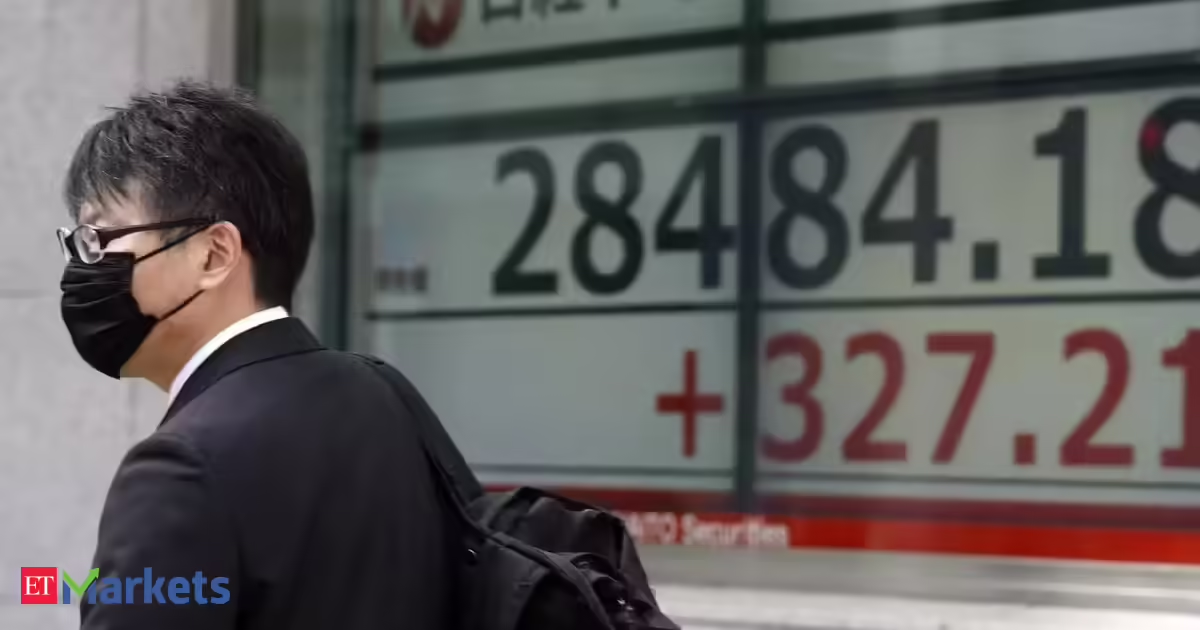
(Bloomberg) — Asian stocks fell alongside US equity-index futures as a selloff in chipmakers deepened with investors questioning whether they had rallied too far and too fast earlier this year. Oil climbed.MSCI’s Asia Pacific equities gauge dropped 2.1%, with Japan’s Nikkei 225 Stock Average losing 4.4%. Taiwan Semiconductor Manufacturing Co. dropped more than 4% as the chip bellwether’s solid earnings outlook was overshadowed by a higher spending forecast. Kioxia Holdings Corp. sank by 15% in Tokyo, halving its market capitalization in just a month.Netflix Inc. also weighed on sentiment, with shares falling 9% in extended trading after the company forecast a second straight quarter of slowing sales growth. Equity-index futures for the Nasdaq 100 Index retreated almost 1%.Elsewhere, Brent rebounded from Thursday’s losses as hostilities across the Middle East continued to escalate and shipping traffic slumped in the Strait of Hormuz. The commodity traded just below $85 a barrel and was up 12% for the week, on track for its biggest weekly gain since April and rekindling inflation concerns.Technology stocks have come under pressure in recent weeks as investors increasingly question whether this year’s blistering AI-driven rally has run too far, too fast. While softer US inflation has eased expectations of an immediate Federal Reserve interest-rate hike and Middle East tensions continue to drive oil prices, the focus remains on AI earnings for evidence that billions of dollars in spending will translate into returns.“Capex guidance comes into focus again as investors get increasingly skeptical on whether growth can be achieved sustainably while maintaining a healthy balance sheet,” said Fabien Yip, a market analyst at IG International. “We expect the market to continue to experience volatility during the earning season, but this is unlikely to be an end to the AI story.”In other corners of the market, Government bonds edged lower in Australia and Japan. Treasuries were little changed, with the yield on the benchmark 10-year holding at 4.55%.The yen traded around 162.45 per dollar even as Japan’s Finance Minister Satsuki Katayama renewed her warning of possible intervention in the market as the currency continued to hover near its lowest level in four decades.Gold was on track for its biggest weekly loss since early June as renewed hostilities in the Middle East and rising oil prices fueled speculation the Federal Reserve may keep interest rates higher for longer.The dollar was a touch stronger against most of its major peers. That was due to a combination of the selloff in technology stocks, rising energy prices, and higher US real yields, said Chidu Narayanan, chief Asia Pacific strategist at Wells Fargo in Singapore.“US data is not ‘hot,’ but it is strong enough to support the dollar even as other factors are leaning towards marginal dollar strength,” he said.What Bloomberg’s Strategists Say…The speed and depth of declines across Asia’s main stock indexes is starting to look like panic selling as investors try to lock in what they can off this year’s remaining gains. The calendar impact is helping to worsen the mood as, with July half way complete, the losses for traders are mounting.— Mark Cranfield, MLIV Asia. For full analysis, click here.Attention remained firmly on the semiconductor sector as investors questioned whether tech stocks had become too richly valued. Alphabet Inc. sank 4.4% Thursday after Google was said to be months behind schedule in delivering its flagship AI model.Traders are grappling with whether the more than $725 billion the four biggest US AI operators are expected to spend this year will translate into returns.The Philadelphia Semiconductor Index has dropped about 19% from a June peak. A gauge of Asian semiconductor makers was headed for its biggest weekly decline since early March, with Japanese companies taking a hit on Friday and South Korean markets closed.“The action in the chip stocks going forward is still the most important issue for the stock market,” said Matt Maley, chief market strategist at Miller Tabak. “They are definitely showing some meaningful cracks, so they’re going to have to see a strong and sustainable rebound soon or it will raise some real warning flags.”Some of the main moves in markets:StocksS&P 500 futures fell 0.5% as of 12:29 p.m. Tokyo time Nikkei 225 futures (OSE) fell 3.6% Japan’s Topix fell 2.6% Australia’s S&P/ASX 200 fell 0.5% Hong Kong’s Hang Seng fell 1.9% The Shanghai Composite fell 1.7% Euro Stoxx 50 futures fell 0.7% CurrenciesThe Bloomberg Dollar Spot Index was little changed The euro was little changed at $1.1439 The Japanese yen was little changed at 162.38 per dollar The offshore yuan was little changed at 6.7762 per dollar CryptocurrenciesBitcoin fell 0.7% to $63,636.54 Ether fell 0.7% to $1,857.09 BondsThe yield on 10-year Treasuries was little changed at 4.55% Japan’s 10-year yield advanced 1.5 basis points to 2.725% Australia’s 10-year yield advanced one basis point to 4.91% CommoditiesWest Texas Intermediate crude rose 1% to $79.75 a barrel Spot gold rose 0.6% to $4,000.96 an ounce This story was produced with the assistance of Bloomberg Automation.–With assistance from Winnie Hsu, Momoka Yokoyama and Matthew Burgess.©2026 Bloomberg L.P.