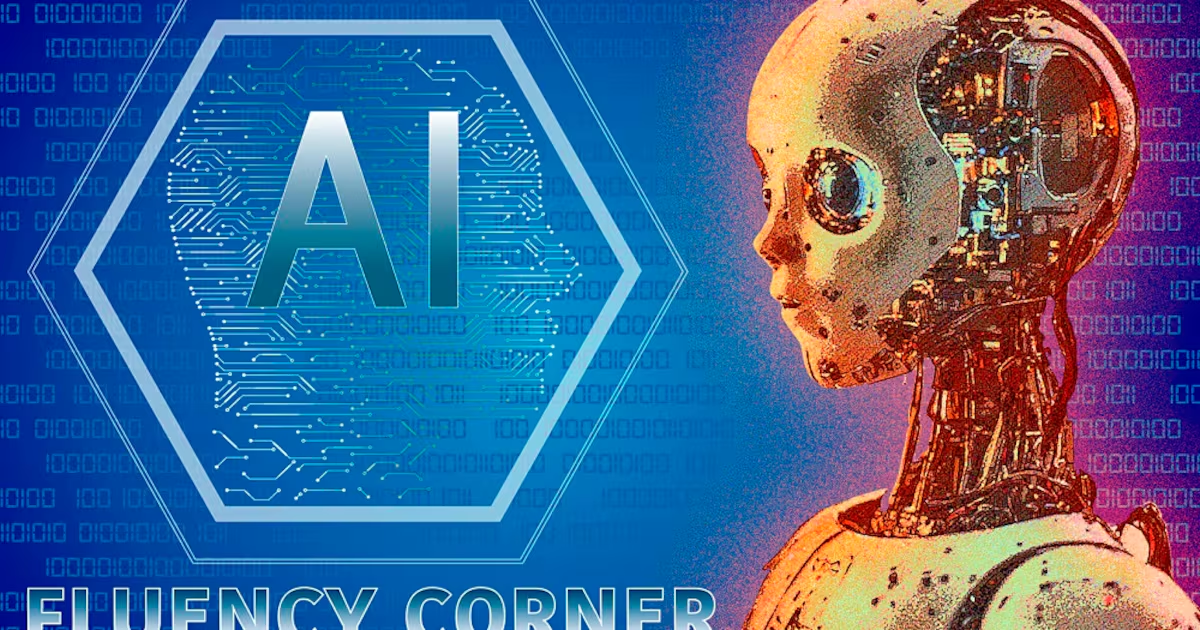
This is the 10th instalment of AI Fluency Corner, a 16-part weekly series in Business Day building one connected mental model of artificial intelligence, in plain language.What is an API?A customer changes her address in a mobile app. Seconds later, billing, delivery, fraud monitoring and customer support all hold the same new detail. Nobody retyped it. One system asked; the others responded. An API carried the conversation.API stands for application programming interface: a controlled set of rules that allows one software system to request data or an action from another. It defines what may be requested, who may ask, how the request must be made and what comes back. Put simply, an API is the doorway through which separate systems work together without exposing everything behind the door. And that doorway is now becoming the route through which AI enters the real operating business.The doorway between digital systemsPicture a restaurant. You do not enter the kitchen, inspect every ingredient or operate the till. You choose from a menu and give the waiter an order. The menu limits what may be requested; the waiter carries it in a form the kitchen understands; the kitchen returns a defined result while remaining private. An API works in much the same way. Your accounting software can request June’s authorised transactions from a bank and receive a structured response without gaining access to the bank’s inner machinery. The same principle sits behind “Sign in with Google”, a live delivery map and a card payment approved in seconds. But the waiter analogy only explains the exchange. The deeper business question is what happens when no waiter exists.When people become the connectionMost people picture a business as departments. Technology sees a chain of handovers: a customer from marketing to sales, an order from sales to stock, a new employee from recruitment to payroll and IT access. Every handover carries information. In a fragmented organisation, a person carries it out: downloading a spreadsheet, changing the headings, attaching it to an email and uploading it elsewhere; finance retypes figures already captured on an invoice. It looks digital because computers are involved, but it is still manual work wearing digital clothing. The invisible handovers are already everywhere. The next leap is not merely letting systems exchange information — it is allowing intelligence to use those exchangesIn a connected organisation, APIs move approved information directly: closing a sale can raise the invoice, update the forecast and open the implementation task from one action. Cloudflare found that successful API requests accounted for 57% of the dynamic internet traffic it processed in its 2024 study. The invisible handovers are already everywhere. The next leap is not merely letting systems exchange information — it is allowing intelligence to use those exchanges.How APIs give AI real reachFor years, APIs lived quietly inside IT. Generative AI has pulled them into the boardroom by exposing an uncomfortable truth: intelligence without access has limited value. A language model may know how overdue accounts are generally handled, but it does not know whether your customer paid this morning, promised payment twice or lodged a complaint yesterday. Without an API, AI can write a polished reminder. With authorised read access, it can ground that reminder in the customer’s actual record. With carefully controlled action access, it can prepare the message, send it after approval, record the interaction and schedule the follow-up. The first AI generates it. The second knows. The third acts. That is the moment an impressive chatbot becomes part of a workflow — and also the moment a writing error can become a business action.The power — and price — of connectionEvery connection that creates leverage also concentrates consequences. An AI that drafts a refund letter may produce an awkward sentence; one that can issue the refund can move money. The first governance principle is therefore least privilege: give a tool only the information and authority required for its task, and no more. Leaders should ask what the connection can read, what it can change, who approved that access, where every action is logged and what happens when the service is wrong or unavailable. Cost matters too: APIs are often metered, so a cheap pilot may become expensive when it makes thousands of calls each day. Then comes dependency. When a critical process is built around one provider’s interface, data structures and pricing, leaving may mean rebuilding the workflow rather than cancelling a subscription. A good API does not simply open a door; it gives the organisation control of the key. And control, not connectivity alone, is what turns digital reach into durable value.The model determines what AI can say. The API determines what AI can do. That distinction is the whole gameBusinesses do not scale because more software arrives; they scale when information can move — safely, deliberately and at the moment it is neededFor 10 editions, we have followed the path from data to algorithms, machine learning, language, prompting and multimodal AI. APIs are where those capabilities meet the institution. They connect the model to the customer record, the payment to the order, the spreadsheet to the dashboard and the decision to the workflow. The future organisation will not be one enormous system doing everything. It will be a network of specialised systems exchanging carefully defined requests through controlled interfaces. That makes API fluency a leadership skill, not merely a developer’s concern. You may never write an API, but you do need to recognise where information is trapped, what an AI tool must reach to become useful, and whether every connection has an owner, a boundary, a cost and an exit. Businesses do not scale because more software arrives; they scale when information can move — safely, deliberately and at the moment it is needed.One task this weekChoose one process you completed recently — onboarding a hire, approving an invoice, answering a complaint, compiling a report. Draw every system it touched, then mark each point where a person copied, retyped, attached, uploaded or transferred information by hand. Those marks are not just inefficiencies. They are a map of exactly where your next wave of AI and automation will create value — and a clue that your biggest barrier may not be a shortage of intelligence, but systems that were never taught to speak to one another.• Next week: Cloud, servers and where your data actually lives — because once systems can speak through APIs, the next question becomes unavoidable: where is the information they are exchanging, who ultimately controls it and what are you really agreeing to when you place your organisation’s data in someone else’s computer?
RUFARO MAFINYANI | The invisible agreements that let systems — and now AI — work together
APIs let software systems communicate securely and are becoming the essential link between AI and real business processes, writes Rufaro Mafinyani.
1,101 words~5 min read