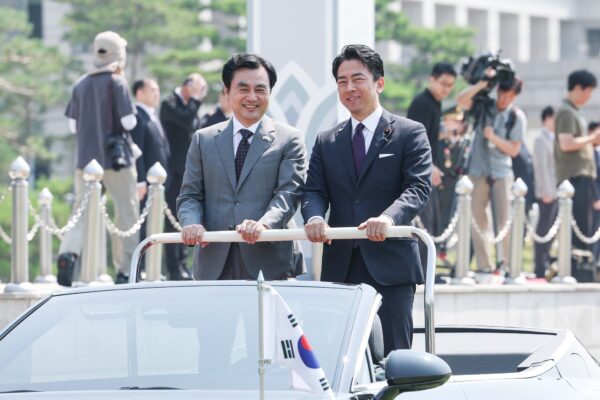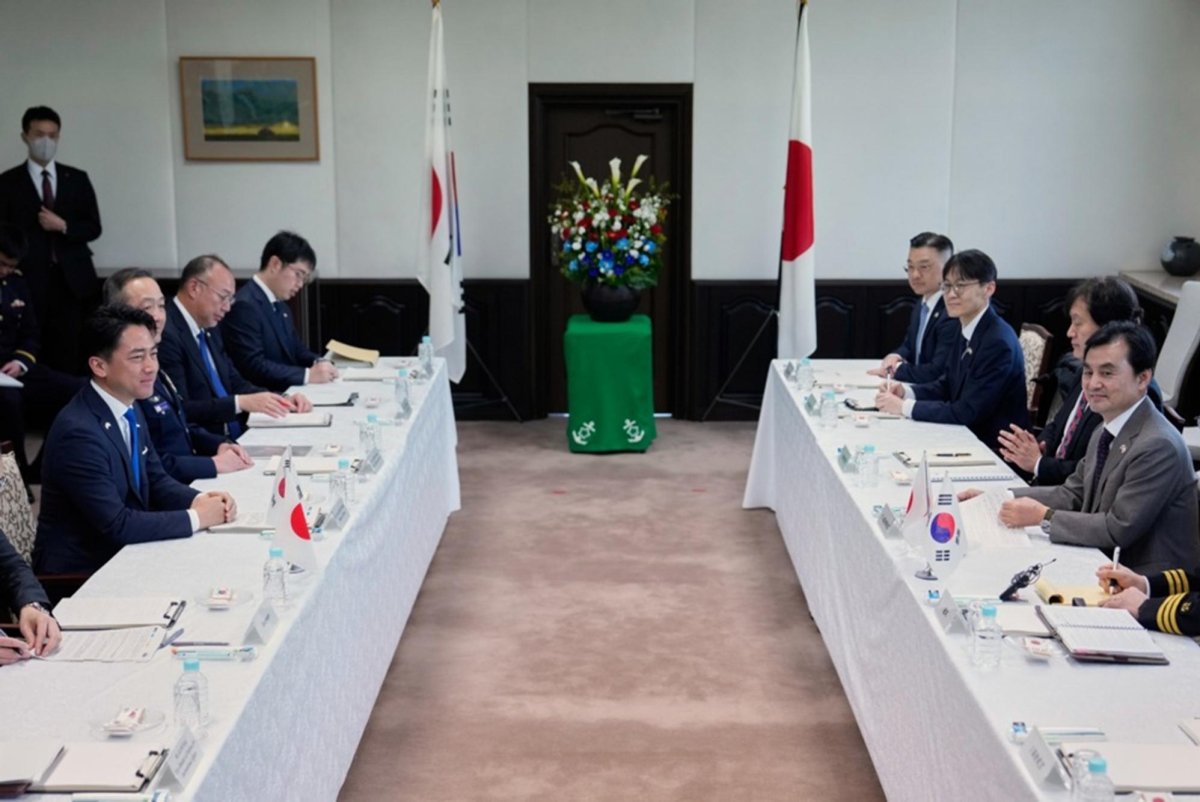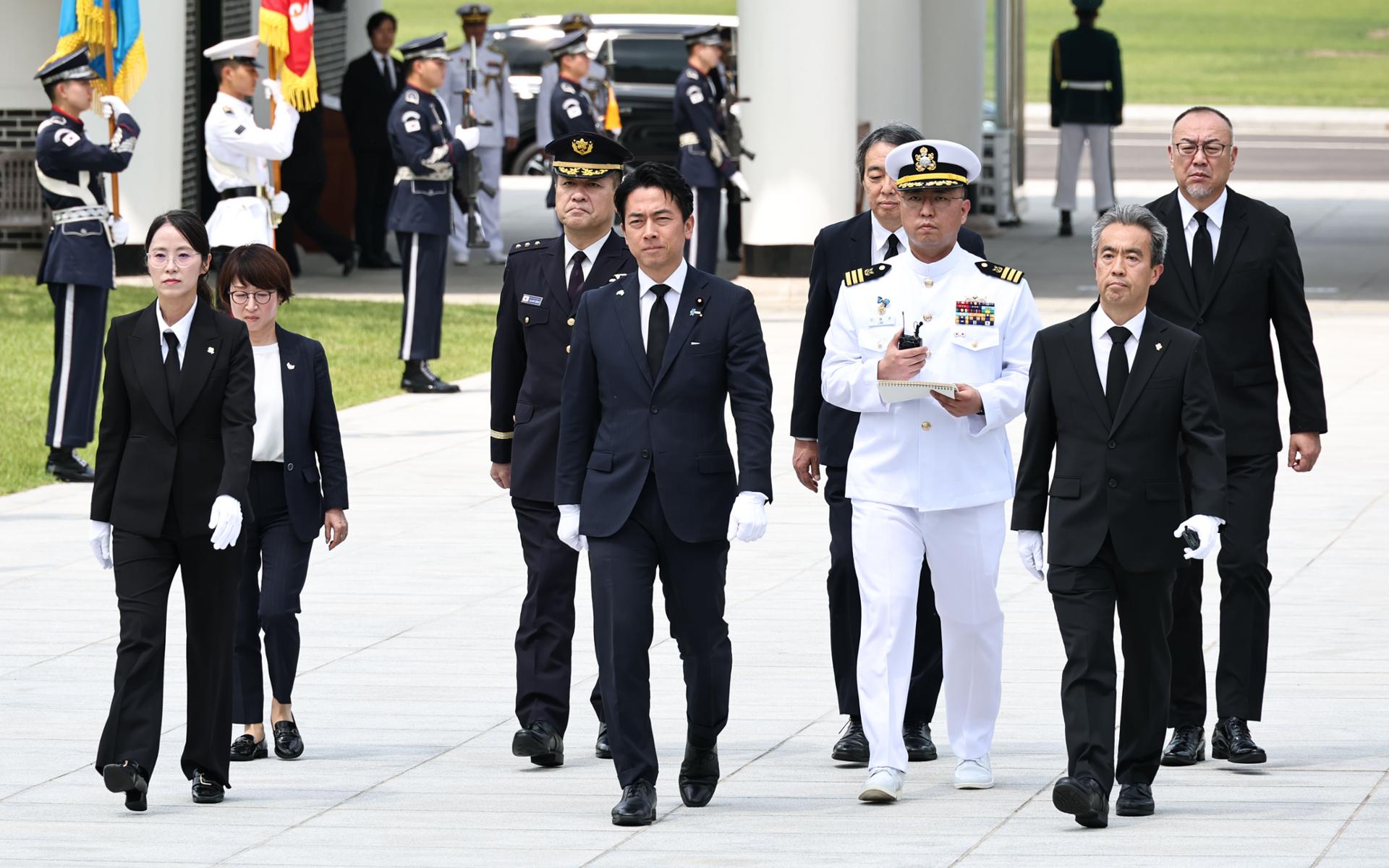
Lee Byung-jong Japan's Defense Minister Shinjiro Koizumi's visit to South Korea late last month for high-level talks with his South Korean counterpart Ahn Gyu-back featured a number of warm, symbolic moments reflecting their growing personal rapport — including a friendly game of ping-pong. Despite the upbeat atmosphere, the regional security environment remains far from reassuring.Koizumi's first visit to Seoul since assuming office came at a time of heightened tensions in the Indo-Pacific region, as growing belligerence from China and North Korea threatens regional stability. Against this backdrop, strengthening ties among regional allies is increasingly critical.Minister Ahn confirmed in late May that South Korea and Japan had discussed the possibility of a military logistics support agreement, which would allow the two countries to mutually procure ammunition, food and fuel. While he emphasized that any such pact remains politically sensitive and far from finalized, the discussions point to a broader strategic alignment in Korea-Japan relations.The meeting between the defense ministers comes at a significant moment and signals a strengthening partnership in response to shared threats. It follows a fourth summit between South Korean President Lee Jae-myung and Japanese Prime Minister Sanae Takaichi, at which Takaichi underscored that "close bilateral cooperation" between the two democracies is "more important than ever."The Indo-Pacific region faces perhaps its most severe security environment since the Second World War. With an increasingly belligerent China, and a North Korean regime rapidly accelerating its nuclear and ballistic missile programs with support from Russia, Takaichi’s Japan is taking a more proactive role in upholding a law-based international order across the region. Seoul, meanwhile, held live-fire drills in the Yellow Sea last month, pushing back on claims that it had softened its posture under a more conciliatory policy toward North Korea.However, South Korea, Japan and wider regional actors are acutely aware that managing these simultaneous threats will require broader regional cooperation. Despite its significant increase in defense spending, geography has its limits. The partners best placed to share the burden are those who face the same dangers from the closest range.South Korea represents a critical piece of this puzzle. Seoul is burdened with the same immediate threats as Japan. To its West, China’s opaque maritime infrastructure investments and live-fire drills continue to test South Korean resolve in the Provisional Measures Zone of the Yellow Sea. To its North, Pyongyang has recently pledged an "exponential" boost to its nuclear forces, before declaring in recent weeks that the country’s nuclear weapons status is "irreversible."In addition, beyond North Korea’s transfer of ballistic missiles and personnel to support Russia's war in Ukraine, China is said to have trained 200 Russian soldiers on its own soil. Unchecked, the growing China-Russia-North Korea axis risks drawing Indo-Pacific security, and the region's economic and trade future, into a wider downward spiral.For Japan, aligning its defensive posture more closely with South Korea is more than just solidarity — it is critical to upholding a Free and Open Indo-Pacific that Tokyo has long championed. Tokyo’s calculation is straightforward. A contested region in which adversaries can pick off allies individually is far easier to coerce than one where like-minded partners can share the burden of regional deterrence.Deterrence, however, is only as credible as the hard military capability behind it. South Korea fields one of the most advanced militaries in the region, and its defense industry is one of the most productive on the planet. The Philippine Air Force is set to order 12 more FA-50 fighter jets from Korea Aerospace Industries, and Manila has already requested the delivery of more advanced KF-21 Boramae by 2029.Japan, meanwhile, is undergoing a significant transformation of its own defense posture. The expected revision of its Three Strategic Documents is likely to encompass adaptation to new forms of warfare, including the use of unmanned systems and artificial intelligence.South Korea's advanced capabilities give tangible weight to Japan's collective security vision — and underscore why Seoul is a natural partner for Tokyo: a country with a strong defense-industrial base, cutting-edge technology and an increasingly aligned strategic outlook.This growing diplomatic alignment is already taking practical form. In a symbolic development, South Korea and Japan resumed bilateral naval search-and-rescue exercises early last month after a suspension of more than eight years.Koizumi's visit to Seoul should mark another step forward. Tokyo's determination to play a leading role in fostering cooperation among like-minded partners in the Indo-Pacific region is clear. For South Korea, facing similar coercive pressures from Beijing and Pyongyang, a partnership with Japan's capabilities and diplomatic weight is essential to preserving regional stability.The "ping-pong diplomacy" between the United States and China in the 1960s opened a new chapter in global geopolitics. The ping-pong game between the defense ministers of Korea and Japan may likewise serve as a small but telling symbol of deepening security ties between Seoul and Tokyo in pursuit of a Free and Open Indo-Pacific region.- - -Lee Byung-jongLee Byung-jong is a former Seoul correspondent for Newsweek, The Associated Press and Bloomberg News. He is a professor at the School of Global Service at Sookmyung Women’s University in Seoul. The views expressed here are the writer’s own. — Ed.
[Lee Byung-jong] Deepening Seoul-Tokyo ties
Japan's Defense Minister Shinjiro Koizumi's visit to South Korea late last month for high-level talks with his South Korean counterpart Ahn Gyu-back featured a
850 words~4 min read