Author(s): MadeAi
Originally published on Towards AI.
Why Evidence for Rare Disease Matters
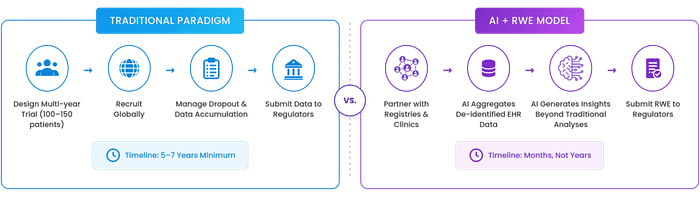
AI and real-world evidence (RWE) are reshaping the path from laboratory discovery to regulatory approval. Their convergence matters most for patients who can’t afford to wait. For patients with rare diseases, waiting for treatment can mean years of uncertainty. In the United States, a rare disease is generally defined as one affecting fewer than 200,000 people. The medical innovation system wasn’t designed for them. Traditional clinical trials require large cohorts, months of enrollment, and statistical power that rare diseases simply don’t have. Moreover, regulatory bodies like the FDA demand rigorous evidence before approval, yet the very rarity that defines these conditions makes that evidence exceptionally difficult to gather.
This is the paradox: patients with the greatest need often experience the longest wait. Meanwhile, clinicians treating these patients generate insights daily from their real-world observations that remain siloed in electronic health records (EHRs), wasted in isolation.