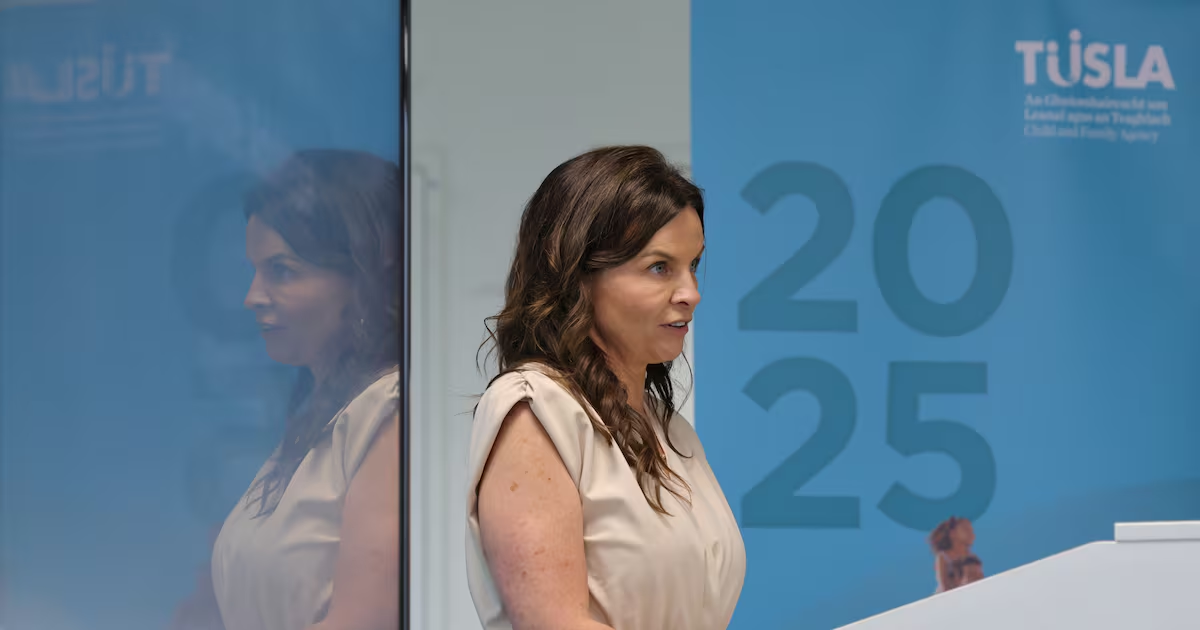
About half of child sex abuse cases referred to a Tusla specialist service last year involved abuse perpetrated by other children, an Oireachtas committee has heard.Kate Duggan, chief executive of Tusla, the Child and Family Agency, said there was an “increasing trend” of children sexually abusing other children. Duggan told the Oireachtas committee on children that the agency’s Barnahus service had 462 referrals last year. Barnahus – Icelandic for `child’s house’ – is a child-friendly model where children who have experienced or witnessed sexual abuse receive Garda, medical, therapeutic and child-protection services under one roof, avoiding the need for visits to multiple agencies and multiple interviews. The model, pioneered in Iceland, is implemented at two sites – in Galway and Cork – with a third under development in Dublin. Asked about increasing levels of child abuse and exploitation, Duggan said the agency was “certainly worried about levels of exploitation of children, and that is not just sexual exploitation”.There were increasing concerns about the influence of criminal gangs on young children and their exploitation in drug-related crime, she said. “When we look at our sexual exploitation data we are seeing higher levels of sexual exploitation in the community at home, than we are among children in care.”She had seen new data from the Barnahus service on Wednesday. “If we look at one of our special services for sexual abuse in terms of Barnahus, about 50 per cent of our referrals are peer-on-peer abuse. So we are starting to see an increasing trend of peer-on-peer sexual abuse or allegations of sexual abuse.”Duggan also said a “wellbeing check” on more than 40,000 children, ordered in the aftermath of the discovery last year of the remains of three-year-old Daniel Aruebose in Donabate, Dublin, should be completed in the autumn. The large-scale check on children, whose child-protection cases were closed during the Covid-19 pandemic, would indicate how numerous agencies – not just Tusla – could better protect children, the committee heard. In September, Minister for Children Norma Foley ordered the welfare check-back on cases closed between March 1st, 2020 and February 28th, 2022, after it emerged Daniel, whose remains were found buried in a field in north Co Dublin, had not been seen since 2021. Concerns for his welfare emerged last year when a spot-check by the Department of Social Protection on a claim for child benefit indicated the boy was not registered with any school or day service. “When the wellbeing check is published, and we expect that will be completed in the autumn, that is going to have great learning for the State,” Duggan said. “In terms of how we use PPS numbers, how we collect information on children who are emigrating, on educational systems and structures. That is going to be really good.”The agency’s 2025 annual report, published on Wednesday, showed the number of child protection referrals surpassed 100,000 for the first time last year. This is more than double the total recorded (43,000) a decade earlier.The increase, said Duggan, was due to “the absolute rise in complex social situations” including “the challenges around housing, the challenges of poverty ... domestic, sexual and gender-based violence” which increases “pressure on the resilience of families” as well as greater awareness of child abuse.
Children perpetrated sex abuse in half of cases referred to Tusla specialist service
‘Wellbeing check’ ordered on more than 40,000 children after Daniel Aruebose case should be completed in the autumn, Kate Duggan says
539 words~2 min read