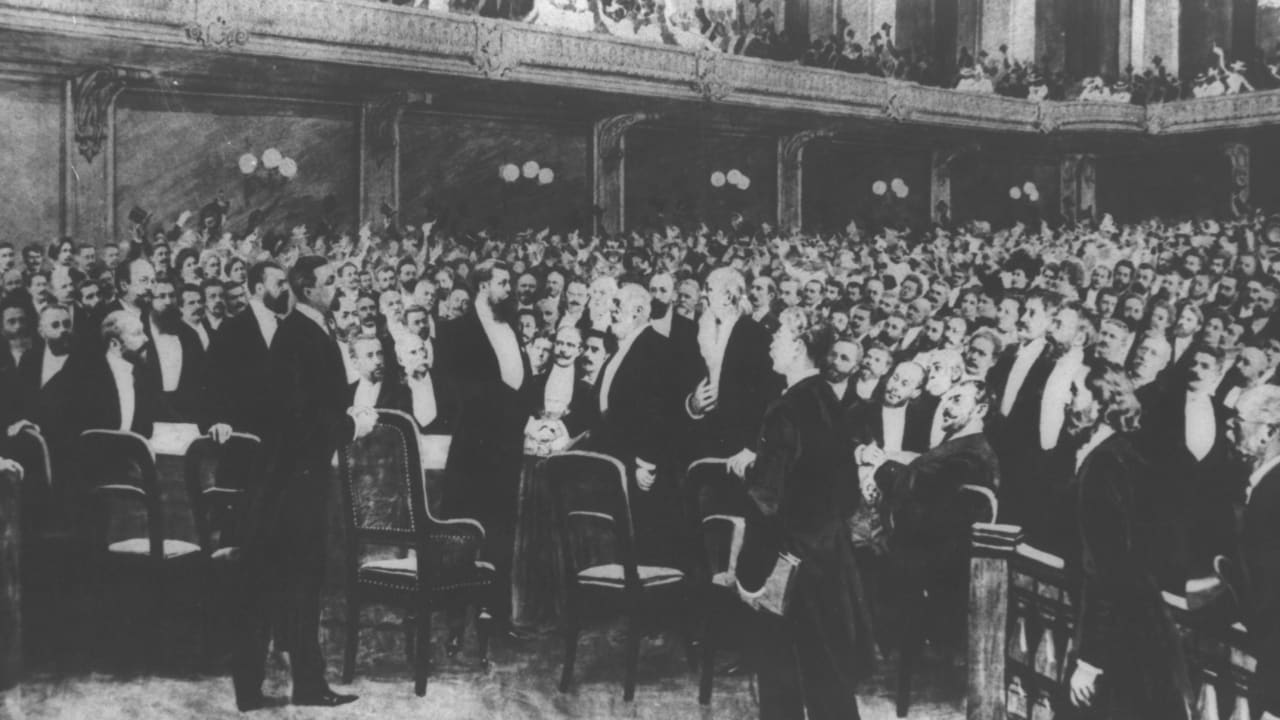
In 1897, Theodor Herzl entered the Stadtcasino in Basel and turned it into the first headquarters of the modern Zionist movement. The delegates gathered there had no army, no government, no sovereign territory and no assurance that history would take them seriously. They possessed little more than an idea, a congress and the audacity to begin.Herzl did not merely believe in a Jewish state. He convened one before it existed.That was the original grammar of Zionism. It was not a label to wear, a demographic category or a political position to declare. The early Zionists did not simply call themselves Zionists. They practiced Zionism.Zionism was a verb.Eliezer Ben-Yehuda did not merely admire Hebrew. He carried it out of the synagogue, brought it into his home and spoke it into the cradle until the language of prophets became, once again, the language of children. The pioneers did not publish declarations about their connection to the land of Israel. They crossed oceans, cleared fields, cultivated farms, established towns and defended settlements whose survival was never guaranteed.FIRST ZIONIST CONGRESS delegates in Basel, Switzerland, 1897. (credit: Wikimedia Commons)Herzl organized. Ben-Yehuda spoke. The pioneers planted.They argued fiercely, as Jews always have. Then they went outside and built.They did not inherit a functioning Jewish state and debate how strongly they identified with it. They created the institutions, language, culture and power their descendants would one day inherit. Their Zionism was measured not by the intensity of their declarations, but by the consequences of their actions.Somewhere along the way, however, we confused the practice for the label. Zionism became a noun: an identity to claim, a box to check, a word to defend and a controversy to explain. We began asking whether someone is a Zionist, as though Zionism were merely something one could be.Identity asks who you are. Zionism asks what you are doingWe hold conferences about Zionism. We publish statements defending Zionism. We debate its definition and answer those who slander it, distort it or demand that Jews apologize for it. That work is often necessary. Advocacy matters when Israel is libeled and Jews are threatened.But advocacy cannot become a substitute for construction.A movement that spends all of its time explaining itself will eventually forget how to act. A people that exists only to answer its enemies has already allowed its enemies to set the agenda.The Jewish world has become extraordinarily good at reacting. When Israel is attacked, we mobilize. When antisemitism surges, we organize. When Jewish students are threatened, we convene emergency meetings. When lies spread, we launch campaigns to correct them. When violence erupts, we mourn, raise money, publish letters and demand protection.All of that matters. But emergency cannot become the organizing principle of Jewish civilization. A people cannot live forever in response mode.War demands survival. Zionism demands creation. A nation must do both.Zionism did not succeed because Jews became better at answering history. It succeeded because Jews began making history. Its founders did not ask only, “How do we preserve Judaism?” They asked the more ambitious question: “How do we create the next chapter of Jewish civilization?”That was the revolutionary leap.Herzl did not inherit institutions; he imagined and organized them. Ben-Yehuda did not merely preserve Hebrew; he restarted it. Ben-Gurion did not simply administer Jewish sovereignty; he helped create it. The early Zionists understood that the Jewish condition could not be solved by persuasion alone. They had no illusion that one more petition, one more speech or one more appeal to the conscience of the nations would rescue the Jewish people.They built political power, agricultural settlements, schools, universities, newspapers, labor movements, immigration networks and systems of defense. But their greatest achievement was larger than the sum of those institutions. They changed the Jew’s relationship to language, land, responsibility, power and history.They sought not merely to find a refuge for Jews, but to restore the creative power of the Jewish people.History does not reward the people with the most eloquent explanation. It rewards the people who build.Then came 1948.One generation did not merely win independence. In 1948, they built the Jewish people’s headquarters: a home, a government, an army and a center of gravity for a people who had spent centuries living at the mercy of others.But a headquarters is not the mission. It exists so the mission can continue.Over time, the miracle of statehood became confused with the completion of the Zionist project. Building too often gave way to preserving. Pioneering gave way to administration. Creation gave way to maintenance. Action gave way to advocacy.Generation after generation inherited the achievements of Zionism, but fewer inherited its habits.We inherited a revolution and began treating it like an heirloom.The Jewish state was never meant to become a museum to the courage of previous generations. It was meant to become the living center of Jewish renewal—a source of language, confidence, culture, power and purpose for the Jewish people everywhere.They did not build it so future generations could become caretakers. They built it so we could become builders.A state can be declared in a day. A people must be rebuilt in every generation.That work remains unfinished. Millions of Jews live Jewish lives almost entirely disconnected from the Hebrew language. Jewish communities across the Diaspora remain physically vulnerable and psychologically dependent on institutions that repeatedly fail to protect them. Too many young Jews encounter Israel first as a controversy rather than as a civilization. Too many learn how to debate Zionism before they have ever been invited to practice it.Jewish philanthropy devotes enormous resources to managing emergencies, but too little to constructing the future. We have become experts at preserving institutions without always asking the question that matters most: What kind of Jew are those institutions producing?Founders ask: What does not yet exist that must?Managers ask: How do we preserve what already exists?A people needs managers. But a movement without founders eventually becomes an industry devoted to its own continuation. It may preserve buildings, budgets, conferences and mailing lists while slowly losing the purpose for which they were created.The crisis of Zionism is therefore not merely a crisis of public relations. It is a crisis of creative will.The question Zionism must now answer is not merely: Do you support Israel? Can you defend Israel in an argument? Will you condemn those who hate it?The deeper question is: What are you building?The genius of Zionism was never simply that it created a state. Its genius was that it transformed nearly every dimension of Jewish life at once. It revived a language, restored political responsibility, reshaped education, transformed agriculture, reimagined economics and produced literature, music, science, architecture and military doctrine.It asked a people who had spent centuries surviving history to begin creating it again.That is what real movements do. They do not merely change governments. They change civilizations.And a civilization dies long before it disappears. It begins to die when it stops creating—when it can defend its past but no longer imagine its future; when its institutions become stronger than its ideas; when its memory grows larger while its ambition grows smaller.Zionism was the Jewish people’s decision to create again.That is why Zionism must once more become an organized program of action.To speak Hebrew is Zionism.To teach a Jewish child the language of his or her ancestors is Zionism.To defend a Jewish community is Zionism.To plant and cultivate the land of Israel is Zionism.To support Israeli agriculture, technology, culture and industry is Zionism.To build institutions that strengthen Jewish confidence and Jewish capacity is Zionism.To create Jewish art, literature, music, education and ritual is Zionism.To visit Israel is Zionism.To invest in Israel is Zionism.To serve Israel is Zionism.To bring Israel into Jewish homes is Zionism.To move the Jewish people closer to their homeland is Zionism.And ultimately, to return to Israel is Zionism.Zionism is not merely support for the existence of the Jewish state. It is participation in the continued creation of the Jewish future.Speak. Hebrew cannot remain a ceremonial language confined to prayer books, classrooms and summer programs. It must return to Jewish homes, families and childhoods. Hebrew is not merely a tool of communication. It is the operating system of Jewish civilization.Defend. The Jewish people cannot continue outsourcing their security, dignity and confidence. Jewish communities must possess the physical capacity and moral courage to protect themselves. Self-defense is not aggression. It is the restoration of responsibility.Plant. Jews must renew their tangible relationship with the land of Israel. Zionism was never purely theoretical; it was rooted in soil, agriculture, labor, ownership and cultivation. A homeland is inherited through stewardship, not sentiment. You do not inherit the land merely by praising it. You inherit it by tending it.Build. Jewish institutions must produce stronger Jews, not merely sustain themselves. We do not need more organizations whose greatest ambition is to survive another fiscal year. We need institutions prepared to survive history.Create. A living civilization does not merely defend itself. It produces beauty. It creates language, technology, ideas, music, literature, architecture and ritual. A civilization that creates only arguments for its own legitimacy has already begun to shrink.Return. Not every Zionist will make aliyah tomorrow. Every Zionist, however, should shorten the distance between the Jewish people and Zion. For some, that will mean aliyah. For others, it will begin with language, education, investment, service or repeated presence. But Zionism must always move the Jewish people closer to Israel, not merely teach them to admire it from afar.Words can be distorted. Labels can be attacked. Definitions can be manipulated.Action is harder to erase.A child speaking Hebrew is an answer. A Jewish community capable of defending itself is an answer. A vineyard planted in Israel is an answer. A new institution, a new school, a new company, a new family and a new immigrant are answers.The enemies of Zionism understand this better than many Zionists do. They are not merely threatened by what Zionism says. They are threatened by what Zionism does. It transforms Jews from petitioners into builders, memory into sovereignty, longing into return and the objects of history into its authors.That is why Zionism remains revolutionary.For years, the Jewish world has asked young people whether they identify as Zionists. Perhaps we should ask them something more demanding: What Zionist act did you perform this week? What did you speak? What did you teach? What did you defend? What did you plant? What did you create? What did you build?Herzl founded a movement. Ben-Yehuda restarted a language. The pioneers rebuilt a homeland.In 1948, one generation built the Jewish people’s headquarters.Our generation must build what it was built for.The first generation of Zionists built a country.Our generation must build a civilization.History is now asking one question of ours:What will we build?A noun describes reality.A verb changes it.Zionism is a verb.Now build.
Zionism is a verb | The Jerusalem Post
Zionism is not merely support for the existence of the Jewish state. It is participation in the continued creation of the Jewish future.
1,786 words~8 min read