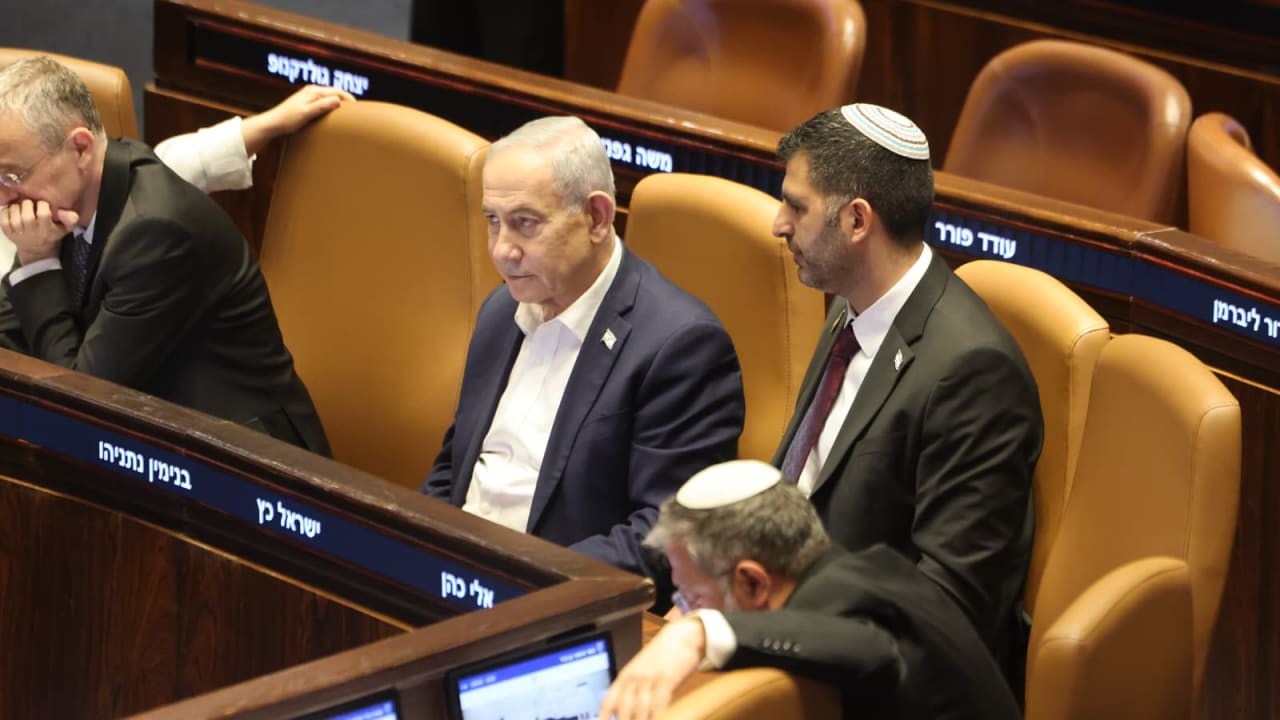
ByKESHET NEEVJULY 16, 2026 19:35Updated: JULY 16, 2026 19:52The Knesset plenum passed into law on Thursday the contentious bill led by Communications Minister Shlomo Karhi, which is set to enact sweeping reforms to Israel’s broadcasting sector. The bill passed in its final second and third readings with 53 lawmakers in favor and 48 against. Prime Minister Benjamin Netanyahu arrived at the plenum during the vote.The legislation is expected to grant the government substantial control over broadcasting media in the country.Critics argue that the legislation could harm freedom of the press and ultimately benefit outlets such as Channel 14, while negatively impacting channels such as Channel 12, which coalition MKs and ministers have claimed is anti-government.Karhi has argued that there exists a monopoly in Israel’s private media market, especially over Israel’s highest-rated TV news outlet, Channel 12.Prime Minister Benjamin Netanyahu and Communications Minister Shlomo Karhi talk amid votes on Karhi's communications bill in the Knesset, Jerusalem, July 16, 2026. (credit: MARC ISRAEL SELLEM/THE JERUSALEM POST)Coalition sprints to pass controversial legislation packageThe bill is considered one of the flagship pieces of legislation that Netanyahu’s coalition has been pushing to pass in the government’s term. The reform has received severe legal warnings, along with concerns over the process by which the legislation was advanced in an attempt to fast-track it by the end of the government’s term.The legislation advanced despite not having received approval from the Attorney-General’s Office.At the heart of Karhi’s bill is the establishment of a single, unified regulatory authority that would replace the existing Second Authority for Television and Radio and the Council for Cable and Satellite Broadcasting. The new body would regulate the supply of audiovisual content uniformly across all broadcasting platforms.A contentious aspect of the new authority is that it would consist of a nine-member committee, with representatives selected by the communications minister. This has led to criticism that the council's appointments would be political.While it is widely accepted that Israel’s broadcasting sector requires change that will better reflect the realities of today’s modern media environment, the reform has raised numerous concerns.According to the Israel Democracy Institute (IDI), it eliminates all safeguards for the quality of journalistic content and grants overly broad enforcement powers to the regulator, which could harm journalistic professionalism.Additionally, a consumer benefit that was promised by Karhi, which would have particularly benefited soldiers, was also removed from the bill at the last minute.The benefit sought to create a government broadcasting application to allow free mobile viewing of major sports broadcasts.The last-minute removal of the benefit came after the haredi (ultra-Orthodox) parties had said that they would not support the bill, citing concerns that the provision could lead to broadcasting on Shabbat.The bill underwent repeated revisions throughout a highly controversial legislative process. A special committee was established specifically to advance the reform, chaired by Likud MK Galit Distel Atbaryan.The committee was formed even though such legislation would typically be referred to the Knesset’s Economic Affairs Committee, which traditionally handles such matters and is chaired by Likud MK David Bitan.Bitan had publicly opposed the reform, prompting critics to argue that the creation of a separate committee was intended to advance the legislation while bypassing internal opposition within the coalition.MK Shelly Tal Meron (Yesh Atid) has been a vocal critic of the legislation, joining numerous debates in the Knesset’s special committee.She told the plenum ahead of the vote that the process by which the legislation was advanced was unlawful.Meron said after witnessing all that went on in the meetings, she had “lost trust in everything that the Knesset is supposed to represent.”Meron also said that Karhi did not provide enough statistics and information that were asked for, and that he would join all the committee meetings “because he wanted to control the committee and there were many times when he did so. “A-G Baharav-Miara claimed communications bill was a threat to Israeli journalismAttorney-General Baharav-Miara disapproved of advancing the broader communications reform bill before it reached the plenum for a first reading.She said in September that the bill posed a concrete threat to the free press in Israel and its ability to fulfill its duties in a democratic society, adding that the proposal itself lacks fundamental qualities.The Union of Journalists in Israel, a key watchdog in the industry, petitioned the High Court of Justice to halt the advancement of the communications reform law.Opposition lawmakers have sharply criticized the reform, with many warning that it is undemocratic and could be used to silence the media during an election year.Opposition leader Yair Lapid, himself a former broadcast journalist, has warned the bill was not a reform but rather “a campaign of incitement and gagging against the free press.”Karhi has rejected these claims, arguing that the reforms will have the opposite effect by opening the market to a wider range of voices, which he has said will strengthen press freedom.Controversy surrounding the legislation increased after the government voted to shut down the 75-year-old state-funded Army Radio in December.The passage of the reform also comes amid reports that Netanyahu has made a deal with the haredi parties to advance their contentious legislation for support on coalition legislation in exchange.Netanyahu's coalition has been on a legislative blitz to advance as much legislation as possible before the Knesset goes on recess this week ahead of the upcoming elections, scheduled for October 27.Lapid vowed ahead of the vote on the reform that “what has been done over the past four days, we will cancel with the stroke of a pen.”“Everything you are seeing here is an unnecessary farce, and it will be repealed within the first 100 days of the next government,” he added.Follow us on Google
Israel's Knesset passes reform expanding gov't oversight of broadcasting | The Jerusalem Post
Legislation passes 53-48, granting the government sweeping broadcasting powers amid warnings of harm to media freedom.
941 words~4 min read