Donald Trump has spent over a decade presenting international politics as a scoreboard with his name engraved in gold across the top. It was an amusing act that attracted millions of followers both at home and abroad. But all of that theatric bicep-flexing might have just come back to bite.We’ve seen the US President preach a very familiar sermon to the world for years. For the controversial Republican and his doting inner circle, it’s all about “America first” and everything that might come under that umbrella.China, meanwhile, has been cast as the great cheat, a strategic thief that stands as the only serious rival between the US and another century of global dominance.It is a rivalry tailored perfectly to Trump’s instincts to display strength. In just about any address from the 80-year-old regarding international relations, there must be a winner, and there must always be a loser. But the latest findings from the Pew Research Center will make for grim reading inside the White House this week.For the first time in Pew’s long-running international polling, China is now viewed more positively than the US across most countries surveyed.“Global views of the United States worsened last year as President Donald Trump’s second term began, though most people still had a more positive opinion of the US than China,” Pew said.“This year, that is no longer the case.”Pew surveyed 42,151 adults across 36 countries between February 8 and May 13. In 25 of them, more respondents held a favourable view of China than of the US.America remained ahead in just six: India, Israel, Japan, the Philippines, Poland and South Korea.The study is an unusually stark measure of soft power, the presumed legitimacy that allows any superpower to persist and lead without having to remind with overt force.But the recent catastrophe in Iran is quickly draining the trust the developed world had built for the US.Trump’s central promise has always been that America’s problems were caused by leaders who allowed other countries to take advantage of it. Each presidential campaign marched to a similar beat. China stole America’s factories, Europe was asleep at the wheel militarily and Mexico failed to control its border. Up north, Canada was an economic offender masquerading as a polite neighbour, while separate international institutions tied Washington down while giving its rivals room to move.What came next were the tariffs, which analysts heavily criticised. While perhaps effective in the short-term, the ripple effect would eventually come back to bite.Trump heavily taxed Chinese imports in his first term, describing trade deficits as evidence that America was losing. During his second, his administration broadened that instinct into a more robust doctrine, confronting allies as readily as rivals and treating decades-old partnerships as contracts open for renegotiation.The intensified rhetoric about seizing Greenland made clear that US protection would not necessarily remain unconditional, and sent a massive wave of apprehension around smaller nations with official partnerships with America.The long game China, on the other hand, has spent the last decade playing a very different game.While Beijing has militarised disputed territory in the South China Sea, increased pressure on Taiwan and tightened control at home, it has worked to develop corners of the globe in preparation for a potential changing of the guard. The Chinese strategy abroad has often been much more patient than Trump’s harnessing of the “world police” title.The Belt and Road Initiative, launched by Xi in 2013, is the clearest example of China challenging the US economically on foreign soil.What began as a modern reconstruction of the ancient Silk Road has expanded into a worldwide network of ports, railways, roads, energy plants, industrial zones, telecommunications links and financial relationships.More than 150 countries and over 30 international organisations have signed Belt and Road co-operation documents with China, according to Chinese government figures. The reach extends through Southeast and Central Asia, across Africa and the Middle East, into Europe, Latin America and the Pacific.AidData, a research laboratory at William & Mary, has tracked 20,985 Chinese-funded projects across 165 low- and middle-income countries between 2000 and 2021, with commitments worth about $US1.34 trillion. It has eventuated in railway lines through Laos, ports in Peru, power plants in Pakistan, roads across Africa, alongside comprehensive communications networks, bridges, even entire industrial precincts.The model has not been immune to criticism. Some projects have saddled governments with difficult debts, weakened environmental protections and, in some cases, given China strategic influence over vital infrastructure. The poorest 75 countries faced an estimated $US22 billion in repayments to China in 2025 alone, according to analysis cited by the Lowy Institute. But the “debt trap” description does not entirely explain why so many governments continue signing up.Developing countries have enormous infrastructure needs and, in some cases, limited patience for the West, especially when the commander-in-chief insists on a lengthy campaign that has left global markets rattled for months.The World Bank has estimated that, if implemented effectively and accompanied by reforms, Belt and Road transport projects could lift 8.7 million people from extreme poverty and 34 million from moderate poverty. It has also warned that poorly designed projects can leave some countries carrying costs that outweigh the gains. China’s offer is viewed as a simple strategic exchange. By offering infrastructure and finance, it can in return request commercial access, political goodwill and eventually long-term influence.AidData found that 79 per cent of leaders surveyed in the Global South believed Beijing was actively supporting their country’s development. Thirty-eight per cent named China as their preferred partner for energy, transport and infrastructure projects, with Beijing particularly strong in sub-Saharan Africa. A new road does not automatically produce affection for the government that financed it. Projects can be delayed, resented or associated with corruption and debt.AidData previously found China’s approval in the developing world fell sharply between 2019 and 2021.But the latest Pew results suggest the ploy is beginning to land.Not loved, but preferredDespite the result, confidence in both Trump and Xi remains low across the globe. Xi failed to attract majority confidence in most countries surveyed, while European respondents remained wary of both leaders.But Pew found that “more overall now say they have confidence in Xi than in Trump”. When you lay out their track records, it is a startling revelation for the US President.Xi is an authoritarian leader who has removed presidential term limits, centralised power, overseen an extensive domestic surveillance state and crushed political freedoms. Despite all that, in Germany, Greece, Italy, the Netherlands, Spain, Sweden and Britain, Xi led Trump by double digits on confidence in world affairs.His highest rating among those European countries was only 37 per cent, recorded in Britain.Pew researcher Jonathan Schulman said the scale of the reversal was unprecedented in the organisation’s tracking. Earlier declines in America’s image were recorded near the end of George W. Bush’s presidency and at the beginning of Trump’s first term, but China had generally remained level with or behind the US.The shift is particularly striking in Canada.In 2023, 57 per cent of Canadians held a favourable view of the US, compared with just 14 per cent for China. By 2025, the two powers were level.Now China leads, with 44 per cent favourable, compared with 33 per cent for the US.Mexico has also crossed over. America’s two closest neighbours now view its principal strategic rival more positively than they view the US itself.That cannot be dismissed as anti-American sentiment in a distant region, or as the product of Chinese influence in countries historically suspicious of Washington. It is happening across the border.The broader Latin American findings tell a similar story. China is now viewed more positively in Argentina, Chile, Mexico and Peru, while public opinion in Brazil and Colombia is roughly divided between the two powers. This is a region where the US enjoyed overwhelming geographic, economic and political advantages. China did not replace those advantages overnight. It accumulated influence through trade, lending, infrastructure and the disciplined avoidance of public arguments about whether Latin American countries were sufficiently grateful.Nobody likes authoritarianism Despite all of that, America does retain one important advantage.More people still believe the US government respects personal freedoms than say the same of China. But even here, the gap is narrowing.In Sweden, the proportion saying the US respected personal freedoms fell from 61 per cent in 2021 to 27 per cent this year. Drops of at least 25 per cent points were recorded in Canada, France, Germany, Italy, the Netherlands, South Korea and Spain.In Australia, only 11 per cent said China respected personal freedoms, although that figure had risen six points since 2021.Mexico produced one of the most remarkable results, with 35 per cent saying China respected its people’s freedoms, while just 20 per cent said the same of the US.In South Africa, a whopping 72 per cent called China a reliable partner, compared with 46 per cent for the US. Sixty-four per cent said China accounted for the interests of countries like theirs when making international decisions, against 42 per cent for Washington.The timing of the survey might have come at the most inopportune moment for Trump.The fieldwork began in February, shortly after the US intensified his rhetoric over Greenland and amid an increasingly confrontational foreign policy. It continued through the sudden escalation in the Middle East, when the US entered a war with Iran that stunned much of the world.Trump had campaigned as the president who would stop wars, contrasting himself to the tired-old political establishment he described as corrupt.That narrative was flipped on its head the moment the US and Israel began the current war with Iran. The domestic reaction was brutal to say the least, with several high profile Trump supporters leading the now famous MAGA-exit.A Ipsos poll in March put Trump’s approval at 36 per cent, down from 40 per cent days earlier, as fuel prices rose and voters turned against the Iran war. By late June, his approval had fallen to 34 per cent, matching the lowest level of his second term. Only one in four Americans said the war had been worth the cost, while his approval on cost-of-living issues had sunk to 22 per cent. A separate Ipsos survey this month found 79 per cent of Americans expected the conflict to become prolonged, while just 18 per cent believed it would end quickly. Only 37 per cent supported US strikes, and half said the war was not worth its cost. Across 17 middle-income countries, a median of 75 per cent said the US interfered in other countries’ affairs a great deal or a fair amount.For China, the figure sat at 45 per cent.Respondents in many of those countries were also more likely to describe China as a reliable partner and a contributor to peace and stability, even with Beijing’s constant rhetoric over Taiwan making global headlines.While Beijing clearly has interests, ambitions and red lines of its own, it is clear Donald Trump’s legacy is closing in on irreparable as he closes in on the second half of his second term.The next daunting question is whether he will push for an unprecedented third term, as floated earlier by some of his most rusted-on allies.Read related topics:ChinaDonald Trump
Trump’s worst nightmare just came true
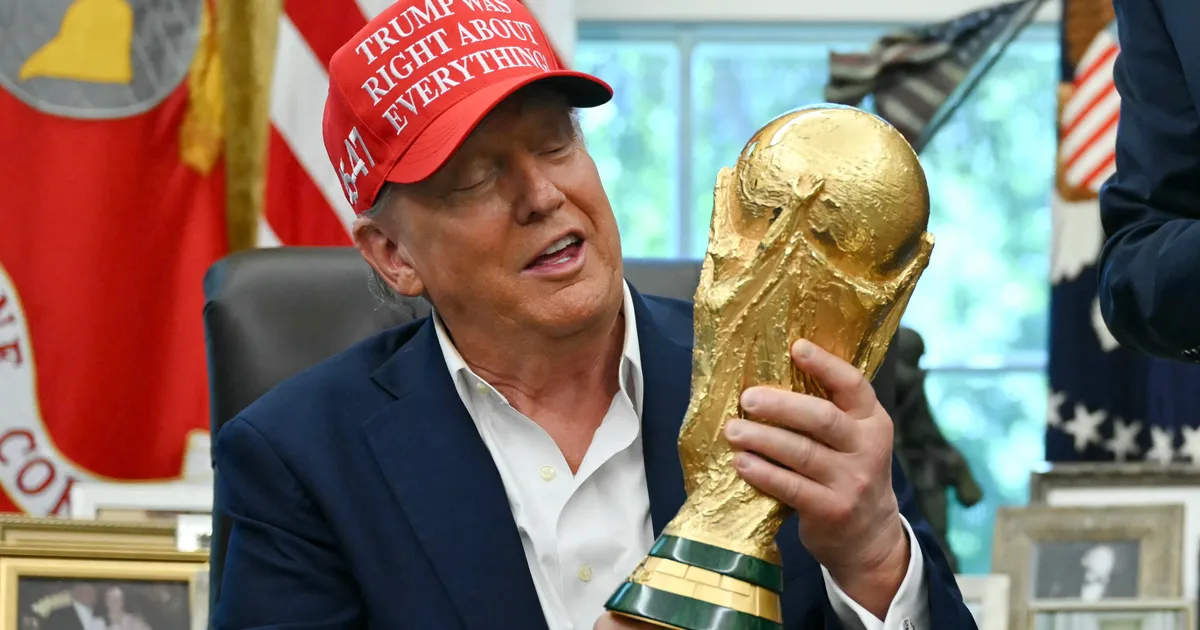
Donald Trump has spent over a decade presenting international politics as a scoreboard with his name engraved in gold across the top.
1,852 words~8 min read