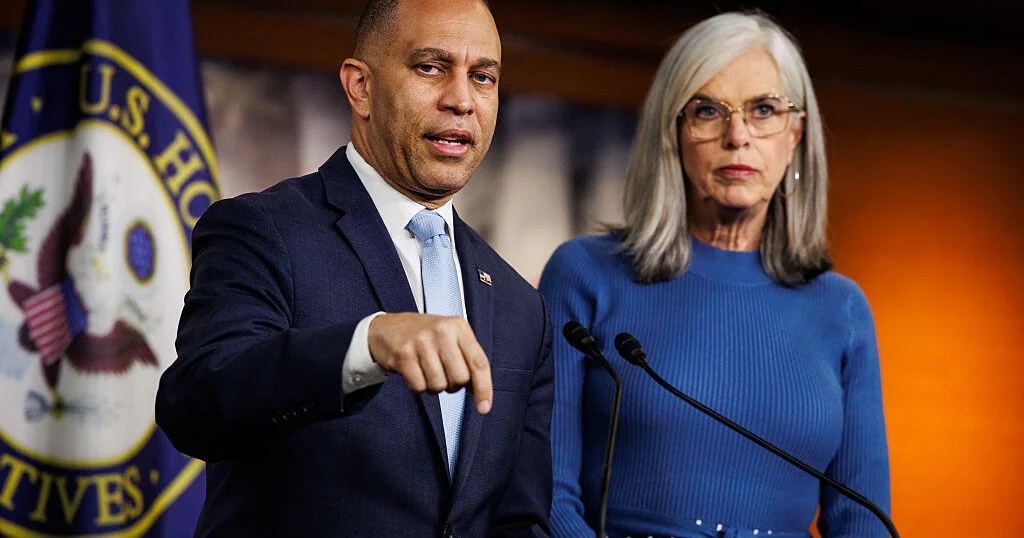
House Minority Leader Hakeem Jeffries (D-NY) found himself in the minority opinion of his party on a vote to cut off U.S. aid to Israel, with a majority of Democrats backing the failed proposal.The proposal, offered by Rep. Thomas Massie (R-KY), would have struck $3 billion of foreign aid to Israel in the annual National Security, Department of State, and related programs appropriations bill. Over 100 House Democrats backed the amendment, despite criticism from Jeffries and other members that the amendment was poorly written. Jeffries told his caucus in a Dear Colleague letter Tuesday that he would not support the amendment but told the caucus to vote their conscience, leaving space for members to his left to support the proposal.
Despite significant Democratic support, with more members voting yes than no, the amendment failed 314-104, as 215 Republicans and 98 Democrats voted in opposition. Ten House Democrats voted present.But Democrats who backed the amendment sidestepped criticizing Jeffries for voting no and applauded him for not whipping members to vote with him.Congressional Progressive Caucus Chairman Greg Casar (D-TX) told the Washington Examiner that Jeffries “left the space for members to vote their conscience on this.”But Casar also said leadership “across the Democratic Party” has acknowledged the party “has to change its policy and its stance on Israel and Palestine, and this vote signals a massive sea change, with a majority of House Democrats sending a clear message that we are no longer sending a blank check to the Israeli military.”Rep. Ilhan Omar (D-MN) told the Washington Examiner she respected Jeffries was “voting his conscience.”“We might disagree, but that is the beauty of our caucus,” Omar said. “Everybody has the ability to make those decisions on behalf of themselves and the people that they represent.”Still, Omar argued U.S. aid to Israel is an issue the Democratic Party’s base has “moved on,” and that it is “no longer a fringe issue.”“Everybody agrees that AIPAC is toxic,” the Minnesota Democrat said. “Everybody agrees the Israelis are committing the genocide. Everybody agrees that it is unjustifiable for us to continue to send them our hard-earned tax dollars. You can’t sleep well at night knowing that it is our money that is causing death and devastation.”Massie’s amendment exposed a stark division within the Democratic Party, for which Israel has become a splintering issue, even dividing Democratic leadership. House Minority Whip Katherine Clark (D-MA) voted yes, a vote that publicly put her at odds with Jeffries. In his letter, Jeffries described the amendment as “overly broad” and said it could limit “humanitarian aid, refugee resettlement, peace-building, and U.S. embassy operations.”While Clark voted opposite Jeffries, she echoed his sentiment that Massie’s amendment was too broad, saying it was “not an attempt to have a serious and necessary debate about offensive military aid to Israel.”Rep. Jim McGovern (D-MA), the top Democrat on the House Rules Committee, told the Washington Examiner that Jeffries allowing for members to split from him on the vote showed what “real leadership is” and acknowledged that some members in his party felt the measure was an “imperfect amendment.”NO. 2 HOUSE DEMOCRAT BREAKS WITH JEFFRIES ON ISRAEL AID VOTERep. Suhas Subramanyam (D-VA), who voted against the measure, rejected the notion that Jeffries’s vote put him out of step with the party as well, saying, “Half of us voted no.”“I would say that Leader Jeffries, in his statement, acknowledged what I think the party is unified on, which is opposition to this war and wanting to prioritize the American people over endless wars, and there’s definitely going to be a reassessment of funding not just Israel but every country and every action in the region around the world,” Subramanyam said. “That’s going to happen soon.”