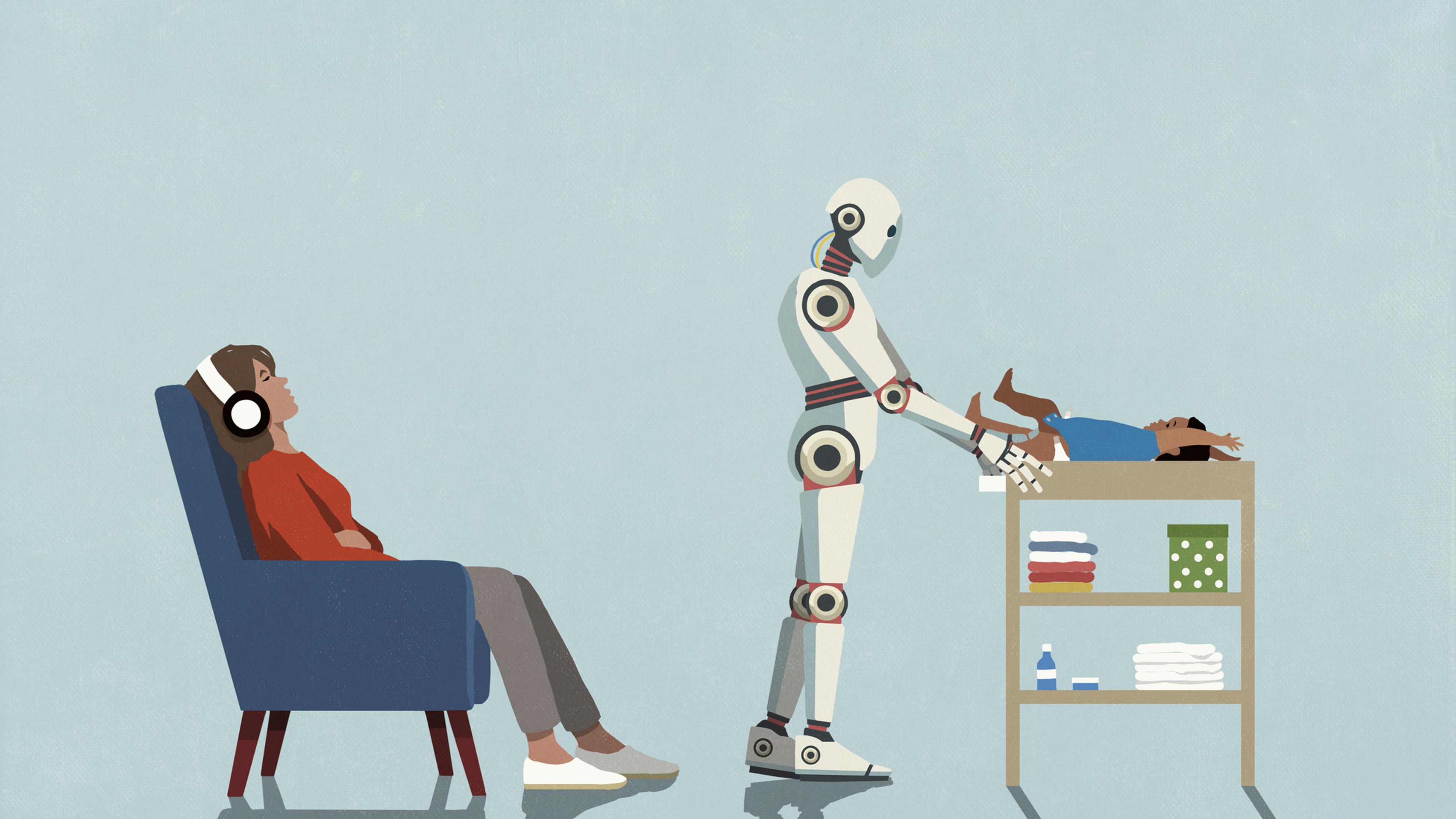
Women use A.I. less than men and do more of the cognitive work at home. The A.I. “family assistant” promises to bridge both divides.July 16, 2026Illustration by Keith NegleyIn a promotional video for Ollie, an A.I. family assistant, one of the company’s founders, Bill Lennon, is about to announce his new venture in front of a camera crew when his phone starts pinging. “THE BABY JUST 💩 ON THE CARPET / like A LOT / WHILE I WAS ON ZOOM W AN INVESTOR.” Then, a somewhat anticlimactic follow-up: “My sister coming for dinner btw did I tell you???” Lennon does not respond directly to these messages, which are presumably from his wife. Instead, he delegates to his phone. “Ollie, can you handle this?” he asks. “I’m in the middle of a shoot right now.” He authorizes his A.I. agent to research and contact local carpet-cleaning services and to create an Instacart order, and then proceeds with the filming. “Well, that wasn’t real,” Christy Shannon, a co-founder, confides to the camera, “but you get the point.”Ollie, after previous incarnations as an A.I.-enabled gift-buying app and a meal-planning app, relaunched in June as the “world’s first A.I. family assistant that runs your entire household.” It connects to your calendars, e-mail, and to WhatsApp, and consolidates the overflow of information—after-school activities, dentist’s appointments, travel plans—into a single text stream. “We exist in a group chat with you and your partner,” Lennon explains in a promo. “The smoothness of the experience of the blue bubbles and the reactions really animates Ollie and makes Ollie a character in the family’s life.” By taking on some of the cognitive load of domestic admin, Lennon says, the app is “giving families more time for what matters.”The marketplace for family-oriented A.I. executive assistants is an increasingly crowded one. Ollie’s rivals include apps such as Cozi (“Family life. Simplified”), Ava (“Fewer forgotten birthdays, more magic”), and Maple (“The operating system for modern families”), along with A.I.-enhanced “smart calendars” such as Skylight. Implicitly or explicitly, these tools are aimed at women, as evidenced by the growing cohort of momfluencers who offer tutorials and tools for making A.I. into a virtual co-parent. (The Cut recently profiled a wealthy mother who uses a team of A.I. agents to run her homeschool, handle paperwork, and make household purchases.) “The hope is that this new generation of tech can offer women support for the second shift of all the planning, the anticipating, the organizing,” Beth Humberd, an associate professor of management at the University of Massachusetts Lowell, told me.Research shows that mothers in heterosexual partnerships take on a disproportionate amount of the mental load involved in raising children and running a household—i.e., not the physical tasks, such as ferrying kids to soccer practice, but the cognitive work of knowing when to sign up for soccer, internalizing the practice schedule, remembering the snack and the water bottle, and so forth. One much-cited study, from 2023, found that, during the coronavirus pandemic, mothers spent more than double as much time on cognitive labor than fathers.My friend Darby Saxbe, a clinical psychologist and professor at the University of Southern California who researches household dynamics, writes in her new book, “Dad Brain: The New Science of Fatherhood and How It Shapes Men’s Lives,” about a study she led that examined the division of labor among hundreds of families with toddlers. For almost “every single task we examined, from pets to childcare,” Saxbe explains, “women’s share of cognitive labor was greater than her share of physical labor.” The single area of household work where Saxbe found that “men did more execution and planning than their partners” was in taking out the trash. “But even for garbage,” Saxbe goes on, “women owned a greater share of the cognitive work (like remembering to buy trash bags and keeping track of trash pickup day.)”Lennon says in another promo for Ollie that, after he had children, “I started seeing how much more my wife was doing than I was,” which inspired him “to give every family its own personal assistant to solve the mental load.” Building an app that has received millions in seed funding from venture-capital firms is certainly not the only option available to a husband and father who sees his wife struggling. And—if it need be said—such an app cannot watch your baby during a big investor call, or put a diaper on the baby before she poops on the carpet. Ollie may well become “a character in the family’s life,” but this character cannot spot-clean the carpet before your sister comes over for dinner, or cook the dinner, or clean up afterward.Still, if A.I. family assistants such as Ollie catch on among cognitively swamped mothers, it could mark a departure from the narrative about the “A.I. gender gap.” Research consistently indicates that women harbor more concerns than men do about A.I.’s ethical implications; women are typically more likely to question A.I.’s efficacy, the security of its data, and its environmental impact. A survey published last month by the Pew Research Center showed that women were less apt than men to be daily users of A.I. chatbots, less likely to say that A.I. improves their productivity, and more apt to have a negative outlook on the future of A.I. Recently, the actress and entrepreneur Reese Witherspoon exhorted women among her TikTok followers to learn the basics of A.I. before it “just speeds past you,” and the self-help author Mel Robbins implored her women fans to entrust their budgets and schedules to Microsoft’s Copilot A.I. tool, declaring, “You cannot be left behind.”The intuitive promise, then, is that the family assistant can help bridge both the A.I. gender gap and the domestic-labor gender gap. Tools like Ollie might serve as a just-for-her gateway drug, opening women’s—specifically mothers’—doors of perception to the infinite possibilities of A.I. Or, as a recent headline in Fortune put it, “The Most Contrarian and Durable Bet in AI Is 85 Million Moms.”Allison Daminger is an assistant professor of sociology at the University of Wisconsin-Madison whose research focusses on gender imbalances and cognitive labor in family life. She told me that, in her interviews with parents, three of the most common “pain points” in their households are daily meal planning, scheduling, and general overwhelm—each of which Ollie and other family assistants claim they can handle. But, Daminger told me, “in the story of technological invention in the household-labor sphere, oftentimes what you see is more of a reallocation of labor rather than a reduction.” A.I. family assistants may pledge to save parents time, she went on, but “that’s not what history suggests will happen.”Labor-saving technology tends to create domestic systems that are far more efficient over all, but not necessarily easier for the people doing the labor. As the historian Ruth Schwartz Cowan wrote in “More Work for Mother: The Ironies of Household Technology from the Open Hearth to the Microwave,” from 1983, innovations such as the modern stove, the washer-dryer, and the vacuum cleaner simplified chores that previously had been shared among multiple family members or contracted out to paid help, placing them instead in the hands of a single unpaid worker. Consumer tech made it possible for the twentieth-century housewife to prepare meals and handle the laundry solo, but it also raised the bar for how elaborate her dinners could be and for how often she was expected to change the sheets.This paradox of household tech found a millennial counterpart in the advent of e-mail, the personal digital assistant, and the smartphone, which added welcome flexibility to the lives of working parents, but also raised bosses’ expectations for their employees’ availability and productivity. In the twenty-tens, the mobile-app marketplace began wrapping its prehensile tail around kids’ sports and school activities. Family logistics that were once maintained easily enough via printouts and PDFs became the provenance of dozens of atomized apps—and, unlike printouts and PDFs, many of these apps make you watch ads and want your bank’s routing info. Unless and until A.I. family assistants can take over Whac-a-Mole duties on countless proprietary apps, many parents may hesitate over the wisdom of solving too much tech with yet more tech.Daminger, who is the mother of a toddler, told me that parents who use A.I. must contemplate both the limits of what the technology can do and the limits they want to place on how deeply A.I. reaches into their lives. Recently, she tried to train Claude to help with meal planning for her family of three, but gave up after a couple of months. “It would leave crucial ingredients out, it would get the proportions totally wrong, it would suggest the same five things over and over,” she said. It might have done a better job, Daminger went on, if she’d added more layers of tech—if she had a smart pantry and smart fridge for Claude to peek inside—or if she’d done more to keep Claude updated on her child’s “ever-changing food preferences.” Then again, these private textures of family life, she said, “are something that I don’t necessarily want to feed to A.I.”Katherine Goldstein, a friend of mine who’s a writer and the mother of three young boys in Durham, North Carolina, gives Claude access to her e-mail, so that it can create travel itineraries and populate the shared family calendar with events and reminders. But, she told me, she tries to treat it as a deterministic algorithm, and not as “a character in the family’s life”—she doesn’t talk to Claude about her kids or ask it for parenting advice, and she has conditioned it not to praise her or offer unsolicited help. Goldstein sees the appeal of an A.I. family assistant but rejects its premise. Tools such as Ollie, she told me, “feel like just another way to raise the bar on what families are supposed to be able to accomplish, in a way that makes me want to put a blanket over my head.”What Goldstein is resisting—and what A.I. family assistants both address and reinforce—is the cultural hegemony of intensive parenting, the time- and research-intensive mode of family life that helps to explain why, for example, working mothers of the early twenty-first century report spending a comparable amount of time engaged in child care as their stay-at-home counterparts of the nineteen-seventies. Juliet Schor, an economist and sociologist at Boston College, told me that there is “a kind of intractability to the cultural imperative of so-called intensive mothering.” It’s one that she doubts an A.I. family assistant can dislodge. These women “can’t use A.I. to give themselves ‘me time’ because they think they’re not supposed to have ‘me time,’ ” Schor said.Those who endorse A.I. as a parenting tool seem torn on this point. In her new book “Human Raised: Nurturing Connection, Curiosity & Lifelong Learning in the Age of AI,” the pediatric surgeon Dana Suskind ponders a “future in which AI helps to liberate parents, and especially mothers, from overwhelming and inequitable workloads.” A.I., she writes, can “free us from a certain kind of parenting: the relentless, optimizing, ‘never enough’ kind that has left so many of us exhausted, guilty, and paradoxically less present for the children in our care.” Yet the end goal of this liberation movement appears to be a more intense brand of intensive parenting. “Faster meal planning means more time on the floor playing,” Suskind writes. “A grocery list organized by aisle means less time spent shopping and more quality time doing projects together.”Suskind argues that one of the many shackles that A.I. throws off for parents and kids is the need to learn and remember stuff. “The cognitive outputs we strained to maximize, including factual recall, information synthesis, pattern recognition, and analytical efficiency, are precisely the tasks generative AI now performs instantly, tirelessly, and at superhuman scale,” she writes. “The core ‘product’ of intensive parenting has been automated.” Now that A.I. has effectively obviated a swath of “cognitive outputs,” parents must emphasize “the irreducibly human talents,” such as empathy, creativity, and critical thinking. Suskind elaborates on these unquantifiable gifts using financialized language: “They are, in economic terms, the new scarcity. And therefore they represent the new value. The new opportunity.” The force multiplier on this high-growth vertical, Suskind writes, is “the parent who is simply, fully there.”One presumes that this parent is also constantly looking at her phone. While promoting “Human Raised” on the “Hard Fork” technology podcast, Suskind reassured the co-host Kevin Roose that if he has a parenting question, he “can confidently ask Claude and Claude will give a right answer.” Roose replied, “That tracks a hundred per cent with my own experience of these tools, which is that they are often more seasoned and more confident about parenting advice than I am.” I waited for either Suskind or Roose to backtrack, to acknowledge that Claude is not seasoned. Claude is not confident. Claude does not have a past, emotions, a frontal cortex, eyes or ears or pores or dreams. Claude cannot have or raise kids—intensively or otherwise—or possess any insight into yours or mine, or know what your kid wants for dinner. Claude is not at the grocery store or the soccer game with you. The Claude of which they speak isn’t real—but you get the point.If one of the best bets in A.I. is a frazzled mother in search of a scheduling bot, that gamble may be premised on the notion that women are naturally and immovably the masters of the domestic universe, and that an A.I.-powered commander can offset the shortcomings of their congenitally bumbling male partners. “Most husbands are oblivious deadbeats,” Lennon, the Ollie co-founder, wrote recently on LinkedIn. “I mean this in the most endearing way.”Many agree, although not so many are endeared. A survey of more than two thousand parents in the U.S., published last year in the open-access journal of the American Sociological Association, introduced the term “gendered cognitive stickiness” to describe how women in heterosexual partnerships are often reflexively assigned to the “ ‘thinking work’ required to anticipate and monitor household needs.” The piece cited “weaponized incompetence” among some men as one of the factors that prevents this work from getting unstuck. In a paper published last year which drew on interviews with eighty-one heterosexual couples, Abigail Ocobock, a sociologist at the University of Notre Dame, surmised that “cognitive labor is far from invisible to women performing it and appears invisible to men only because they use resistance strategies to avoid it.”In “Dad Brain,” Saxbe takes a gentler tack. Because cognitive labor “can be performed while sitting on the couch, it often goes unacknowledged and unappreciated by others,” she writes. “Taking an overflowing trash can out to the curb is a heroic gesture, but nobody gets applause for remembering that tomorrow is field day and if you don’t pack a bathing suit your child won’t be able to go on the waterslide with her friends.”The A.I. family assistant might make all of this labor more visible—albeit via group text and push notification—and perhaps more evenly distributed. But, as Humberd told me, “I always think back to the stickiness of gender roles. Like, do I hope, over time, that these tools help make it such that women aren’t the ones managing the cognitive load? Yes. Do I think we’re going to get there in my or your parenting lifetime? No.”In her current research, Daminger told me, she is exploring a theme that she calls the “spectre of the nag.” “Women are working hard to figure out how to get change to happen in their household, and especially how to ask their partner for change in a way that is not seen as nagging,” she said. “But what if A.I. is the one doing the nagging? Then it’s, ‘He doesn’t listen to me—but maybe he’ll listen to Claude.’ ” She paused for a moment. “I don’t know what that says about family life.” ♦A scientist with a Ph.D. from Harvard fatally shot three of her colleagues. Then revelations about her family history came to light.
The A.I. Gender Gap Meets the Parenting Gender Gap
Women use A.I. less than men and do more of the cognitive work at home. The A.I. “family assistant” promises to bridge both divides.
2,673 words~12 min read