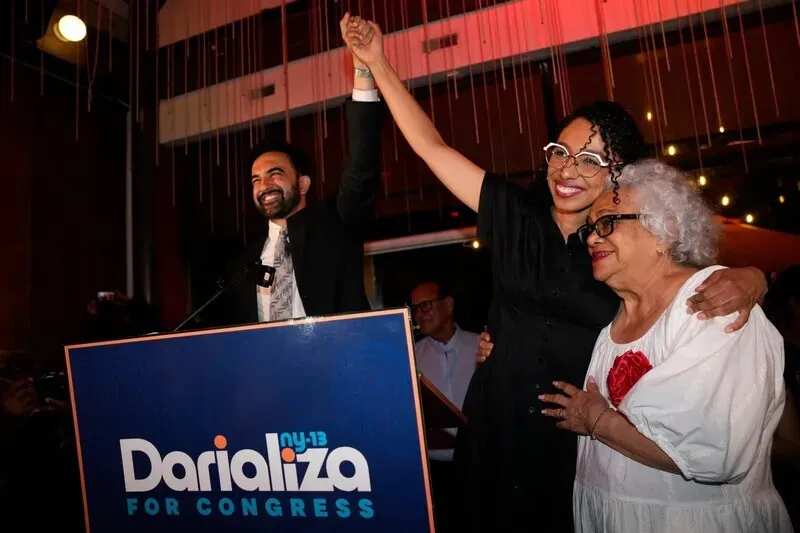
New York Mayor Zohran Mamdani celebrates the primary victory of Darializa Avila Chevalier, a member of the Democratic Socialists of America, on June 23, 2026. (AP/Yonhap)
By Jang Seog-jun, planning commissioner for House of Wisdom Under ShelterDemocratic socialism as a movement has surprisingly surged in popularity in the US. Members of the group Democratic Socialists of America (DSA) are getting nominated for seats in the House of Representatives in constituencies like New York and Colorado. This is an unprecedented phenomenon in American politics, which has long been dominated by the mainstream Republican and Democratic parties.In Korea, this striking shift in American politics has sparked a wide-ranging debate. Some say Korean progressive forces should explore operating as factions within major political parties, while others want to see a political force that prominently embraces socialism based on the DSA’s example. Though all these views stem from legitimate concerns, they miss the key historical significance of the change: the decline of the American empire, which has underpinned the global order, reaching a point of no return.At the dawn of the 20th century, the British Empire held the reins of the global capitalist order. But the UK’s status as the world’s sole hegemonic power was beginning to wane with the rise of emerging powers such as Germany. This era saw trade unions and socialist forces in Britain in 1900 launch the Labour Party, their first independent political party. Even after its founding, the party initially served as a subordinate partner of the Liberal Party. Nevertheless, the Liberals took the rise of Labour seriously enough to rush the announcement in 1909 of the People’s Budget, ushering in the era of rudimentary welfare and redistributive policies.Challenges within the UK, however, kept worsening. In the four years immediately preceding the outbreak of World War I (1910-14), the rapid growth of industrial unions mostly in mining, railroads and ports resulted in a surge of large-scale strikes. In 1918, as the decline of British hegemony was keenly felt after the war, Labour finally adopted Article 4 of its constitution explicitly declaring socialism as the party’s goal. By securing around 30% of the votes in the 1922 and 1923 general elections, Labour replaced the Liberal Party as a new rival to the Conservative Party. In 1926, a general strike led by industrial unions, which had long spearheaded the Labour movement, literally brought British society to a weeklong standstill.Such internal opposition and pressure within the UK hastened the global retreat of the declining British Empire. While Labour was not a principled anti-imperialist force, there was undoubtedly a connection between the party’s rise and the strong push for India’s struggle for independence. As voices calling for a reconfiguration of power and wealth redistribution grew louder, the belief that the contraction of the empire was inevitable spread among the British elite. Immediately after World War II, the emergence of the British welfare state coincided with the definitive transfer of the imperial throne across the Atlantic.Today’s surge in left-wing politics in the US is reminiscent of the UK’s transformation a century ago. Like in that bygone era, a declining empire today faces external challenges like China and the Global South, but also domestic resistance from a public no longer willing to accept the sacrifices necessary to sustain the empire. Such rebellion gets intricately intertwined with external challenges, and the unexpected link between the two helps make the world appear more humane and civilized after an empire’s fall. This was the case at least in the 20th century, and this is precisely the historically ordained role that the left in the US should assume.Please direct questions or comments to [english@hani.co.kr]