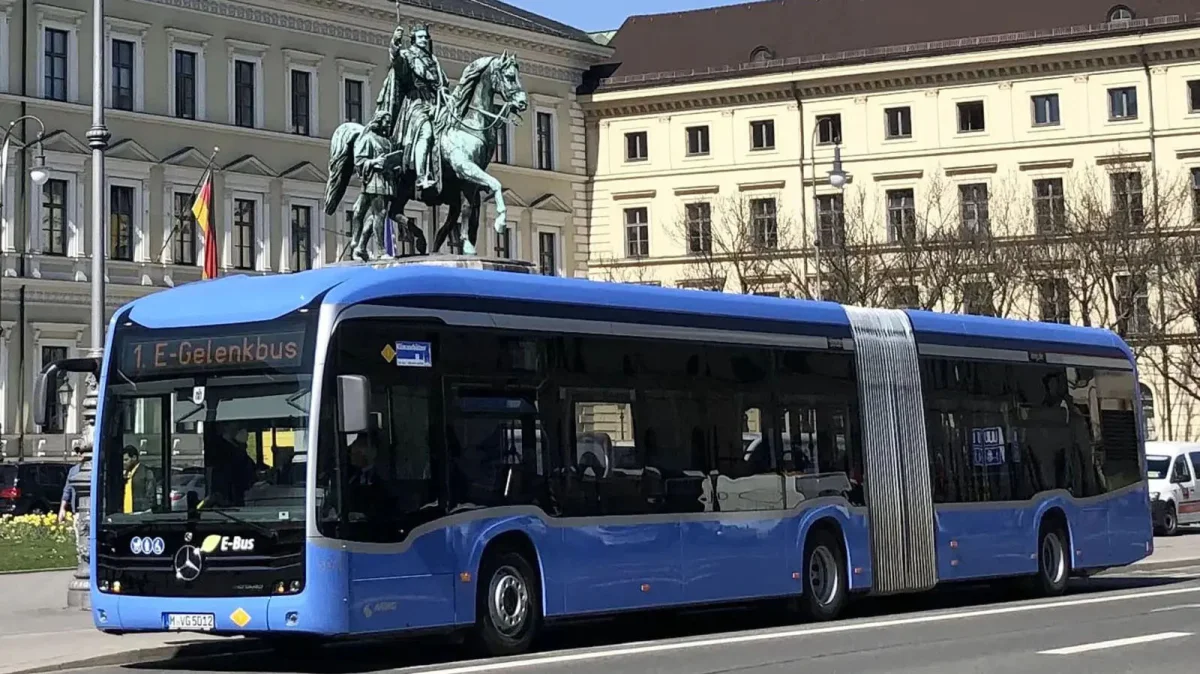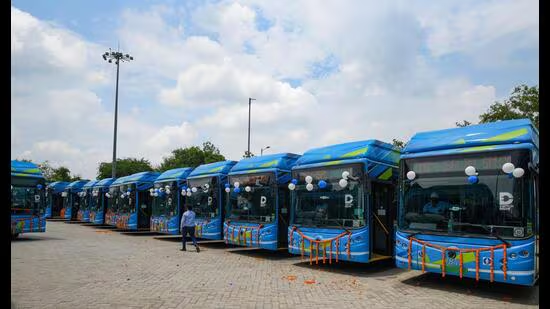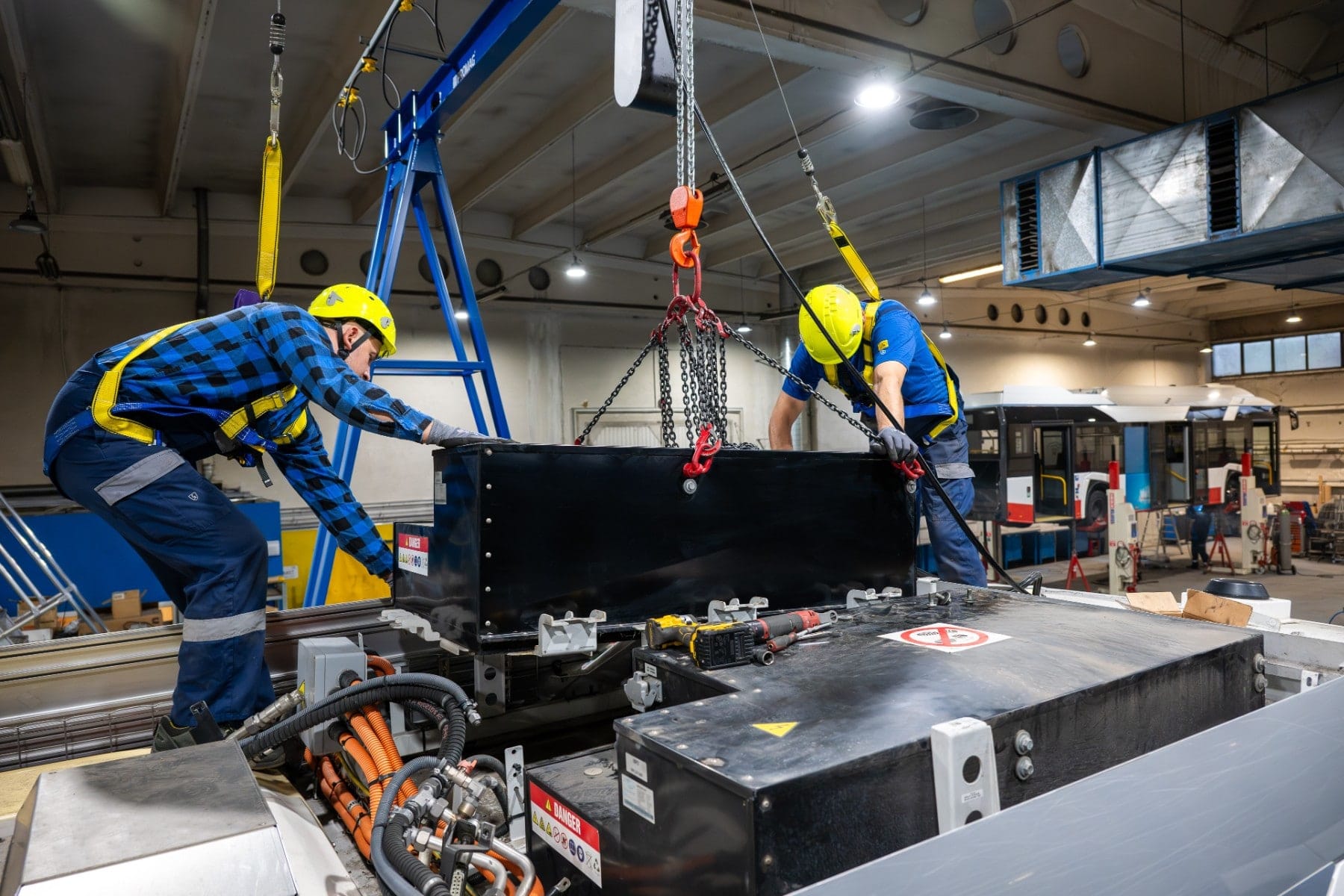
A study by Empa highlights the potential of converting diesel buses to battery-electric drivetrains. Rather than waiting for vehicles to be replaced at the end of their service life, e-retrofitting could accelerate the electrification of Europe’s bus fleet by around 15 years. According to the researchers, this could be crucial for meeting climate targets. Here are the details.Image: SolarisWhile the electrification of Europe’s bus fleets is gathering pace, it is advancing more slowly than climate targets require. The bottleneck is not the availability of battery-electric buses, but the long service life of existing vehicles. City buses remain in operation for an average of around 20 years. Even if only zero-emission buses were newly registered from 2035 onwards, Europe’s bus fleet would not reach 95% electrification until 2057, according to a study by the Swiss Federal Laboratories for Materials Science and Technology (Empa).This is where e-retrofitting could make a significant contribution. Instead of operating existing diesel buses until the end of their service life or replacing them prematurely, operators can convert them to battery-electric drivetrains. Empa’s calculations suggest this approach could bring forward the full electrification of Europe’s bus fleet by around 15 years.At the same time, operators can continue using functional vehicles, as only the engine, gearbox, fuel tank and exhaust system are replaced, while the body, chassis and interior remain in service. The authors argue that retrofitting could become an additional pillar of the transport transition by enabling faster decarbonisation, lower investment costs, reduced demand for raw materials and greater flexibility in expanding public transport.Empa’s life cycle assessment shows that e-retrofitting generates around half the greenhouse gas emissions associated with producing a new battery-electric bus. Per vehicle, this results in savings of approximately 58 tonnes of CO₂ equivalents. The approach also reduces demand for primary raw materials, cumulative energy input and other environmental impacts, including water consumption and particulate emissions.Applied across Europe’s bus fleet, the technology could deliver CO₂ savings of around 300 million tonnes by 2100, roughly equivalent to Spain’s annual emissions.The environmental benefits are accompanied by economic advantages. According to the study, a retrofit costs roughly half as much as a new battery-electric bus. As electric buses incur lower operating costs than diesel vehicles, transport operators could reduce both investment and maintenance expenditure over the long term.Depending on the scenario, the authors estimate that e-retrofitting could lower total bus transport costs by between 2.2% and 3.2% by 2100. The resulting savings could then be reinvested in the expansion of public transport.However, the benefits extend beyond transport operators. According to Empa, e-retrofitting could also support the ramp-up of Europe’s electromobility industry. By converting part of the existing bus fleet, manufacturers would not need to increase production of new electric buses at the same rate. This would give them additional time to expand production capacity and strengthen supply chains, while suppliers could unlock new business opportunities for standardised retrofit kits, battery systems and electric axles.At the same time, the approach could create new prospects for workshops and service providers, as traditional maintenance business is expected to decline over the long term as electrification advances.The study’s calculations show that just 1% of today’s automotive mechatronics workforce would be enough to retrofit up to 75,000 buses per year. If 5% of the workforce in this sector were allocated to the task, Europe’s existing diesel bus fleet could theoretically be electrified in less than three years. The same capacity could then be redirected to other commercial vehicles, such as trucks.The model also indicates that the climate benefits remain largely unchanged regardless of the fleet strategy adopted, but can be realised significantly faster through e-retrofitting.Despite the promising findings, some aspects of the study remain theoretical. For example, the economic analysis is based on model assumptions and previous pilot projects, as large-scale retrofit programmes are still uncommon. Actual conversion costs are also likely to vary depending on the vehicle platform, battery concept and required range. In addition, questions around certification, warranties and standardisation remain unresolved.The study also does not examine charging infrastructure in detail. While the authors suggest that existing depots or overhead line networks could be used—allowing smaller batteries in some cases—operators would still need to invest in charging infrastructure, grid connections and energy management systems. The success of the concept also depends on the availability of key components such as batteries, power electronics and electric motors, with battery supply likely to remain the main bottleneck.For Europe’s bus market, the study raises two fundamental questions: Does decarbonisation necessarily require the replacement of entire vehicles? Or is it enough to replace only the most emissions-intensive component of a bus—the conventional drivetrain?While manufacturers currently focus on new battery-electric models, e-retrofitting could emerge as a complementary approach. Whether the concept gains momentum will depend less on technical feasibility than on the political and economic framework conditions. To date, funding programmes have focused primarily on the purchase of new electric buses. If retrofitting is to play a larger role in future, policymakers will need to introduce adapted funding schemes, standardised approval processes and industrialised retrofit solutions.If these conditions are met, e-retrofitting could significantly accelerate the electrification of Europe’s bus fleets.www.empa.ch
Study: E-retrofits could accelerate bus fleet electrification by 15 years - electrive.com
A study by Empa highlights the potential of converting diesel buses to battery-electric drivetrains. Rather than waiting for vehicles to be replaced at the
853 words~4 min read