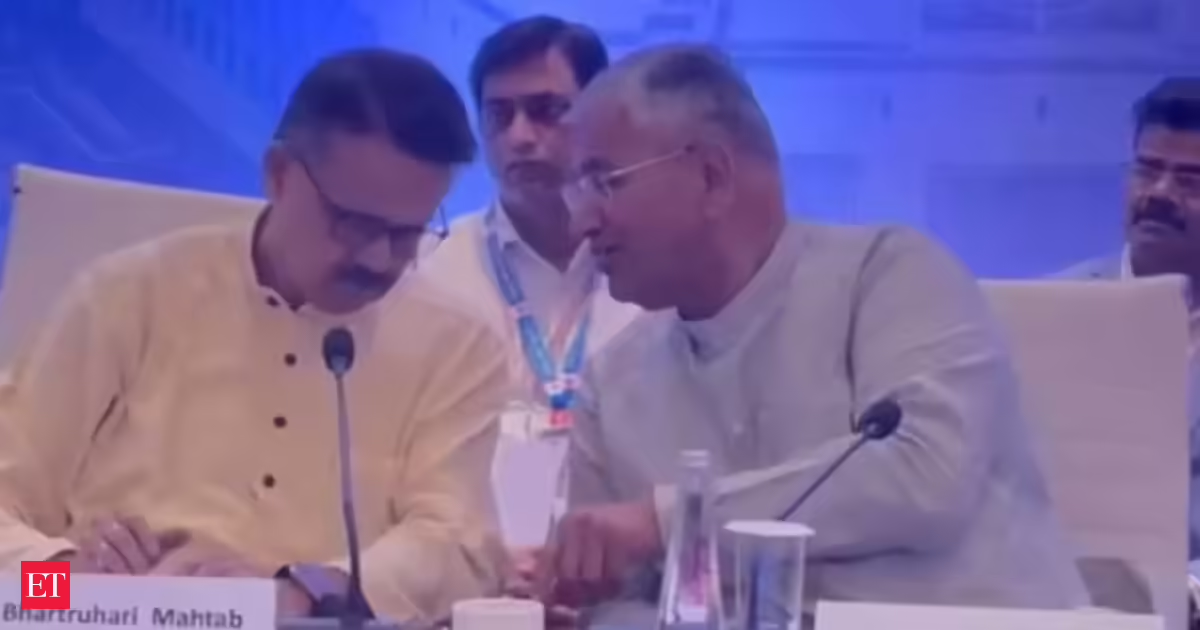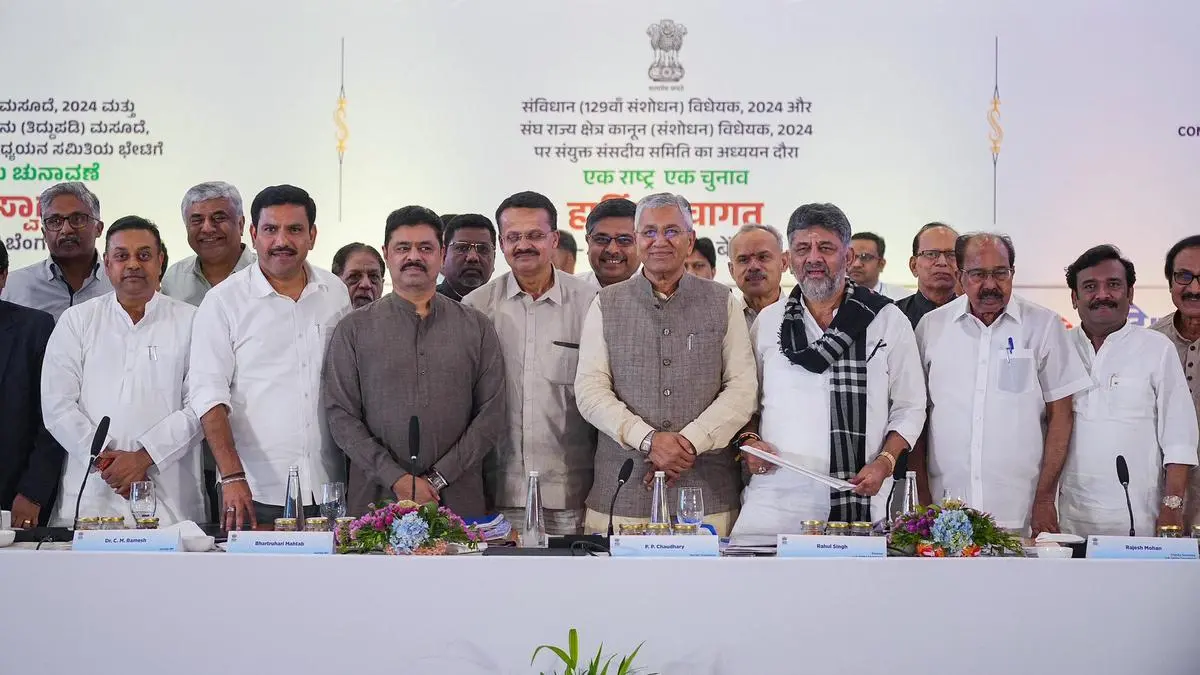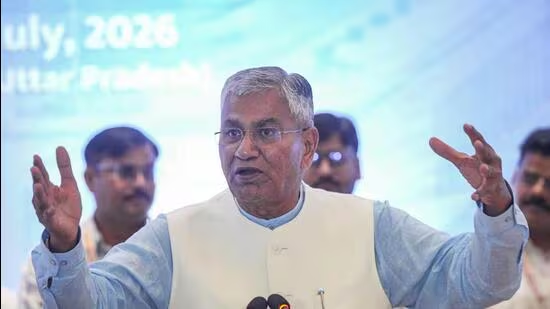
Stakeholders have said frequent elections adversely impact education, the country’s economy and voter turnout during polls, PP Chaudhary, chairman of the Joint Parliamentary Committee (JPC) on One Nation, One Election (ONOE), said in Lucknow on Wednesday as the committee concluded its three-day consultation with experts here.PP Chaudhary, chairman of the Joint Parliamentary Committee, at a press conference in Lucknow on Wednesday. (PTI PHOTO)“Ninety-nine per cent of civil society members supported One Nation,One Election during the interaction with the JPC in various states,” Chaudhary said at a press conference in the state capital.“If Parliament passes the Constitution (129th Amendment) Bill 2024 and the Union Territories Laws (Amendment) Bill, 2024 with a two-thirds majority, it might pave the way for simultaneous elections to the Lok Sabha and state assemblies during the 2029 general election,” he said.The JPC is visiting various states to consult stakeholders before finalising the report on the country’s biggest election reform.“During deliberations with stakeholders, we were told that regular elections adversely impact primary and higher education,” he said.“The country is in election mode year-round due to polls in one state or another,” Chaudhary said.“The Model Code of Conduct is implemented with the notification of the election by the ECI (Election Commission of India). It adversely impacts all sectors. During the Bihar assembly election, production in industrial units in Surat slowed down due to the migration of labourers,” he said.“Uttarakhand chief minister Puskhar Singh Dhami told the JPC that 43% of the state’s economy depends on the tourism sector. Elections in various states adversely impact tourist movement, and voter turnout is also low,” Chaudhary added.“With the implementation of One Nation, One Election, there will be a calendar for Lok Sabha and assembly elections. Elections will be held in phases to ensure that migrants exercise their franchise rights,” he said.The JPC is also considering suggestions to amend anti-defection laws, he said, adding that both confidence motions and no-confidence motions against a government should be introduced simultaneously on the floor of the house.“We are also considering amending Article 174 and Article 85 of the Constitution, which empower the President and Governor to dissolve the Lok Sabha and legislative assembly on the advice of the council of ministers,” he said.Elections to Lok Sabha and state legislative assemblies were held together from 1951 to 1967. However, this cycle was disrupted in 1968 and 1969 due to the premature dissolution of some state assemblies. In 1970, the fourth Lok Sabha was also dissolved prematurely. Since then, elections for Lok Sabha and state assemblies have been held with different schedules. He said the argument by some people that simultaneous polls are against the spirit of federalism is wrong.In 1983, the ECI had urged the government to hold Lok Sabha and assembly elections simultaneously, he said.“The Law Commission of India in 1999, Parliament’s Standing Committee in 2002, the Niti Aayog in 2018, and the Ram Nath Kovind Committee in 2024 had recommended One Nation, One Election.Legal experts told the JPC that simultaneous elections to the Lok Sabha and state assemblies are not against the country’s federal structure. Top economists have said simultaneous elections will save around ₹7 lakh crore,” Chaudhary said.JPC CONCLUDES THREE-DAY CONSULTATIONS IN LUCKNOWThe Joint Parliamentary Committee (JPC) on the Constitution (Amendment) Bills relating to One Nation, One Election (ONOE) concluded its three-day deliberations in Lucknow on Wednesday after holding extensive consultations with eminent academicians, constitutional experts, Padma awardees and civil society representatives.On the final day, the committee interacted with vice chancellors, directors and heads of departments from leading universities and institutions across Uttar Pradesh. Representatives from Dr Ram Manohar Lohia National Law University, Lucknow; Banaras Hindu University, Varanasi; Indian Institute of Information Technology (IIIT), Kanpur; Rani Lakshmi Bai Central Agricultural University, Jhansi; Dr. Rajendra Prasad National Law University, Prayagraj; Babasaheb Bhimrao Ambedkar University, Lucknow; University of Lucknow; Indian Institute of Management (IIM) Lucknow; and the University of Allahabad, Prayagraj interacted with the JPC.The academicians presented comprehensive views on all clauses of the proposed Bills.Later, the committee interacted with Padma awardees from the state and representatives of civil society organisations. Emphasising that the success of the One Nation, One Election initiative rests on broad public participation and informed dialogue, the committee invited their views on the proposed reforms and held detailed discussions on various dimensions of the initiative. The members also explained the rationale and key features of the proposed constitutional amendments.
Stakeholders say frequent polls hit education, economy: JPC chairman
If Parliament passes the Constitution (129th Amendment) Bill 2024 and the Union Territories Laws (Amendment) Bill, 2024 with a two-thirds majority, it might pave the way for simultaneous elections to the Lok Sabha and state assemblies during the 2029 general election, says JPC chairman PP Chaudhary
727 words~3 min read