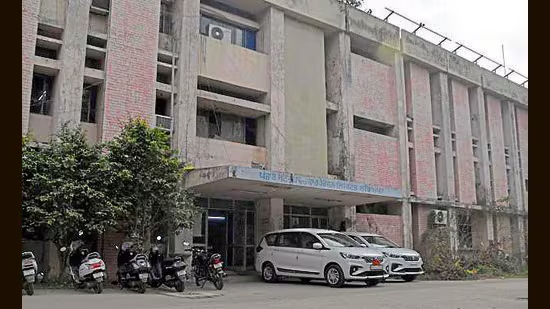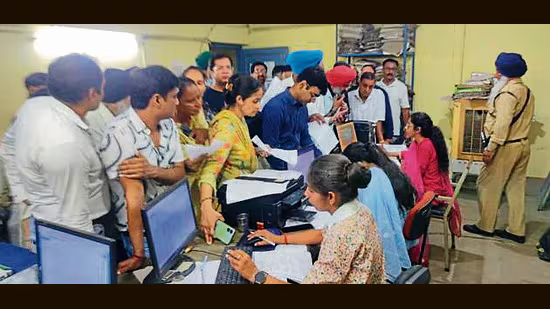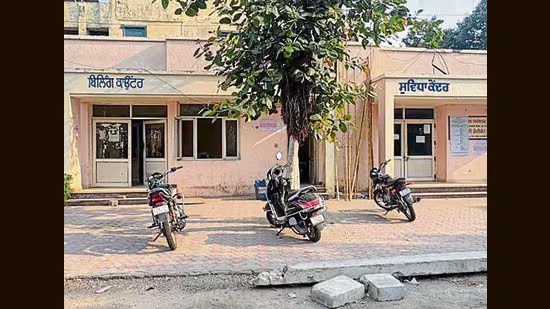
komal.kumari@hindustantimes.comJagdev Singh Hans said the additional expenditure was an unavoidable consequence of the disruption in the billing process. (Gurpreet Singh/HT)The ongoing strike by meter readers has left Punjab State Power Corporation Limited (PSPCL) with an additional financial burden of more than ₹1.41 crore in its Central Zone after the utility was forced to dispatch thousands of high-value electricity bills through speed post due to disruption in the regular meter reading and billing process.Official figures show that 1,18,254 N-Code bills were generated across the Central Zone up to July 7. Of these, 61,566 bills totaling ₹5,000- ₹15,000 were delivered via speed post at a cost of ₹23 per bill, resulting in an expenditure of ₹1,41,67,754. The remaining 56,688 bills, with dues ranging from ₹1,000 to ₹5,000, were delivered manually.The additional expenditure comes as meter reading has remained affected due to the ongoing strike, forcing the power utility to adopt an alternative billing and delivery mechanism to ensure consumers receive their electricity bills within the prescribed timeline.Under the N-Code billing system, electricity bills are generated when fresh meter readings cannot be recorded. In such cases, the bill is prepared based on the consumer’s electricity consumption during the corresponding month of the previous year. For example, if the meter reading for May could not be recorded, the bill is calculated on the basis of the consumer’s May consumption in the previous year. Similarly, the June bill is prepared using the previous year’s June consumption. Once regular meter reading resumes, the billing software automatically adjusts the difference between the provisional and actual consumption in subsequent billing cycles.Among the four circles of the Central Zone, West City Ludhiana recorded the highest number of high-value N-Code bills, with 23,328 bills in the ₹5,000- ₹15,000 category, followed by East City Ludhiana (18,912), Suburban Ludhiana (10,328) and Khanna Circle (8,998).At the subdivision level, Sundarnagar Special Division reported the highest number of bills above ₹5,000, with 6,906 such bills, closely followed by Focal Point Special Division (6,897). Other divisions with a high number of Speed Post deliveries included Aggar Nagar Special Division (5,701), Model Town Special Division (5,666) and Khanna Division (4,304).The impact of the delayed meter reading is now visible at subdivision offices across Ludhiana, where consumers have been approaching officials in large numbers after receiving higher-than-usual electricity bills. Officials said Agar Nagar subdivision has witnessed the highest footfall over billing-related queries, while Model Town, Focal Point and several other subdivision offices have also been witnessing a steady rush of consumers seeking clarification.Chief engineer, PSPCL Central Zone, Jagdev Singh Hans, said the additional expenditure was an unavoidable consequence of the disruption in the billing process.“Since regular meter readings could not be carried out due to the ongoing strike, the department had to issue N-Code bills and dispatch eligible bills through speed post to ensure consumers received them within the prescribed timeline. This resulted in additional expenditure for the corporation. Consumers should not panic after receiving an N-Code bill. These bills are prepared on the basis of the corresponding month’s consumption of the previous year, and any variation is automatically adjusted once regular meter reading resumes. Consumers should approach the concerned subdivision only if there is a genuine discrepancy or if the bill is significantly higher than their normal consumption,” Hans said.
Ludhiana: Meter readers’ strike costs PSPCL over ₹1.4-cr as bills dispatched via speed post
Official figures show that 1,18,254 N-Code bills were generated across the Central Zone up to July 7. Of these, 61,566 bills totaling ₹5,000- ₹15,000 were delivered via speed post at a cost of ₹23 per bill, resulting in an expenditure of ₹1,41,67,754
543 words~2 min read