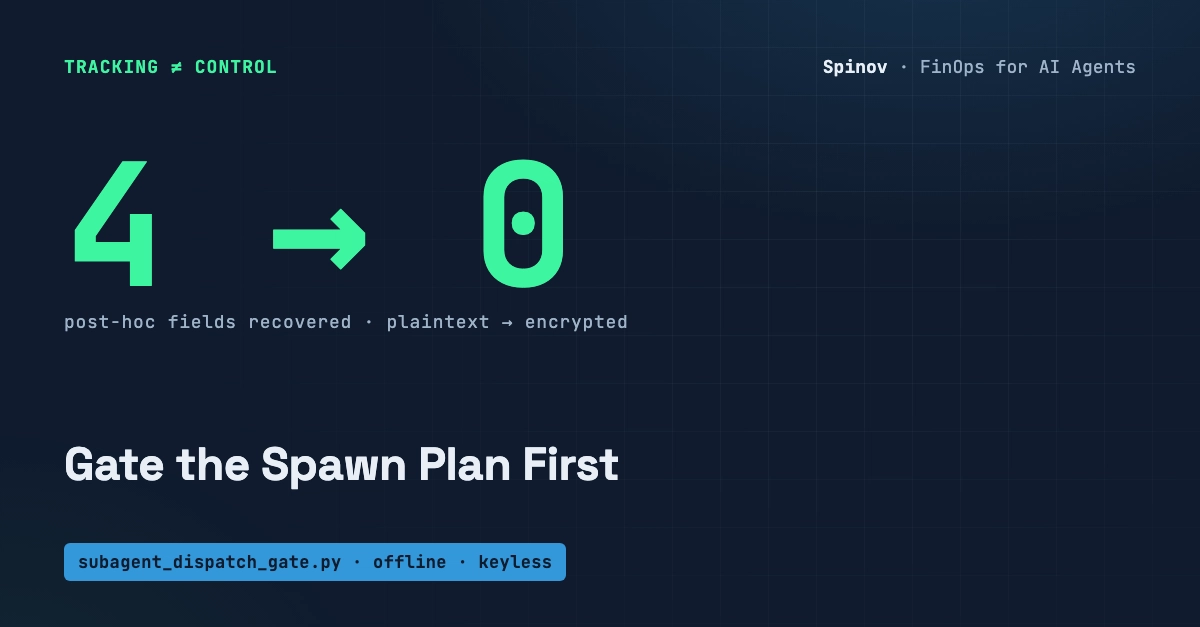
Pre-dispatch authorization for AI sub-agents means checking a child spawn's grant envelope (its role, tools, path scope and token budget) against the parent's policy in the last plaintext moment before handoff, not by reading a trace afterwards. When the orchestrator encrypts the handoff, the after-view goes blind. The before-view does not, because it sits earlier on the timeline.
On July 14, "Codex starts encrypting sub-agent prompts" hit 408 points and 240 comments on Hacker News in a day. The tracking bug behind it is filed as openai/codex#28058, titled "Regression: encrypted MultiAgentV2 messages remove readable task audit trail." A change encrypted the orchestrator-to-sub-agent payload, and the plaintext task record humans used to read after the fact turned into ciphertext. People who had been inspecting what their sub-agents were told, after dispatch, could no longer read it.
That is a good thing to notice, and a worse thing to fix by asking for the plaintext back.
AI disclosure. I wrote subagent_dispatch_gate.py with an AI assistant and ran it myself: Python 3.13.5, offline, standard library only, no network, no keys, no funds. Every number, exit code and sha256 below is pasted from a real local run. I ran the whole demo twice and the two output.txt files are byte-for-byte identical (sha256 5af48191642d66f7c364c429c50d2ad1a021f09004f5566ba878c7be87fcaaf1). The one synthetic part is clearly marked: encrypt_artifact() models the observable consequence of encryption (opaque bytes you cannot parse back into fields), not Codex's real crypto. And every fact about Codex here comes from that HN thread and that issue. I did not reproduce their system.