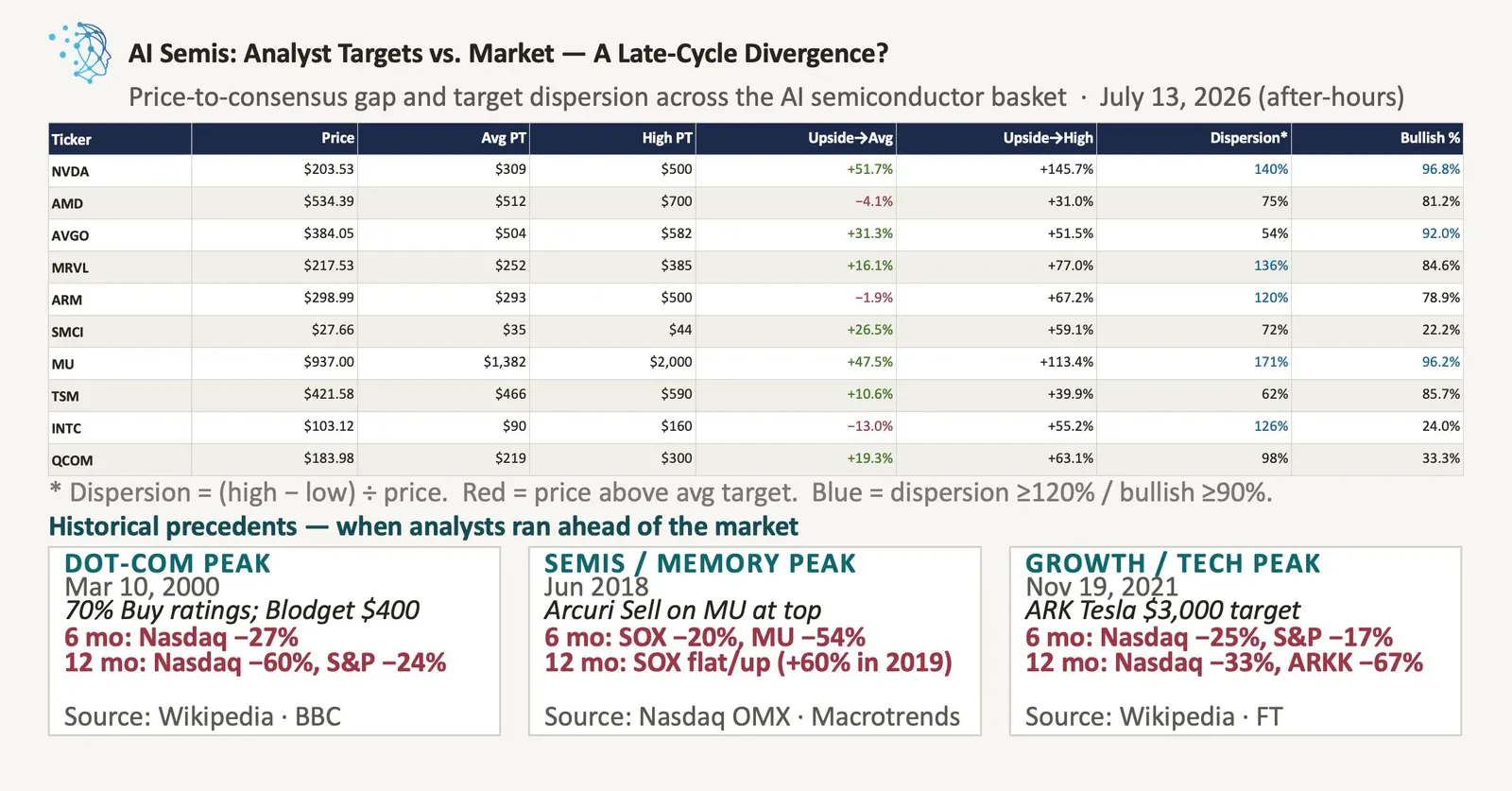
Have you noticed a disturbing trend lately in your AI stocks? As analysts continue to increase their earnings and price projections for popular AI stocks, the prices continue to decline. All in spite of massive revenue growth projections. Yahoo Finance tallies the damage as over $2.3T in the chip stocks alone since late June. But why are stocks falling while the analyst community remains bullish? Being of the curious sort, I dug into a lot of data and learned that such a divergence has happened three time in the last few decades. The results aren’t pretty. Let’s look at the factors driving this divergence.(Note that Nvidia and Qualcomm, which are included in this analysis, are clients of my firm, Cambrian-AI Research.)The Analyst See Continued StrengthLet’s start with the analysts. They aren’t basing their lofty projections on rising valuations, in fact most are using conservative valuation metrics. MU is a good example. KeyBanc’s John Vinh thinks the current memory shortages, which have been driving the stock to rise will last at least for another 18 months. After a trip to Asia, he raised his target price on Micron to $1,750 from $1,600 in a research note Monday. That would indicate an 93% increase from today’s price of $904. Mr. Vinh’s target is based on a price-to-earnings (PE) ratio of nine times his forecast for Micron’s earnings in fiscal 2027. Micron is down over 7% today, over 10% in the last week, and over 25% since June 30. Either Mr. Vinh and fellow analysts are wrong, or the market is. Analyst set their projections based on a variety of factors, but typically they project revenues and profit margins to determine likely earnings, and apply a PE ratio to yield a price. And all AI companies see nothing but blue skies ahead, with little change to the competitive landscape. So we should not be surprised to see Nvidia, MU, and many others sport attractive price targets. And the Micron example is just one of many. I compiled a list of analysts who updated their stock price targets for AI firms over the last sixty days. It’s a long list, but the table below summarizes my findings. The universe includes AI accelerators (NVDA, AMD), custom silicon/networking (AVGO, MRVL, ARM), AI servers (SMCI), memory/HBM (MU), foundry (TSM), and CPUs (INTC, QCOM)and totalled over 50 analyst projections. As you can see, the largest divergences belong to those companies that have either been on a tear (like Micron or Arm) and those who have long suffered under the bane of languishing stock price amid rising targets (I’m talking about you, Nvidia).I used various AI models to collect this data and create this summary from over 50 analyst target revisions.The AuthorFinally, I looked for historical comparisons and found 3 over the last 25 years. In two of those cases (the Dot-Com peak and the 2021 tech peak) stocks were considerably lower after six and twelve months after the peak. For the Semi/Memory peak in 2018, stocks recovered, but it took a year. Clearly, three data points should not lead to conclusions, but they give one pause.But The Market is ScaredInvestors in AI are sitting on large gains, and are constantly seeking the early sell signs to protect their gains. When will demand peak? How will competitors create inroads into the leaders’ position? Are the analysts under appreciating the potential for a competitive surprise or an innovation that way-lays the current leaders as many investors feared had happened when Deep Seek first popped its head up? Or will the flood of CAPEX reach a peak and begin to decline?Nothing grows to the sky.I think it is healthy to be a little afraid at this point, and every earnings announcement will be scrutinized to find the nuggets of worry. The TSMC earnings tomorrow could be a good example. Until the next one. Markets climb walls of worry. And there is plenty to be worried about. And there is plenty to be excited about! Every investor must decide for her/him-self which is stronger; the worry or the thrill.Disclosures: This article expresses the opinions of the author and is not to be taken as advice to purchase from or invest in the companies mentioned. My firm, Cambrian-AI Research, is fortunate to have many semiconductor firms as our clients, including Baya Systems, BrainChip, Cadence, Cerebras Systems, D-Matrix, Flex, Groq, IBM, Infleqtion, Intel, Micron, NVIDIA, Qualcomm, SImA.ai, Synopsys, Taalas, Tenstorrent, Ventana Microsystems, and scores of investors. I have long investment positions in some of the companies mentioned in this article. For more information, please visit our website at https://cambrian-AI.com.
What Is Driving The Divergence Between AI Analyst Targets And Reality
AI stock prices are surprisingly falling, despite analysts consistently raising earnings and price targets, leading to over $2.3 trillion lost in chip stocks since June.
765 words~3 min read