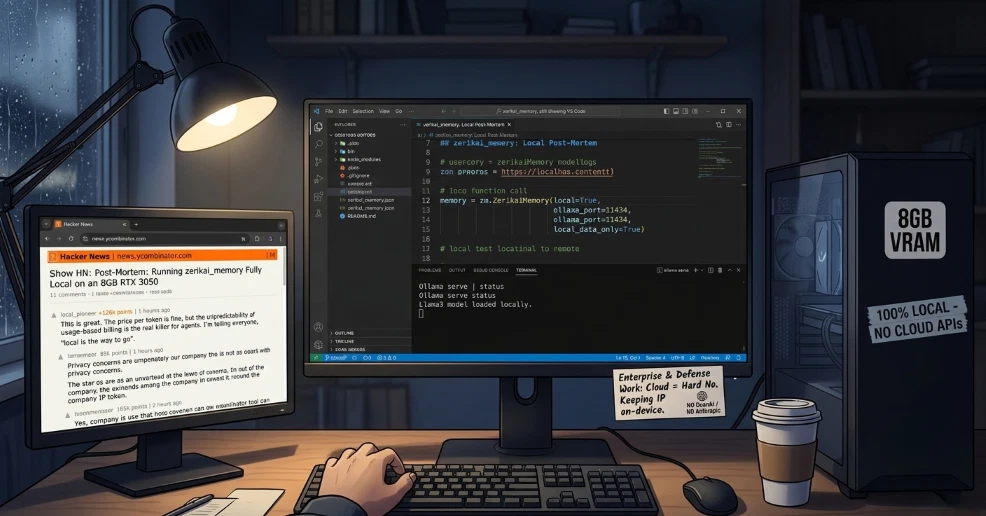
Developers are pushing back against cloud API billing and the privacy risks of sending proprietary codebases to third-party endpoints. A Hacker News thread from this year put it plainly: the problem isn't the price per token, it's the unpredictability of usage-based billing when AI agents are continuously polling APIs. On Reddit, the privacy concern is starker -- for enterprise and defense work, sending company IP to OpenAI or Anthropic is a hard no regardless of cost.
zerikai_memory has a local mode for exactly this: everything runs through Ollama, nothing leaves your machine. We shipped mistral:7b as the default local model. ornith:9b dropped in June 2026, trained specifically for agentic coding tasks, so we tested both. Here is what we found.
How zerikai_memory Uses a Local Model
zerikai_memory runs in three modes: cloud (DeepSeek), local (Ollama), and hybrid. Routing between them is handled by _should_use_cloud() at main.py:986, a 4-step priority chain: explicit override, keyword match, word count threshold, then MEMORY_MODE env var fallback. In local mode that function always returns false -- everything stays on-device.
In local mode, every synthesis call hits _query_ollama at main.py:1555. The model receives a project brief from _load_project_context plus structured ChromaDB entity payloads: function signatures, file paths, line ranges, docstrings. It returns an answer with inline #file:line citations. One call, no streaming, no tool loop.