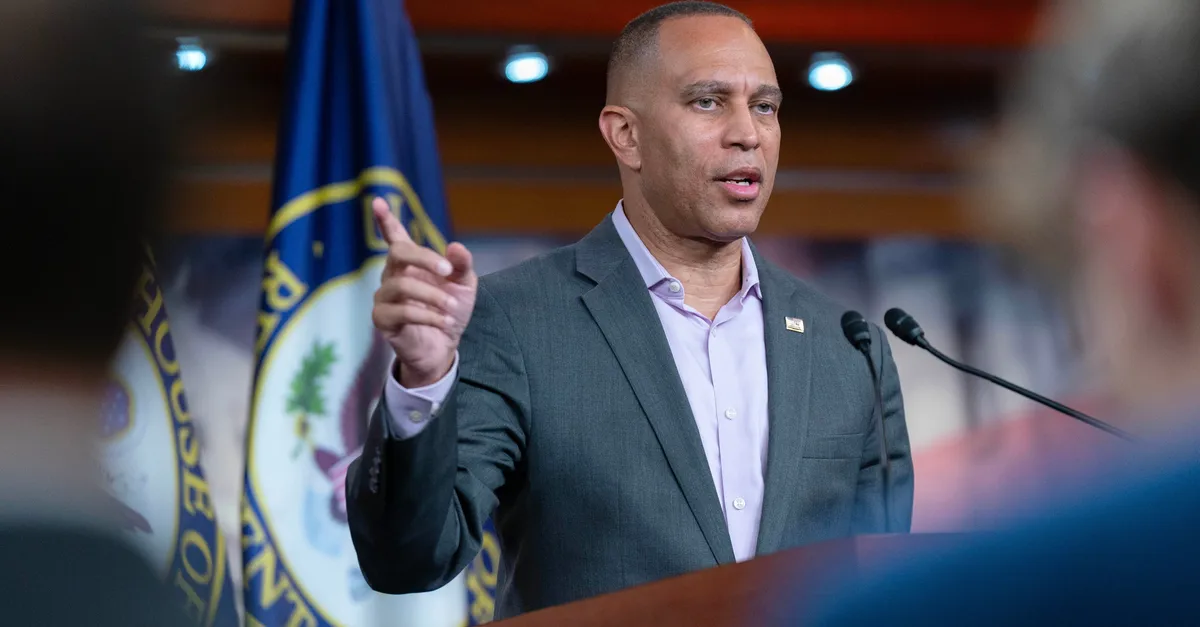
WASHINGTON — A plurality of House Democrats voted to discontinue sending military aid to Israel in a symbolic vote on Wednesday, showcasing how thoroughly much of the party has turned against the country since its brutal assault on Gaza began nearly three years ago. The House ultimately rejected the amendment to discontinue aid by a vote of 314–104, with 103 Democrats in favor, 98 against and 10 voting “present.” Even if the measure had passed the House, it would have stood little chance of approval by the Senate. Still, the vote is a rebuke of Israel’s government, led by Prime Minister Benjamin Netanyahu, and a signal support for the country may no longer be an unquestioned bipartisan proposition. Israel’s assault on Gaza in the aftermath of Hamas’ Oct. 7, 2023, attack on Israel has killed more than 81,000 people and been labeled a genocide by most major human rights organizations. The vote was on an amendment by Rep. Thomas Massie (R-Ky.) that would bar aid to Israel, including nonmilitary aid, meaning it went farther than some past proposals to bar only weapons. Massie was the only Republican who voted yes. In the lead-up to the vote, Democrats put out an unusual number of advance statements justifying their positions, with party leaders seemingly engaged in a balancing act. House Democratic leader Hakeem Jeffries (D-N.Y.) came out against the amendment this week, but sought to strike a middle ground by not telling Democrats to vote one way or another. Rep. Katherine Clark (D-Mass.), the No. 2 House Democrat, said before the vote she’d be a yes, as did former House Speaker Nancy Pelosi (D-Calif.).Jeffries said Republican leaders had only allowed the House to vote on the amendment, which they did not support, in order to divide Democrats, whom he said should remain committed to Israel, but not necessarily its current prime minister. “The far-right Netanyahu government has isolated Israel from much of the world, severely damaged its standing in the U.S., jeopardized normalization efforts in the region and repeatedly undermined prospects for peace,” Jeffries wrote. Some Democrats struggled with how to vote. Rep. Richard Neal (D-Mass.) said he was still undecided as he walked from his office to the House chamber. “The problem is with a lot of amendments, they’re yes or no,” Neal told HuffPost. He wound up voting yes. Sen. Bernie Sanders (I-Vt.), the progressive whose own proposals curtailing military aid to Israel have garnered more and more Democratic “yes” votes in recent years, said Democrats are simply responding to the electorate. “I think the polling is very clear. The overwhelming majority of Democrats, I think it’s about 75%, believe that we should not be providing military aid to a country which has committed genocide in Gaza, which helped get us into this terrible war in Iran, and I think maybe a third of the Republicans feel the same way,” Sanders told HuffPost. “So there’s overwhelming, I think, opposition on the part of the American people to continue military aid to Israel when we have so many pressing needs in this country that should be addressed.”A New York Times/Siena College poll in May showcased how unpopular aid to Israel has become: Just 37% of registered voters support sending aid to the country, while 47% oppose it. Voters are now equally split in their sympathies for Israel and Palestinians: Thirty-five percent sympathize with Israel more, 37% sympathize with the Palestinians more and 15% sympathize with both equally.Among Democrats, a mere 25% support sending military and economic aid, while 68% are opposed. Independents were similarly against sending more money to the Jewish state, with just 28% supporting it and 68% opposed. Among voters who support Democrats, 48% said the party had been too supportive of Israel, while a mere 8% said the party was insufficiently supportive and 34% said the party had the right approach. Still, the vote is considered a political risk for some Democrats. The American Israel Public Affairs Committee has shown a willingness to spend tens of millions of dollars in primaries to defeat candidates who support anything short of unquestioned military aid for the country.Rep. Mary Gay Scanlon (D-Pa.) said the shift in Democratic support for aiding Israel isn’t strictly a result of domestic politics. “I think one could look to the conduct of the Israeli government to see that there’s been a shift,” Scanlon told HuffPost.
More than 100 Democrats Vote Against Aid To Israel In Big Symbolic Vote
The proposal won’t become law, but it signals an ongoing shift in Democratic support for Israel.
729 words~3 min read