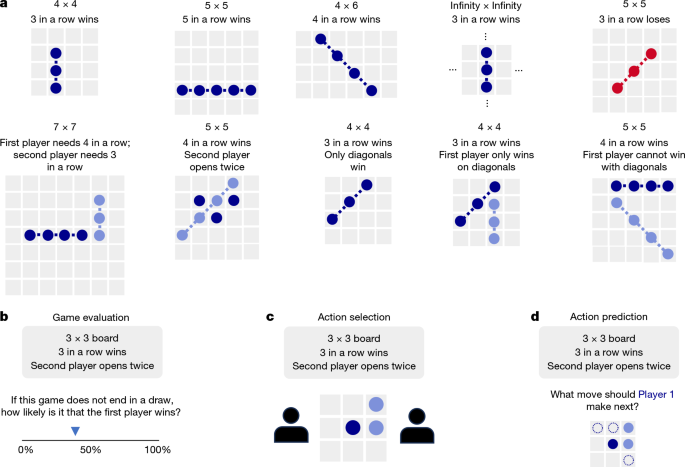
MainGames occupy a special space in psychology and and computer science1,2,3,4,6,7,8,9,10,11,12 for good reason: games are systems of rules and reward that hold a mirror to the structures, patterns and challenges that reality confronts us with, across familiar and merely possible experiences. Mancala lets us sow and capture abstract resources. Chess lets us strategize over bloodless battlefields. Go lets us encircle and claim territories with silent stone troops. A good game lets us thrill to uncertainties and losses that we might shy from in real life.Substantial work in cognitive science focuses on the nature and development of expertise, using games as a testbed3,6,13. Human experts, correspondingly, have long served as goalposts in the quest to build intelligent machines, with a particular focus on emulating and ultimately beating humans at their own games, using more game-playing data and raw computational horsepower than any human expert could acquire in their lifetime2,4,14,15.But people are not experts at most of the problems they encounter throughout their lives, or most systems they are thrown into before they need to decide on an action. Human cognition is flexible enough to consider many potential problems and many potential systems of rule and reward. Thinking about whether a system of rules and reward makes sense, whether to participate, or what actions to take first—across a wide range of novel situations—is arguably at least as important for everyday human cognition (if far less studied) than the cognitive processes that lead a small number of humans to become expert players in any one game.Here we study the abilities of novice game reasoners across a range of over 100 novel games from a subclass of strategic grid-based board games that are not entirely unlike games they have probably seen before (for example, Tic-Tac-Toe or Connect-4), but vary in their rules and underlying dynamics (see examples in Fig. 1a and Extended Data Table 1). In a series of large-scale behavioural studies, each with hundreds of participants, we assess people’s thinking about novel games in three reasoning settings (Fig. 1b–d): game evaluation (determining how rewarding a game is likely to be before playing); action selection (choosing moves when playing for the first time, with another first-time player); and action prediction (judging the likelihood of moves other first-time players might make without having played directly themselves). Our setting is different from much previous work on games, which usually focuses on one or a small set of games and many rounds of play in that game; here, we consider many games and little (or even no) experience.Fig. 1: Our novel game dataset and suite of game tasks.a, Ten example games from our 121 game dataset. Games vary in board sizes and rules, such as what it takes to win and how many pieces any player can place on their opening move. b–d, We assess people’s reasoning about novel games through three behavioural studies designed to test: how people reason about games before they even play a single game (b); how people decide what actions to make in their first instance of play (c); and how people predict others should play when watching them play (d).Our core contribution is a computational account of how people reason about these novel problems. Expert models of gameplay typically involve deep tree search with potentially thousands of evaluations of possible states (Fig. 2a). It seems unlikely that a novice reasoner is engaging in such intensive search and evaluation before they have extensive—or any—experience. But neither are people likely to be completely unsystematic. We hypothesize that novice thinking occupies a valuable intermediate point between these extremes (Fig. 2b): people are non-random in assessing new problems and run computations analogous to those that underlie state-of-the-art artificial intelligence (AI) game systems and cognitive models of expert human gameplay4,6,14—but scaled down to a level that is more realistic for everyday thought.Fig. 2: The Intuitive Gamer model compared with previous models of game reasoning.a, Previous work modelling expert gameplay often involves deep tree search to determine what move to make, given a board state St (refs. 4,6). It is unlikely that novice human reasoners conduct such computationally expensive search and state evaluation before deciding whether to engage with the problem at all. b, We consider what novice reasoners might be doing instead. Gameplay agents can differ in the amount of compute and expertise brought to bear to reason about any game (differing in search depth and value sophistication). Our proposal is that people reasoning about problems with which they have no experience sit at the lower end of this spectrum, but not the lowest. c, The Intuitive Gamer conducts depth-limited (‘flat’) search with game-general abstract goal-directed value functions that have yet to encode game-specific features. The Intuitive Gamer gameplay agent conducts no more than a single step of lookahead when deciding what action (At+1) to take from a given board state (St) at a given move turn t. The Intuitive Gamer is goal-directed, assessing whether any action would advance the player’s own goal (purple) and how much it might block the progress of the opponent’s goal (yellow). The final action is selected probabilistically by sampling from a softmax distribution over the estimated values per action. d, To reason about any new game query ψ for a given game description G, we posit that people conduct only a few (k) self-play simulations between the gameplay agent (as depicted in c) to answer the query, which could be run to termination or probabilistically stop early. In summary, the Intuitive Gamer model is fast (low k), flat (low search depth), goal-directed (in the value function) and probabilistic (in action selection), and involves mental simulations of gameplay. See Methods for a detailed formalism of the model.We instantiate and test this hypothesis in an Intuitive Gamer model that makes judgements and decisions by running mental simulations of gameplay that are (1) fast, (2) flat, (3) goal-directed and (4) probabilistic. The Intuitive Gamer model accounts very well—and significantly better than alternative models—for how people evaluate these games before play. Features computed from the same model can capture people’s judgements about the game’s objective value, as well as more subjective evaluations such as a game’s expected ‘funness’. Action choices simulated by this same model generally capture how novices actually play in games and how they make predictions about unfolding games they have never played themselves.The Intuitive Gamer modelThe capacity to evaluate properties of a new game and decide whether the game is worth engaging with might intuitively feel like it comes before developing a policy for actually playing the game. However, our intuition as modellers is the opposite: game properties such as expected values depend on both the rule specifications of a game and the policies adopted by the players. We hypothesize that this could be true for novice human game reasoners—before taking a single action in the game—if their policies are extremely simple to construct, fast to execute and support probabilistic sampling of reasonable action choices. If so, a policy can be queried just a small number of times to simulate gameplay, from which the game reasoner can draw reasonable inferences about the game’s properties using these simulated traces.We instantiate this hypothesis with our Intuitive Gamer model. The model consists of two modules: a ‘flat’ game-playing agent, which runs an extremely depth-limited search to select actions probabilistically on the basis of abstract yet locally evaluable ‘goal-directed’ heuristic functions (Fig. 2c); and a ‘fast’ game reasoner that makes probabilistic inferences about game propositions and their expected values using a small number of simulated games (Fig. 2d).Player moduleA long tradition of modelling human behaviour in games has used some combination of game-state evaluation functions and search over the decision tree of game states16,17, as depicted in Fig. 2b, to construct a policy. Our approach broadly falls into this tradition. However, existing accounts typically assume highly tuned or expert-designed value functions and deep simulation2,6,14,18, which by definition cannot be expected of a novice. Rather, we propose a model that combines a general-purpose abstract value function—which could be easily constructed from understanding the rules of the game—with depth-limited search. Instead of simulating the downstream effects of a move via extensive forward search, the Intuitive Gamer player module uses only a single step of ‘look-ahead’ and selects an action probabilistically by evaluating the resulting board states according to a small collection of general heuristics (Fig. 2c). These heuristics are built on the assumption that players understand and pursue their goals (as defined by the game rules) and attempt to prevent their opponents from doing the same, subject to constraints on computational resources19,20. The Intuitive Gamer player module then is a more general, compute-bounded version of prior game-based agents (Methods).Reasoning moduleWhereas the Intuitive Gamer player model captures action choice during a game, the Intuitive Gamer reasoning module captures judgements about game properties by nesting the player module within a sample-based probabilistic inference procedure (Fig. 2d). For any game, the reasoning module infers answers to a query (for example, what is the likelihood that the game will end in a win, loss or draw for a given player?) by simulating k game playouts and iteratively calling the player module at each turn of self-play. Each simulation ends when the game reaches a win or draw state, or may terminate early with some probability. Computations over the simulated gameplay traces then inform the resulting distribution over the query values (for example, game outcomes). We assume simulated games are independent, though this could be relaxed in the future (see ‘Discussion’). In keeping with our focus on fast, resource-limited reasoning, only a small number of game simulations are used (which we estimated empirically, see results and Methods) in line with previous evidence that people use a relatively small number of simulations to form beliefs and make decisions21,22,23,24,25,26.Alternative modelsOur Intuitive Gamer framework naturally extends to model players with more or less competence and motivation. We can think of the Intuitive Gamer as operating under the same mechanisms as more expert models, but scaled down (offering, therefore, a path to scale back up). We can vary parameters in our framework (value function and search depth) to instantiate a version of the kind of cognitive models that have been successful at capturing human experts in a single ‘four-in-a-row’ game6. We refer to this variant as the ‘Expert Gamer’, which differs from the Intuitive Gamer by conducting a deeper search (approximately depth-5) and using a more sophisticated value function (Methods). On the other end of the spectrum, we consider unmotivated players who select actions uniformly at random (Fig. 2b), which we refer to as the ‘Random Gamer’. We also compare reasoning judgements to Monte Carlo tree search (MCTS)4,27,28, an alternative tree-search approach that is even more computationally intensive and popular in AI systems for strong general game playing (see Methods for contrast with our Intuitive Gamer and other cognitive models). Finally, we compare against models that do not involve explicit structured game simulation, operating either over pre-computed linguistic features from the game description alone (Methods and Supplementary Information section 5) or more flexible linguistic computable models, for example, language models (Supplementary Information section 5).Resource-rational reasoningThe Intuitive Gamer occupies an interesting point on the Pareto frontier of compute efficiency and game reasoning sophistication. On the one hand, the Intuitive Gamer is orders of magnitude faster than more sophisticated game reasoners (MCTS and the Expert Gamer) in wall clock time and number of board states evaluated (Extended Data Table 2a and Supplementary Information). The Intuitive Gamer is approximately 700× faster than the Expert Gamer in wall clock time, with approximately 500× fewer board evaluations, and is nearly 40,000× faster than MCTS, with almost 10,000× fewer node evaluations, as computed under self-play game simulations for the respective models. On the other hand, although not as close to game-theoretic optimal play as the Expert Gamer or MCTS, game evaluations under the Intuitive Gamer are still well-correlated with game-theoretic optimal analyses and far more aligned with game-theoretic optimal play than random play (Extended Data Table 2b and Methods). The Intuitive Gamer’s mechanisms of fast, flat goal-directed probabilistic simulation thus constitute a highly efficient and resource-rational approach to game reasoning, which we hypothesize people could plausibly and productively engage when encountering new games.Games to study novice game reasoningTo explore how people reason about new games within the bounds of a behavioural study, we need a broad collection of games that are novel without requiring lengthy demonstrations or explanations. To that end, we implement a range of two-player, grid-based strategy games derived from classic M–N–K games (examples include tic-tac-toe and gomoku, in which players take turns placing pieces on an M × N grid trying to make K pieces in a row—a subgenre of games frequently studied in previous work6,29,30). Our set of 121 distinct games covers a variety of environment specifications (for example, the size and shape of the board), transition dynamics (for example, the number of moves a player makes on their turn) and win conditions (for example, whether completing a line results in a win or a loss). In addition, games vary in their duration and balance under optimal play (Methods). In each case, however, the core mechanic of the game (that is, placing a piece into an empty grid cell) remains both consistent and familiar. See examples in Fig. 1a and Extended Data Table 1.Reasoning about games before any playWe first assess how people evaluate a game (Fig. 1b), from ‘just thinking’ about the game alone—before any play. We consider two kinds of game evaluation: how people assess the expected outcomes of a game and a more subjective assessment of whether the game is likely to be engaging to play (its funness).Is the game likely to be fair?We recruited 238 participants to evaluate the expected outcomes of the game in a ‘zero-shot, zero-experience’ experiment. Participants ‘just thought’ about the games, estimating both the likelihood of a draw and the likelihood that the first player would win if the game did not end in a draw for games solely on the basis of a natural language description of the rules and a depiction of a blank board. These estimates define an expected payoff of the game from the perspective of the first player (Methods), which in turn encodes an intuitive notion of fairness (that is, whether a game is biased towards a particular player).We assessed how each characteristic of the Intuitive Gamer model (fastness, flatness, goal-directedness and probabilistic simulation) contributes to people’s payoff predictions by comparing with alternative models that increase or decrease the sophistication of each component (Fig. 3a). The Intuitive Gamer model correlates well with human estimates (R2 = 0.81 (95% confidence interval (CI), 0.77, 0.85)), matching the total explainable variance from the human data as estimated by split-half correlations (R2 = 0.82 (95% CI, 0.77, 0.86)). The Intuitive Gamer captures human judgements significantly better than alternative models that vary in sophistication. It outperforms the Random Gamer model (R2 = 0.47 (95% CI, 0.41, 0.54)), Expert Gamer model (R2 = 0.65 (95% CI, 0.60, 0.70)), MCTS baseline (R2 = 0.60 (95% CI, 0.55, 0.64)) and a variant of the Intuitive Gamer that is not probabilistic (R2 = 0.53 (95% CI, 0.48, 0.57)).Fig. 3: Evaluating games without ever playing.A total of 238 participants judged the expected payoff of games drawn from our 121-game suite. a, Expected payoff predicted by humans and by alternative models for each game. Each point represents the payoff for one of the n = 121 game stimuli. Error bars show 95% CIs around the mean human estimate and the mean model prediction from k = 6 simulations sampled from 20 simulated participants. b, Variance explained (R2) by the full Intuitive Gamer and lesioned variants. Removing flatness, probabilistic simulation or goal-directedness reduces the fit to human payoff judgements. The dashed line indicates the mean and 95% CI split-half R2 on the human-predicted payoffs, indicating that the full Intuitive Gamer model captures essentially all of the explainable variance that is not due to noise. c, Fit to the variance of human payoff judgements as a function of the number of simulations k. A small number of simulations (k ≈ 5–7; we use k = 6) best captures the variability in participants’ judgements. Fit is measured by the root mean squared error (RMSE) between human and model variance by game and by Wasserstein distance between their variance distributions across games. Full scatterplots are shown in Extended Data Fig. 1, and details of our sample complexity analysis are in the Methods. d, Expected payoff predicted by humans and by game-theoretic optimal analysis for the 78 games (out of 121 games) for which an optimal payoff could be computed. Error bars depict 95% CIs around the bootstrapped mean human prediction per game.To more directly probe each component of the Intuitive Gamer model, we conducted a series of experiments in which we varied key model components singly and in combination (see Supplementary Information section 1 for a complete summary). The base model can be parameterized by a series of binary choices: whether to be goal-directed in value assessments; whether to be probabilistic; and whether to be flat. Modifying any of these factors relative to the full model impairs the fit to human payoff judgements (Fig. 3b). ‘Fastness’ can be further varied by modulating the number of simulations the Intuitive Gamer reasoning module takes when assessing payoff. A small number of simulations (k more than one, but less than ten) best captures the variance in human prediction (Fig. 3c and Extended Data Fig. 1; see complexity analysis details in Methods). These comparisons suggest that human payoff judgements of novel games are well-modelled by efficient and compute-limited simulation rather than purely random exploration of game states or deeper search and computationally intensive simulation. For simplicity, this estimate assumes that all simulations are independent and run to the end of the game; allowing simulations to probabilistically terminate early (Methods) yields similar fits in the expected payoff evaluations and number of mental simulations per participant (Extended Data Fig. 2).We were able to estimate the optimal game-theoretic payoff for many (78 of 121; Methods) of the games, allowing us to compare people’s subjective judgements with a fully objective game evaluation. Human judgements are reasonable relative to the game-theoretic optimal (R2 = 0.62 (95% CI, 0.57, 0.67)). Although human judgements generally track the direction of the game-theoretic optimal (for example, estimating a payoff greater than zero when the first player should definitely win), the Intuitive Gamer provides a superior qualitative and quantitative fit to human judgements.Is the game likely to be fun?We ran a parallel ‘zero-shot zero-experience’ study as described above on a new group of 246 participants who were asked to make a subjective estimate of how fun a game is likely to be, before ever playing, to test whether the Intuitive Gamer’s reasoning process can also account for how people make more subjective evaluations about new problems. Games varied widely in their judged funness (Fig. 4a and Supplementary Information section 8), and funness judgements generally varied more across individuals than judgements of expected payoff, which is reasonable given that funness is both more vague and a more subjective evaluation. Games that were judged most fun tended to have larger boards (often 10 × 10) and win conditions connecting a moderate number of pieces in a row (often 4 or 5), but there is no simple relation between these features and funness: many 10 × 10 games were judged below average (Extended Data Fig. 3b), and the single most fun game was a 5 × 5 board with a misère rule, where 3 in a row loses.Fig. 4: Evaluating whether games are likely to be fun before ever playing them.A total of 246 participants judged whether they thought the games would be fun. a, Representative games rated by people as more or less fun, with position on the spectrum arranged approximately according to the mean of participants’ funness ratings. b–d, These funness ratings are related to several game features that can be read out under Intuitive Gamer model simulations: game balance (b); predicted advantage over a random agent given the Intuitive Gamer model’s gameplay (reward for thinking; c); and expected game length, as fit with a quadratic term to account for a nonlinear relationship to funness (d). e, A regression model with all features predicted under the Intuitive Gamer model (balance, reward for thinking, and length) captures much of the explainable variance in the human funness ratings (R2 = 0.57 (95% CI, 0.51, 0.63) compared with split-half R2 = 0.60 (95% CI, 0.51, 0.68)). Error bars depict 95% CIs around the human mean funness per game; error bars for the model depict 95% CI over the predicted mean for each of the fit models (models are fit to each bootstrap subsample). Black circles show games from a, highlighting that funness judgements under the Intuitive Gamer generally align with the ordering of funness of games judged by people. A full listing of the games and their average human funness scores are in Supplementary Information section 8.We hypothesized that several features of a game that can be read off easily from our model’s fast and flat probabilistic simulations—how balanced a game is, how much a game rewards thinking, and how long a game is—could quantitatively explain much (or even most) of the variance in people’s funness judgements. Our measure of balance captures the notion that people prefer games they expect will be decisive (unlikely to end in a draw), where both players have an equal chance to win. Our thinking reward captures the relative advantage of playing strategically (‘thinking’) versus moving haphazardly (‘without thinking’). The effect of game length is modelled as an inverted U-shape of expected number of moves to a draw or win, reflecting the intuition that longer and more involved games tend to be more fun, unless they extend unnecessarily. (For details of how these game features are computed, see Methods.)Each of these three features computed under the Intuitive Gamer model captures significant variance in human funness judgements (Fig. 4b–d and Extended Data Fig. 4a,b). A simple regression model that combines these features (including a quadratic game length term) attains R2 = 0.57 (95% CI: 0.51, 0.63) (Fig. 4e), which approaches the total variance explainable in the human data based on bootstrapped split-half R2 from participants over all games (R2 = 0.60 (95% CI: 0.51, 0.68)). This model also quantitatively explains the qualitative trends we observed in funness judgements, capturing the nonlinear relation between funness, board size and the number K in a row to win (Extended Data Fig. 3).Finally, a generalization test (Methods) showed that these fits are not sensitive to the choice of games, and that game features estimated from Intuitive Gamer simulations predict funness judgements better than those from the Random or Expert Gamer models, using more or fewer compute resources (depth of thinking), or models that relied exclusively on surface-level game features (Extended Data Fig. 4c and Supplementary Information section 5.7).Taken together, these two experiments in which participants ‘just think’ to rate both objective measures of a game (for example, its payoff or fairness) and more subjective evaluations (for example, its enjoyability) lend support to our hypothesis that these kinds of novice judgements are best captured by a reasoning module that is goal-directed but limited in its computational cost (that is, fast and flat) compared with alternatives that vary in terms of computational demands and game reasoning sophistication.Decision-making in first-time gameplayRelative to the flat, single-step thinking that our Intuitive Gamer model posits people use to evaluate new games, conventional models of how people actually play games6 perform much deeper tree search, simulating multiple future turns by both players to evaluate potential moves before choosing the best move at each step of a game. But these models have been evaluated only on players who are either experts in a game or have at least played a game many times. Here, we consider what human players do when they are playing a game for the very first time. That is, we ask whether they search deeply, as previous models might suggest, or whether they use only a fast and flat decision mechanism, as our Intuitive Gamer model does—and as our results suggest they do when merely imagining how a game might unfold before playing it.What moves do people make?To test whether the Intuitive Gamer player module captures how people actually play a game for the first time, we recruited 302 participants to play each other in a subset of 40 of the 121 game variations, plus tic-tac-toe (Fig. 1c). Each participant played only a single round of any given game.Initial evidence that the Intuitive Gamer model captures not only how people think about new games but also how they play them for the first time comes from comparing the distribution of actual game outcomes (first player win, second player win or draw) in this gameplay experiment with the outcome distributions to be expected if both players make move decisions according to the model. The model captures most of the variance in actual game payoffs with novice players (R2 = 0.72 (95% CI: 0.67, 0.76)) and predicts these payoffs as well as human estimates of expected game payoffs do, from our earlier game evaluation experiment (Extended Data Fig. 5).A more direct test is to compare predicted move choices that the Intuitive Gamer model makes at each turn of each game with the actual moves that new players made at the same game steps when they were playing these games for the first time. Because there is a strong element of randomness in people’s move choices as well as the model’s predictions, we evaluated the likelihood of people’s moves under the Intuitive Gamer relative to alternative models that are either more or less sophisticated and computationally intensive, the Expert Gamer and Random Gamer models from our previous study, respectively (Fig. 5a). The Intuitive Gamer model best predicts players’ moves in aggregate, as measured either by average per-move log likelihoods or per-match log likelihoods (summed over all moves within a match), across 1,808 distinct matches with a total of 9,892 moves. All of these differences are highly significant as measured by paired t-tests (mean differences in total per-match log likelihood for the Intuitive Gamer versus Expert model = 2.83, t1807 = 29.4, P < 0.001; versus Random model = 3.73, t1807 = 26.4, P < 0.001; mean differences in per-move log likelihood for the Intuitive Gamer versus Expert model = 0.51, t9891 = 39.9, P < 0.001; versus Random model = 0.68, t9891 = 42.3, P < 0.001).Fig. 5: Modelling people’s actions and distribution over predicted actions in the first encounter with a new game.a, The average log-likelihood of human moves under three variants of the game player module. Data come from 302 participants playing a single round each of 5 novel games (along with tic-tac-toe); across participants, 40 of our novel games were tested. The Intuitive Gamer model captures players’ moves significantly better than alternatives. Error bars depict 95% bootstrapped CIs. b, The estimated contribution of each model in a probabilistic mixture (admixture model; Methods) fit to participants’ moves for each game. The Intuitive Gamer model is the component that best explains participants’ moves in approximately 90% of games (37 of 41); games in which people would not be novices (tic-tac-toe) or some particularly atypical games (for example, misère games, where the first person to get K in a row loses, listed with an ‘L’ as in ‘7 × 7 4 L’) are comparatively less well captured by the Intuitive Gamer compared with alternative models. Game descriptions are lemmatized to show board size (for example, 7 × 7) and key features (for example, HV indicates only horizontal and vertical wins are allowed; P2 2p means player 2 can move twice on their first turn; the number after board size indicates the number in a row needed to win). A full description of lemmatized game codes are in Methods. c, TVD (lower is better) between human and model-predicted distributions over next moves for the same three models. Judgements come from a new group of 314 participants who estimated where a participant should move next in frozen videos from the gameplay experiment. The dashed line is the split-half human TVD (effectively the noise ceiling). d, Mean TVD by game. The Intuitive Gamer generally best matches human judgement distributions, with similar failures to the play data (for example, for misère games). Error bars depict standard deviation over boards for each game. e, Decisions of whether to accept or reject a draw when requested are captured by the expected value of the player’s current position, but participants tend to be willing to reject a draw and play out a game with a slightly lower expected value if the game is judged to be fun.We also fit these three models of action choice to the distribution of all moves people made in each individual game and the distribution of all moves an individual player made across the different games they played using probabilistic (admixture) models (Supplementary Information). At a per-game level, the Intuitive Gamer model generally, but not always, fits human play better than the Expert or Random models: it captures more than 50% of the probability distribution of moves in 32 out of 41 games, and a plurality of moves in 5 of the remaining games (Fig. 5b). Individual player’s distributions of moves are also best fit by the Intuitive Gamer: it captures more than 50% of the probability distribution of moves for 243 out of 302 players, and a plurality of moves in 16 of the remaining players (Extended Data Fig. 6).Post hoc exploratory analyses into intermediate stages of gameplay suggest that the Intuitive Gamer model best fits early and mid-stage play, although in later-stage play, greater depth variants are more comparable (Supplementary Information). This could be due to some people being more motivated to think more deeply at the end of the game or finding it easier to think more deeply with a smaller space of moves to consider (as there are fewer legal moves at the end of the game).In addition, as in the game evaluation experiments, both aspects of goal-directedness in the Intuitive Gamer value function (offensive progress towards your goal and defensive assessment of how to block your opponent’s progress) matter for capturing human behaviour in novel games (Extended Data Fig. 7). Overall, our results support the hypothesis that when playing a novel game for the first time, people adopt a similar fast, flat and goal-directed approach to choosing their next move as they appear to do in mentally simulating games before they start to play.What move should someone else make?In the previous experiment, as in almost all studies of gameplay, participants made only a single choice for each move, and they played each game only once. Yet our model posits that people think about new problems by running probabilistic mental simulations, letting them form graded expectations about the value of a range of possible actions. To assess how well the Intuitive Gamer player module captures people’s probabilistic expectations, we recruited a new group of participants to predict distributions of likely actions when watching videos of other novices playing these games (Methods and Fig. 1d).The Intuitive Gamer model generally better captures the distribution of moves predicted by people compared with alternative models across the 249 game boards for each match and game stage, as measured by the total variance distance (TVD) between model and people’s predicted distribution, and is near the expected noise ceiling (computed via split-half) human judgements for most game boards (Fig. 5c). Differences in distance (where lower means closer to people’s predicted action distribution) are highly statistically significant as measured by paired t-tests in the TVD per game board for the Intuitive Gamer versus Expert model = −0.15, t248 = −15.0, P < 0.001 and versus Random model = −0.09, t248 = −7.5, P < 0.001. Exceptions for poor fits align with those found in the play experiments (for example, on misère games; see Fig. 5d and example boards in Fig. 6). Fits are robust to choice of distributional measure (Supplementary Information). People assign similar log probability on the move actually played by the human player to that of the Intuitive Gamer, further highlighting alignment of the Intuitive Gamer to people’s probabilistic judgements (Supplementary Information).Fig. 6: Example human- and model-predicted distributions over the next action in real games.a–j, Each panel shows a representative state taken from a different game between two human players, along with the actual move one player took at the next step and the predictions made by other humans and two models for how that move should have been made. Filled black and white circles show the moves both players took prior to this point in the game. The one open circle on each board indicates where the human participant whose turn it was on this move (white or black) actually played. The top, middle and bottom boards show the predicted next-move distributions from human participants in the watch-and-predict study, the Intuitive Gamer and the Expert Gamer, respectively. The purple shading gives the predicted probability of choosing each empty square. Humans often distribute probability over several plausible moves (a–e), although sometimes they strongly favour a single move (f,g); the Intuitive Gamer often captures this pattern. The Expert Gamer model fits human predictions less well, in some cases because it allocates high probability to a small set of high-utility moves that are often counter-intuitive to naive players (a–c,e); and in other cases by allocating diffuse probability across many states when deep search indicates a sure loss under perfect play (d,f). The Intuitive Gamer does not always fit best: the Expert Gamer can sometimes better match human confidence (g), and the Intuitive Gamer can be too sharp in its predictions (h). In some cases, both models are sharper than humans, including crowded boards where people may miss a winning or blocking move (i) and misère variants (j). The full set of predictions (for 249 moves across 41 distinct games) is included in Supplementary Information.When is a game worth continuing?Game evaluation is important not only when deciding whether a game is worth playing but also for assessing—during play—whether a game is worth continuing to engage with. In our gameplay study, participants had the option to request a draw at any point in play. If they received a draw request from another player, they had the choice of whether to accept the draw and immediately terminate play or reject the draw and keep playing. Over the 1,808 matches participants played, players made 142 draw requests, of which 83 were accepted and 59 were rejected. We next considered how people decide whether or not to keep playing when they receive a draw request.We modelled these choices as probabilistic value-based decisions trading off a player’s expected reward of winning with the expected cost of continuing to play, both of which can be computed under the Intuitive Gamer reasoning module conditioning on the current board state (rather than a blank opening board, as in our earlier game evaluation studies; Methods). In exploratory analyses, we also hypothesized that a player might be willing to keep playing a game even if the expected cost of continuing outweighs the potential objective monetary reward, if playing provides an alternative subjective reward, for example, if it is likely to be fun. A logistic regression model fit to participants’ draw request decisions using these three features (Methods) captures the intuition that players’ game-time evaluations are probabilistically rational under limited resources (time) and sensitive to subjective factors such as the engagement of games in addition to their objective value (Fig. 5e). Ablations of the Intuitive Gamer evaluation function lead to significantly worse qualitative and quantitative fits to human draw request choices (Extended Data Fig. 8a,b).DiscussionSystems of rules and rewards govern many aspects of human behaviour—from jobs and institutions to games and geopolitics. A core question is, how can people think reasonably about any such system or problem for the first time, so flexibly and quickly? We formalized and empirically evaluated a computational model of an Intuitive Gamer, which draws on fast and flat goal-directed probabilistic mental simulations to make rich quantitative predictions about how novice players judge the objective value of a previously unseen game, as well as to make more subjective evaluations. Our model also captures how people act within these games, and does so better than alternative models with more and less computational power. The same model generalizes across these different tasks and the many different games we study.Our work differs from most previous studies of gameplay in cognitive science and AI, which focus on how expert play is achieved, and typically consider only expertise in a single game. By contrast, we study a class of 121 strategic games with varying dynamics and highlight the phase of ‘pre-expertise’: the critical first moments before people can rely on the benefits of repeated experience, but when they must nonetheless take reasonable actions and even decide whether to play at all—or to continue playing. Studying pre-expertise across varied domains is important not just for our understanding of cognition generally, but also to construct more accurate models of human behaviour in game theory under novel economic mechanisms31,32 or alongside unfamiliar agents such as AI systems33,34. The Intuitive Gamer approach could inform the design of more efficient AI systems that make reasonable judgements in new multi-agent settings despite using much less compute than conventional expert-level models.Our work also differs from prior studies of funness in games, which have focused on identifying factors that lead people to experience a game as fun. By contrast, we have focused on modelling the intuitive theories people have about how they would expect to experience a game as fun, before playing it for the first time. Features identified in the previous literature, such as strategic depth35 and competence36 reflecting the need for challenge, or learning progress37 and thinking progress38, do align with those in our model, especially the reward for thinking component. Future work could study whether other aspects of motivation identified in previous gaming literature—autonomy, social connectedness, immersion and ease of control36—also contribute to people’s intuitions about funness, and whether these could also be modelled using a generalization of our Intuitive Gamer model.As a model of human reasoning, our work at present is limited to a subset of perfect information, two-player competitive board games, and these games reflect novelty within a genre that many people are familiar with rather than completely novel experience. It is an open question how the heuristics our model uses could generalize to more complex games in the same class, such as Go or chess, and to entirely new classes of games. Many extensions are possible, such as generalizing the contiguous-line features that we consider towards connectivity or territory metrics that reflect partial or graded progress towards a game’s win conditions. Natural language could be used to suggest short programs expressing such heuristics, as in verifiable code-based rewards in reinforcement learning39. Although we hypothesize that key features of the Intuitive Gamer reasoning module—being fast, with a few probabilistic simulations of play, where play is assumed to involve goal-directed agents—would extend to other game classes, it is an open question how ‘flat’ reasoning might be and what more general heuristics might capture intuitive reasoning in the wider range of games that characterize human social life. Understanding peoples’ general game reasoning on a wider class of games beyond competitive settings, for example, cooperative or multi-agent contexts, is necessary to move towards a general model of people’s ‘intuitive theory of games’, analogous to the computational models of intuitive theories of physics or intuitive theories of mind that cognitive scientists have constructed40,41.In addition, there is a need for more fine-grained process-level and individual-level accounts of how people reason about novel games. More work should study how people judge the expected outcome of a game if they stop imagining play before reaching a win or draw, if their simulations are temporally dependent, or when they do not simulate at all—and how models can best capture these complexities. Our model also does not address how people may learn and adapt such heuristics within or across games, limitations that suggest important directions for future work. How mental computation for reasoning about familiar games may shape thinking about a new game42, especially in high-stakes situations26 or when time is limited or thinking is costly19,20, and how in-game experience43,44 and preferences for different kinds of play and strategy45 influence game reasoning, will also probably be important for modelling variability in peoples’ thinking.Finally, people also make new games and new problems, either by modifying old ones to make them more challenging or more fun, or by creating entirely novel goals and pursuits—which has led to some of humanity’s greatest discoveries and innovations38. In ongoing work, we are exploring whether models based on fast and flat simulation can also explain the moves people make in these ‘meta-games’ of game-creation and modification.Science itself is such a ‘meta-game’: a family of games against nature46, where scientists set the rules that lead to the most productive research47. Similarly, mathematicians may explore conjectures and proof strategies by imagining adding or relaxing the logical rules of how a problem is formulated48. Suppose, more speculatively, that these and other creative activities at the frontiers of human knowledge do in fact share something deeply in common with intuitive reasoning about games, or even children’s play. Then, perhaps mechanisms such as the fast probabilistic mental simulations studied here could help to explain aspects of how researchers choose to approach a problem, or which problems to think about in the first place. Whether scientific thinking can be meaningfully captured by such models is very much an open question, but one we are now better positioned to investigate. At the very least, it feels like a game worth playing.MethodsGame constructionWe manually constructed the 121 two-player competitive strategy game variants played on M × N grids, where M is the number of rows and N is the number of columns. One goal in creating these games was to ensure there is enough diversity in board size and rule structure as well as systematic variance. To that end, we designed a series of variations on square boards: on 10 × 10 boards, we have K-in-a-row for K from 2 to 10; for 3-in-a-row, we have M by N = M boards from 3 to 10; we also include a few 5 × 5 boards with varying K. We additionally included a few other square boards varying in complexity, as well as rectangular boards ranging in size from from 1 × 5 to 5 × 10, and we have integer 2 ≤ n ≤ 6 for K-in-a-row. To assess how people reason about games that are not physically realizable, we included three ‘infinitely’ sized games with K = 3, 5 and 10 for K-in-a-row. These categories give us 41 games with typical ‘M–N–K rules’ (for example, where the players take turns and have the same objective: ‘make K in a row, where horizontal, vertical, or diagonal all count’). This set includes the standard tic-tac-toe as well as 4 × 9, 4 in a row wins from ref. 6. We then created a number of games with varied game rules. We kept the selection of board sizes and K-in-a-row fixed across categories (ten games within each category). The selection included 3 × 3, 4 × 4, 5 × 5 and 10 × 10 boards and n ∈ {3, 4, 5, 10}. We also designed games with more atypical rules, varying the winning conditions (for example, K-in-a-row loses and diagonal connections do not count as wins) and first-mover dynamics (for example, player 1 can place two pieces on their first turn). These categories give us an additional 80 games, totalling the 121 in our dataset. We manually implemented an automated win condition checker that permits flexible game assessment over all game types.Game name codesGames are expressed in abbreviated form throughout the paper. Games are described by their board size (rows × columns) and the number K in a row to win. For example, ‘4 × 4, 3’ means the game is played on a 4 × 4 grid and the first person to get 3 pieces in a row wins. Unless otherwise stated, horizontal, vertical and diagonal all count. If only horizontal and vertical 3 in a row count, the game would be written as ‘4 × 4, 3 HV’. If only diagonal counts, then the game will be written as ‘4 × 4, 3 D’. If the constraint only applies to one player (for example, P1 can only win horizontally and vertically, and P2 can win any way), that is represented as ‘4 × 4, 3 (P1 HV)’. If one player can go twice on their turn, for example, the second player (P2) can play twice, that is written as ‘4 × 4, 3 (P2 2p)’. A misère game (where first to K in a row loses) is written with an ‘L’, for example, ‘4 × 4, 3 L’. In our dataset, multiple rule modifications cannot co-occur, so each game can be expressed in this abbreviated way.The full game natural language game descriptions were provided to participants (for example, as shown in Extended Data Table 1). The game codes are used only for ease of presentation in this paper.Human experimentsAll human experiments were conducted under prior approval from the institutional review board at the Massachusetts Institute of Technology through the Computational Cognitive Science Lab. All participants provided informed consent.Zero-shot outcome evaluation experimentWe recruited 238 participants from Prolific49 to judge novel games. Each participant was randomly presented with 10 games sampled from our 121 diverse game stimuli, as well as regular tic-tac-toe (won by making 3 in a row on a 3 × 3 board) to set baselines for game judgements. We collected approximately 20 judgements per game stimulus for each game reasoning query. Participants were paid at a base rate of US$12.50 per hour with an optional bonus up to US$15 per hour; the full experiment approximately took 25 minutes.Participants were instructed to evaluate likely game outcomes. Specifically, participants produced judgements on a continuous 0 to 100 probability scale to predict the likelihood of a first player win (“If the game does not end in a draw, assuming both players play reasonably, how likely is it that the first player is going to win (not draw)?”) and a draw (“Assuming both players play reasonably, how likely is the game to end in a draw?”). Judgements were made using sliders. Both game outcome question sliders appeared on the same page.Participants produced judgements about each game based on a linguistic game specification. We additionally provided participants with an interactive scratchpad board that they were told they could, but were not required to, use to inform their judgements. The scratchpad was automatically sized to the board of the game specified; infinite boards were presented on a 13 × 13 grid with dashed lines indicating the board could continue. The scratchpad permitted automatically placing pieces of different colours (‘red’ and ‘blue’ to simulate different players); participants could force the the next play to be made by the same player (for example, colour red twice in a row) by pressing the spacebar. Two buttons appeared below the scratchpad, permitting the user to either undo their last move or clear the screen to begin a new ‘game’. See Supplementary Information section 4 for examples of the experiment interface. Participants were required to consider each game for at least 60 s before being allowed to make their game judgements. Outliers were determined as the 10% of the judgements farthest from the mean judgements of other participants (in terms of the summed distance from the two queries) and filtered out for each game.After answering all game reasoning queries, we additionally asked participants to create a new grid-based game variant that they would find fun. Participants wrote a linguistic game specification, describing the board size and win conditions. As in the game judgement queries, participants were again provided an optional scratchpad and required to spend 60 s before submitting a response. The scratchpad enabled participants to try out the game they intended to create. After specifying a game, participants were asked to answer the same game reasoning query (either game outcomes or game fun) about their own game. These game-generation responses were not studied here and are actively being explored in a follow-up study. Example screenshots of experiment interfaces are included in Supplementary Information section 4.Zero-shot funness evaluation experimentWe repeated the same methodology above with a new group of 257 participants, replacing the game outcome questions with a question about game funness. Participants instead assessed the expected funness of the game (“How fun is this game?”) on a confidence scale spanning 0 (the least fun of this class of game) to 100 (the most fun of this class of game). 11 participants were filtered due to having provided non-effortful or AI-generated games in the creation stage, resulting in a total of 246 participants, and the same outlier filtering was applied per trial as in the outcome evaluation.Zero-shot human–human play experimentWe recruited 302 participants to play these novel games in a pre-registered experiment. We selected a subset of 40 games from the full set of 121 to span a representative range of the gameplay variations (board shapes, board sizes and win rules) in the original dataset while generally favouring games that would not take very long to play in a live experiment. We randomly constructed eight batches of five of these games. Each participant additionally played one round of tic-tac-toe. The order of games was shuffled for each new set of participants.Each participant was automatically paired with another player. We developed our interface using Empirica50, which supports synchronous human–human pairing. Participants played one round from five different games. Players were informed they would get a bonus of US$0.50 for every win. Participants had to spend at least 5 s reading the game description before they began. We appended ‘Horizontal, vertical and diagonal all count’ to all game descriptions where any direction was allowed after we noticed some participants in pilots were confused as to which line directions would result in a win. Players were randomly assigned to move either first or second and a corresponding piece colour (red or blue). Players took turns making moves on the synchronous game interface. Players had no time limit on their turn.Players were also allowed to request a draw or decide to surrender using buttons at the bottom of the interface. If a player surrendered, the game ended immediately (and that player lost). If a player requested a draw, the other player was allowed to either accept the draw (after which the game ended immediately and no player won) or reject the draw (leading the game to continue being played). Draw requests appeared as a popup banner for the other player. We include screenshots of the interface in Supplementary Information section 4.The match ended when either a player won, a player surrendered, the board filled up completely (draw), or the players agreed to a draw. Both participants were informed about the game outcome. After each match, players made a judgement about either the expected outcomes of that game overall (with a new set of reasonable players) or the game’s funness (in a new match against a new player). Each pair of players was randomly assigned to either the outcome or funness rating condition. Judgements were made on a slider. Players were also presented with a ‘frozen’ version of the match on an example board with which they could replay all of the moves they and their opponent had made. Players also indicated how skilled they thought their opponent was at this game (“Out of 100 other random new players, where do you think the opponent you just played would rank in skill for this game?”). After the judgements were made, the players continued to the next, new game. At the end of the study, they filled out a text-based survey providing general information on their strategy and how fun they found the experiment. We filtered out 18 participants who did not pass our quality control (that is, they provided judgements that were ‘standard’ values (near 0, 50 or 100) on 80% or more of judgements) for a total of 284 subjects.Watching and predicting play experimentWe recruited a new set of 314 participants, in a pre-registered experiment, to reason about the games zero-shot from only indirect experience: watching two other agents play. We selected a subset of 20 of the games from the previous human–human play study to ensure representation across game rules and dynamics. We also included tic-tac-toe (totalling 21 games). Participants watched a series of videos of other agents’ gameplay. Each video involved two humans playing each other, sourced from our live human–human gameplay experiment. We sampled four human–human played matches randomly from each of the 21 games (owing to a randomized batching error, only three unique matches were sampled for tic-tac-toe; hence, 249 game boards over the matches from 21 games and three stages per game), after filtering out any matches that ended preemptively from a draw request or surrender. For each match, we sampled three specific boards to be evaluated corresponding to the beginning, middle and end of the match. For the beginning and end boards, we randomly selected either the third or fourth move and the second-to-last or third-to-last move, respectively. For the middle board, we selected the median move. We filtered out any match that ended before eight moves. Participants watched one match from five different games, plus tic-tac-toe.Before each match, participants were informed of the game rules and required to think about the rules for 5 s before the video began. We again appended “Horizontal, vertical, and diagonal all count” to all game descriptions where any direction was allowed. Videos played forward at a fixed rate, as in ref. 6. We chose 2 s per move to give viewers enough time to process each move without taking too long overall. Each video was stopped at the three time points described above. At each stopping point, participants indicated their belief over where they thought the acting player should move next. Participants were given five clicks, which they could spread across the legal moves on the board to indicate their confidence that the player should move there. We chose five clicks to balance granularity of the elicited belief distribution against the burden on the participants. After each click, the opacity of the cell increased to indicate higher confidence. Participants were informed of the number of clicks they had left and could reset their clicks by clicking on a button below the interactive board.After watching each video and indicating where they thought a player should move at each of the three timepoints, participants were then shown the remainder of the game as a board snapshot (cells indicated where players had moved and the order of play). Participants then answered either the same game outcome or funness judgements about the game overall, as described above. Judgements were made on a slider. Participants also indicated how skilled they thought each of the players was. We filtered out 10 participants who did not pass our quality control, leaving us with a total of 304 valid participants.Problem formulationFormally, one can think of a system, problem, or game G in terms of a space of feasible states \({\mathcal{S}}\); possible actions \({\mathcal{A}}\); rules \({\mathcal{T}}\) specifying valid actions and state transitions, and governing the overall dynamics; and goal functions mapping from states \({\mathcal{S}}\) to possible rewards \({\mathcal{R}}\). We are interested in how a reasoner infers properties of a new game ψ(G) (for example, whether a game is likely to end in a draw or have a bias towards a particular player; whether the game is likely to be engaging and fun) as well as a policy πG(at∣st) for how to play (choosing actions given the current state at time t, to achieve their goal, for example, to win), without experience of actual traces of gameplay and relying instead on simulated or imagined traces. Our aim is to model how people approximate ψ(G) and πG in a way that can (1) take in any G as input, and (2) do so with a limited compute budget and no direct experience with game G.Intuitive Gamer model specificationWe first describe a formal account of the Intuitive Gamer player module, and then describe the reasoning module.Intuitive Gamer player moduleFormally, at a given board state (\({s}_{t}\in {\mathcal{S}}\)), the Intuitive Gamer player module scores all legal next actions (\({a}_{t}\in {\mathcal{A}}\)) according to a measure of immediate progress made towards a player’s own goal (Uself) and a measure of progress blocked (Uopp) towards the opponent’s goal (Fig. 2c). Progress is based on the extent to which an action connects more contiguous pieces towards a winning K-in-a-row configuration. These two utilities are designed to capture the general intuition that game players aim to make progress towards their goal while preventing their opponents from doing the same. In addition, we can consider other easily computable heuristic functions that may bear on the value of an action (Uaux, for ‘auxiliary’). In our experiments, we consider an auxiliary heuristic based on proximity to the centre of the board. It encodes a ‘centre bias’—a preference for making moves near the centre of the board, which allows a piece to participate in more winning terminal configurations. These heuristics are drawn from features used by previous studies in similar games6,29,30, although we generalize them to our broader class of strategic games. The final heuristic value assigned to a given action on a particular board, \(\widetilde{{\mathcal{V}}}({s}_{t},{a}_{t})\), is a sum of the three utility components described above: $$\widetilde{{\mathcal{V}}}({s}_{t},{a}_{t})={U}_{\mathrm{self}}({s}_{t},{a}_{t})+{U}_{\mathrm{opp}}({s}_{t},{a}_{t})+{U}_{\mathrm{aux}}({s}_{t},{a}_{t}).$$
People use fast and flat simulation to reason about new games - Nature
Large-scale behavioural studies show that people approach a new game systematically and adaptively rationally. A cognitive model called the ‘Intuitive Gamer’ offers insights into this process and may inform the design of more flexible AI systems.
17,968 words~82 min read