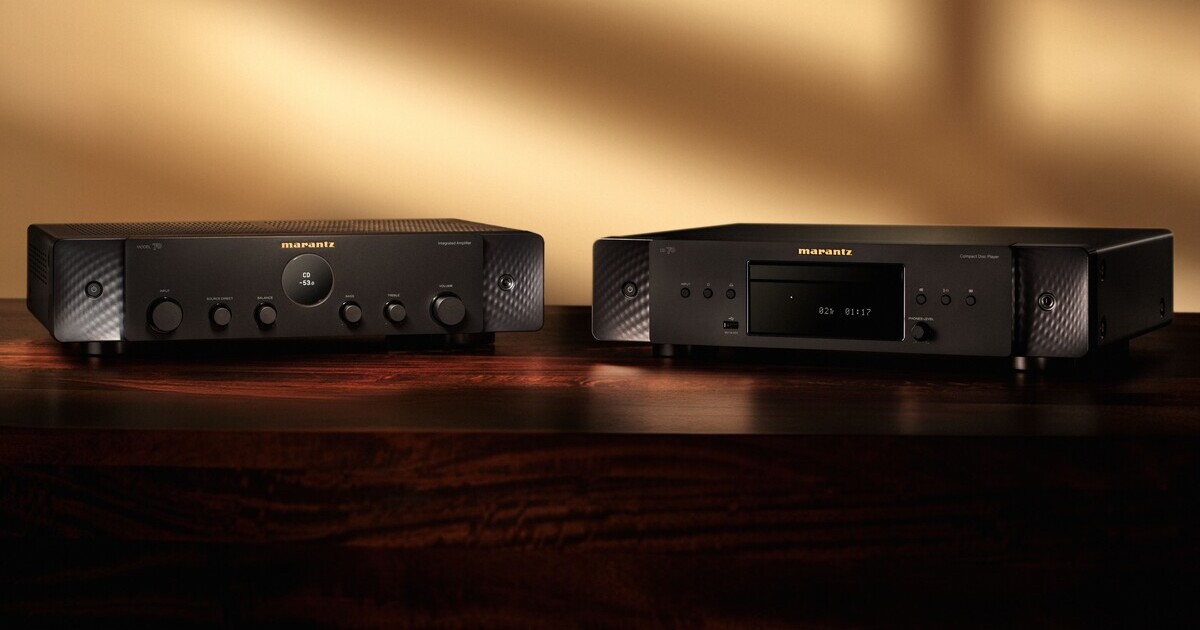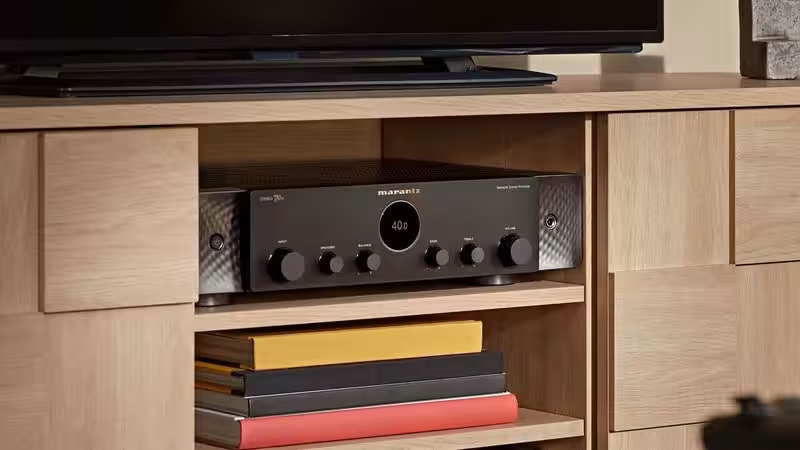
Link CopyTwitterLinkedinWhatsappMarantz Model 70 Skips America At Launch, Its Founder's CountryMasimo makes pulse oximeters. The finger clips that measure blood oxygen on hospital wards. In April 2022 it paid $1.025 billion for Sound United, the holding company that owns Marantz, and in September 2025 it sold that same portfolio to Samsung's Harman International for $350 million. Three years. Two-thirds of a billion dollars gone. And the brand Saul Marantz founded in a Queens basement in 1953 collected its eighth owner.On 15 August, that brand ships the Model 70, a £749 integrated amplifier wearing the naming convention Saul invented - Model 1, Model 7, Model 9, Model 10B. It arrives beside the CD 70, a £499 disc player, which carries an American price of $750.The Model 70 is absent from the American catalogue.Marantz has said little about why. The trade coverage has settled on tariffs, which is the obvious answer and a partial one. The fuller explanation sits on Marantz's own US price list, in public, where anyone could have read it. It involves a legal instrument that expires in nine days, a corporate parent ten months old, and an amplifier that would arrive to find its own siblings already holding the shelf - at a lower price, with double the power.arter view, the circular porthole lit against a dark background. Product-hero framing.Eight owners, one portholeThe arithmetic first. Masimo's purchase price appears in its own quarterly filing with the Securities and Exchange Commission, alongside the mechanics: Viper Holdings Corporation merged into a Masimo subsidiary christened, with more wit than the transaction deserved, Sonic Boom Acquisition Corp. That deal closed on 11 April 2022. Harman announced its own purchase in May 2025 and completed on 23 September. Sound United now runs as a standalone strategic business unit inside Harman's Lifestyle Division, whose president, Dave Rogers, said at closing that the brands are "rooted in a deep passion for sound". Forty-one months of ownership had by then cost Masimo roughly $16 million a month in written-down value, which is one way to express a deep passion for sound.There is a kind of band that keeps touring after the founding lineup has gone. The name is a property. The catalogue is an asset. The songs get played, and the people on stage are competent professionals who joined later. Marantz has been that band since December 1967, when Saul Marantz - offered the ceremonial title of President Emeritus - resigned and walked away from the company carrying his surname. He died on 16 January 1997, aged 85, having lived long enough to watch the compact disc arrive and his company pass to Philips.1: Marantz Japan. 2002: D&M Holdings, merger with Denon. 2017: Sound United. 2022: Masimo, $1.025 billion. 2025: Harman International / Samsung Electronics, $350 million - Sources: SEC filings, Harman International, company records]Trending StoriesThen the price ladder, which is where the reader's money lives. The PM6007 launched in September 2020 at £499. Its replacement asks £749, a rise of 50 per cent across five years and eleven months. The CD6007 arrived at £399, and the CD 70 lands at £499, a rise of 25 per cent. The amplifier has climbed at twice the rate of the player it partners.What that money buys is a genuine redesign, and the first one in a very long time. The 6007 range wore an industrial design inherited from the PM6002 of 2007. Stand the two side by side and a finish and a badge separate them. Marantz sold the same face for nineteen years, the entire lifespan of the iPhone, and has now replaced it with the textured fascia and the circular porthole that the rest of the range has worn since 2020. Underneath sits a larger toroidal transformer, an upgraded power supply, an ES Sabre DAC, moving-magnet phono, HDMI ARC, and aptX Adaptive Bluetooth that transmits as well as receives. The volume control moves from an analogue potentiometer to an electronic one, which the archived PM8006 spec sheet shows was an 8000-series feature. The entry rung inherited it as the tier above it was retired.The DAC deserves a footnote, because its history shows how little of this is design. Marantz launched the PM6007 around an AKM AK4490. Then a fire at AKM's Japanese semiconductor plant took the part off the market, and Marantz swapped mid-life to an ESS ES9010K2M, its engineers retuning the substitute to sound like the component they had lost. The Model 70 ships an ES Sabre. A factory fire in another country decided which chip sits inside the amplifier arriving this August, and the press release credits the engineering team.The company describes the work as "optimised circuit layouts, carefully selected components and vibration-resistant chassis structures", which is the sound of an engineering team being asked to justify £250.The prefix that died quietlySaul Marantz was a commercial artist by trade and an electronics obsessive by temperament, a man who came home from the Pacific after the war, pulled the radio out of his 1940 Mercury and rebuilt it indoors on the reasonable grounds that he did all his listening at home. What began as a domestic irritation - the equalisation curves on early LPs varied by label, and the equipment available refused to accommodate them - ended in 1952 as the Audio Consolette, a hundred units hand-assembled in the basement of a house in Kew Gardens, and sold out at once. Four hundred more followed inside a year. The Marantz Company was incorporated in 1953, in a factory in Woodside; the Model 1 arrived in 1954; and the run of components that followed - the Model 7 preamplifier, the Model 8B, the Model 10B tuner whose manufacturing cost was so far below its selling price that its success came close to destroying the firm - established a numbering scheme that meant something to anyone who cared about sound reproduction for the next seventy years.The prefix that replaced it belongs to a different company. PM is a Japanese-era designation, arriving with the production that Superscope moved to Standard Radio Corporation from 1966 onward to build Marantz-branded components at prices Americans could afford. It survived Philips, Marantz Japan, D&M Holdings, Bain and Sound United. It reached 2020 as the last visible trace of the brand's second life.Then it started dying. Marantz began its reinvention at the top in 2020 with the Model 30, and worked downward: Model 40n, Model 50, Model 60n, Model 10, Model M1. The PM6007 was the last high-volume PM standing. Its stablemate has already gone - visit Marantz's American site today and the PM8006 lives at a URL containing the phrase archive-amplifiers, filed under Archived Products, tagged Archived, with an upgrade path that points at the Model 40n.So the position is this. Marantz has retired the naming convention of its Japanese era in favour of the naming convention of its American founder. It has done so under Korean ownership. And it has done so in the year it stopped offering the result in America.Nine daysThe tariff explanation deserves a fair hearing, because the timing is remarkable. On 20 February 2026 the Supreme Court held, six to three, in Learning Resources, Inc. v. Trump, that the International Emergency Economic Powers Act withholds from the president the authority to impose tariffs. Within hours the administration signed Proclamation 11012, invoking Section 122 of the Trade Act of 1974 - a 10 per cent surcharge on imports from everywhere, effective 24 February. Section 122 had last been used by Richard Nixon in 1971. It caps the rate at 15 per cent and the duration at 150 days, and the president lacks the power to extend it. Congress alone can do that.Which puts an expiry date on the American tariff schedule: 24 July 2026. Nine days from now. The Court of International Trade has meanwhile held Proclamation 11012 invalid, in Oregon v. United States, on 7 May, on the grounds that it failed to identify the balance-of-payments deficit the statute requires; relief went to three plaintiffs and the Federal Circuit stayed the rest pending appeal. On 2 June the US Trade Representative published proposed Section 301 tariffs covering 60 countries, which is the architecture of whatever comes next.The Model 70 ships on 15 August. Three weeks after the schedule governing its landed cost expires, into a replacement regime that exists at present as a proposal.That explains a missing price. It struggles to explain a missing product - because the CD 70 has an American price of $750, and it crosses the same border, on the same day, under the same schedule.For the rest, read the price list. Marantz sells the Model M1 in America at $1,000: a hundred watts, wireless streaming, HEOS built in. It sells the Stereo 70s at the same money: seventy-five watts, six HDMI inputs, streaming. Convert £749 at the rate implied by the CD 70's own dollar price and the Model 70 surfaces at roughly $1,100 - for fifty watts, a single HDMI ARC socket, and whatever streaming you care to plug into the back.Half the power, a fraction of the features, a 10 per cent premium, on the same page as the alternatives. Marantz has declined to explain the American absence. Its own price list does the explaining.Dethroned at the bottom, cornered at the topThe bigger problem is that £749 is a retreat dressed as a promotion. For most of a decade the PM6007 was the default answer to the question of what an entry-level amplifier should be. Then the Rotel A8 took the crown - cheaper, plainer, stripped of digital inputs, and more revealing through the midband than the Marantz it displaced. Whatever the reasoning, the shelf Marantz held for a decade belongs to Rotel now, and the replacement asks £250 more than the amplifier that lost it.Below it now sits the WiiM Amp Pro at £399: streaming, room correction, HDMI ARC, an app that behaves, and roughly half the money. It bundles the streamer, the DAC, the room correction and the amplification into a single box, and treats the amplifier as the least interesting component in it. The Model 70 answers with a moving-magnet phono stage and a porthole.Above it, the company has a stranger problem. Harman owns Arcam, whose A5 and A15 occupy this exact price territory with an integrated-amplifier philosophy that competes with Marantz's directly. It also owns Denon, JBL, Mark Levinson, Bowers & Wilkins, Polk Audio, Definitive Technology, Classé and Boston Acoustics. Samsung's audio division now holds so many integrated amplifiers that the Model 70's fiercest competition shares its parent, its distribution and, in several markets, its dealer.Which leaves the CD 70 to carry the emotional argument - the format's return, the collector's shelf, the treasured library. The data behind that argument says something else. The British Phonographic Industry reports UK CD revenue of £99.6 million in 2025, up 3.1 per cent, its strongest since 2021. The same body reports UK CD unit sales of 9.7 million, down 7.6 per cent. Fewer discs. Higher prices. Vinyl took £174.7 million and 62.9 per cent of the physical market.[DATA BLOCK: UK physical music, 2025. CD revenue £99.6 million, up 3.1 per cent. CD units 9.7 million, down 7.6 per cent. Vinyl revenue £174.7 million, up 19.9 per cent - 62.9 per cent of all physical sales. Total physical revenue £278.0 million, up 12.8 per cent - Source: BPI]Look at what drove the American numbers and the picture sharpens. Luminate's 2025 data has CD sales climbing through the second half on the back of Taylor Swift's The Life of a Showgirl, which has accumulated 27 physical editions to date, and Stray Kids' Karma, which moved 585,000 physical copies of which 524,000 were CDs. The K-pop mechanism is the engine: seven versions of one mini-album, each built around a different member, each with its own photo book. Luminate found 27 per cent of American K-pop listeners bought a CD last year against 19 per cent of the general audience.These are objects. They are bought to be owned, photographed and stacked - the deluxe reissue that stays sealed. The CD revival and the CD-player market are two businesses that happen to share a plastic disc, and Marantz has built a £499 player with HDAM-SA2 circuitry and selectable digital filters for the second one while the press release borrows the momentum of the first.The country missing from the mapThe Model 70's India price is missing. So is its India date. The launch carried sterling, euros, Australian dollars and an American figure for the disc player. India got silence.This is a habit rather than an oversight. Open Marantz's region selector and the choices run: the United States, Canada in English and French, Australia, China, Japan, Taiwan, Belgium in two languages, France, Germany, Austria, the Netherlands, the United Kingdom. India routes to Global. Marantz maintains a Belgian website and a Taiwanese website. The second-largest smartphone market on earth gets a drop-down entry.What India has instead is a dealer channel - HiFiMART, ProHiFi, Ooberpad, AVStore, Audiomaxx - where the listings read call or WhatsApp for discounts and offers, where the Model M1 sits at Rs 1,16,900, and where a PM8006 that Marantz archived in America remains a live product with a phone number attached. Imported hi-fi separates arrive carrying basic customs duty and 18 per cent IGST, levied on the duty-inclusive value. That rate is the joke. The GST rationalisation of 22 September 2025 abolished the 28 per cent slab and moved consumer electronics to 18, which means an integrated amplifier is cheaper to land in India today than at any point since 2017, a category that has meanwhile escaped the PLI schemes, the ISM 2.0 framing and the local-manufacturing arithmetic that reshaped every adjacent business here. Every integrated amplifier sold here arrives from somewhere else, because the volumes make local tooling absurd.Harman changes the conditional, though it settles little. Harman runs engineering operations in Bengaluru, and Samsung's India distribution works at a scale far beyond a six-dealer hi-fi network. Should Harman elect to route the Sound United brands through that apparatus, Marantz would acquire an India launch calendar it has lacked since 1953. Should it decide the volumes fail to justify the effort, the arrangement stays as it is: a global site, a WhatsApp number and a duty bill.The evidence so far points at the second. Ten months into Samsung's ownership, the first entry-level Marantz separates in six years launched with a price for Australia and silence for India.Born in New YorkWatch 24 July, then. Watch whether the CD 70's $750 survives the transition to whatever replaces Section 122, and watch whether the Model 70 appears on the American site once the schedule settles. The absence may last a quarter. It may last for good. Marantz has left the market guessing at the difference, which is itself a decision.And while waiting, visit marantz. com. The American site has a section called World of Marantz, and inside it, a page titled Born in New York. It tells the story of the commercial artist in Queens, the radio out of the Mercury, the basement, the hundred units, the company founded in 1953.The same website sells the CD 70 from its featured-products menu. It has an amplifier category. It has an Outlet, and a Marantz Recertified programme offering refurbished units at a discount. It has a registered address at 5541 Fermi Court, Carlsbad, California, a copyright line reading Harman International Industries, Incorporated, and a careers link that resolves to jobs. harman. com. Sign up for the Marantz newsletter and you are agreeing to Harman's privacy policy. This August, an American may buy a secondhand Marantz amplifier from Marantz. The new one is absent from every part of it.In Blade Runner, the Voight-Kampff test exists to separate a replicant from a human, a manufactured thing walking around with someone else's memories installed, certain they are its own. The test works by asking questions and watching what the eye does.Run it on the Model 70. It carries Saul Marantz's numbering, Saul Marantz's porthole and a heritage page about a basement in Kew Gardens. It is sold by a Californian subsidiary of a Connecticut company owned by a Korean conglomerate. And it will be absent from the shelves of the country whose memories it is wearing.The eye holds steady. That is the tell. FAQsWhy is the Marantz Model 70 unavailable in North America?Marantz has given no public reason. Two explanations fit the evidence. The US tariff schedule expires on 24 July 2026 when the Section 122 surcharge lapses, three weeks before the 15 August launch. And Marantz already sells the 100-watt Model M1 and 75-watt Stereo 70s in America at $1,000 each, which leaves a 50-watt Model 70 at roughly $1,100 with nowhere to sit.How much do the Marantz Model 70 and CD 70 cost?The Model 70 integrated amplifier costs £749 in the UK, €850 in Europe and AU$1,455 in Australia. The CD 70 compact disc player costs £499, €600, $750 in the United States and AU$1,000. Both go on sale on 15 August 2026 in black and silver-gold finishes. India has no announced price or date.What replaced the Marantz PM6007 and CD6007?The Model 70 replaces the PM6007 and the CD 70 replaces the CD6007, ending a run that began in September 2020. The PM6007 launched at £499, so the Model 70 represents a 50 per cent rise. The CD6007 launched at £399, making the CD 70 a 25 per cent rise.Who owns Marantz in 2026?Harman International, a wholly owned subsidiary of Samsung Electronics, completed its acquisition of Sound United on 23 September 2025 for $350 million. Masimo had bought the same portfolio for $1.025 billion in April 2022. Sound United - which includes Marantz, Denon, Bowers & Wilkins and Polk Audio - operates as a standalone business unit inside Harman's Lifestyle Division.What are the Marantz Model 70's specifications?The Model 70 is a Class A/B integrated amplifier delivering 50 watts per channel, using current-feedback topology, an enlarged toroidal transformer and Marantz HDAM circuitry. It carries an ES Sabre DAC, a moving-magnet phono stage, HDMI ARC, aptX Adaptive and aptX HD Bluetooth with transmit and receive, electronic volume control, and preamplifier plus subwoofer outputs.Is the Marantz Model 70 worth it against the WiiM Amp Pro?They answer different questions. The WiiM Amp Pro costs £399 and includes streaming, room correction and HDMI ARC in one box. The Model 70 costs £749 and offers a discrete analogue amplifier, a moving-magnet phono stage and Marantz's warmer voicing, with streaming supplied by whatever source you connect. Vinyl-first buyers should look at the Marantz; app-first buyers should look at the WiiM.end of article
Marantz Model 70 Skips America At Launch, Its Founder's Country
Masimo makes pulse oximeters. The finger clips that measure blood oxygen on hospital wards. In April 2022 it paid $1.025 billion for Sound United, the holding company that owns Marantz, and in September 2025 it sold that same portfolio to Samsung's Harman International for $350 million. Three years. Two-thirds of a billion dollars gone. And the brand Saul Marantz founded in a Queens basement in 1953 collected its eighth owner.On 15 August, that brand ships the Model 70, a £749 integrated amplifier wearing the naming convention Saul invented - Model 1, Model 7, Model 9, Model 10B.
3,095 words~14 min read