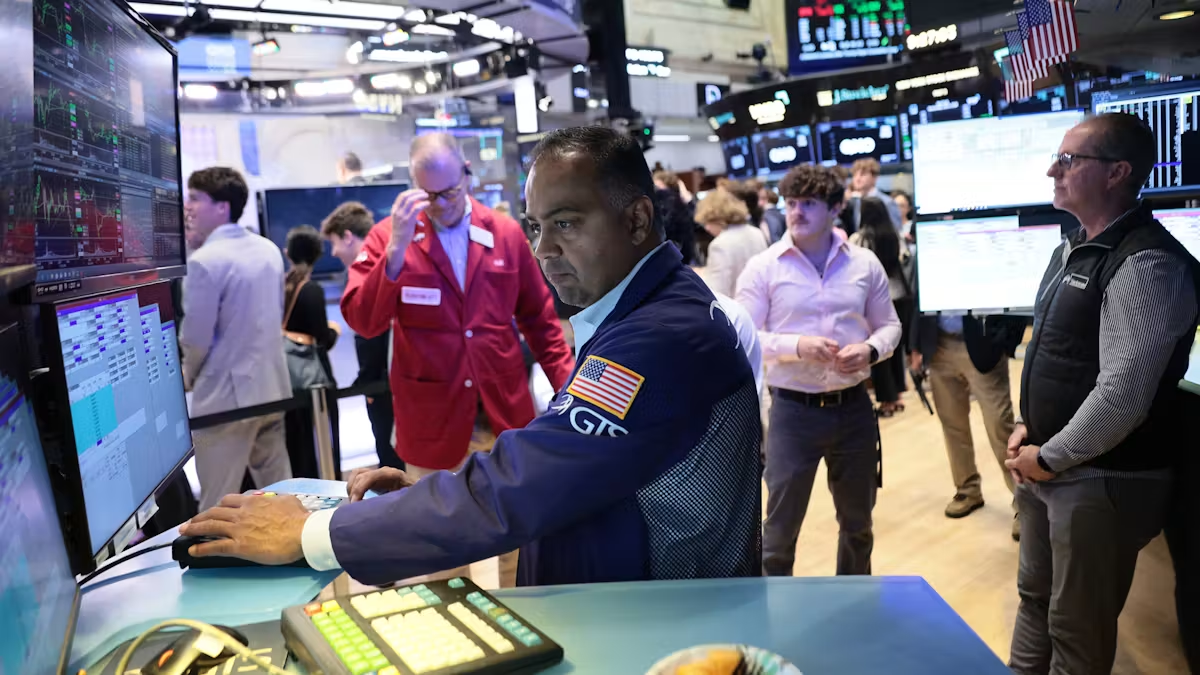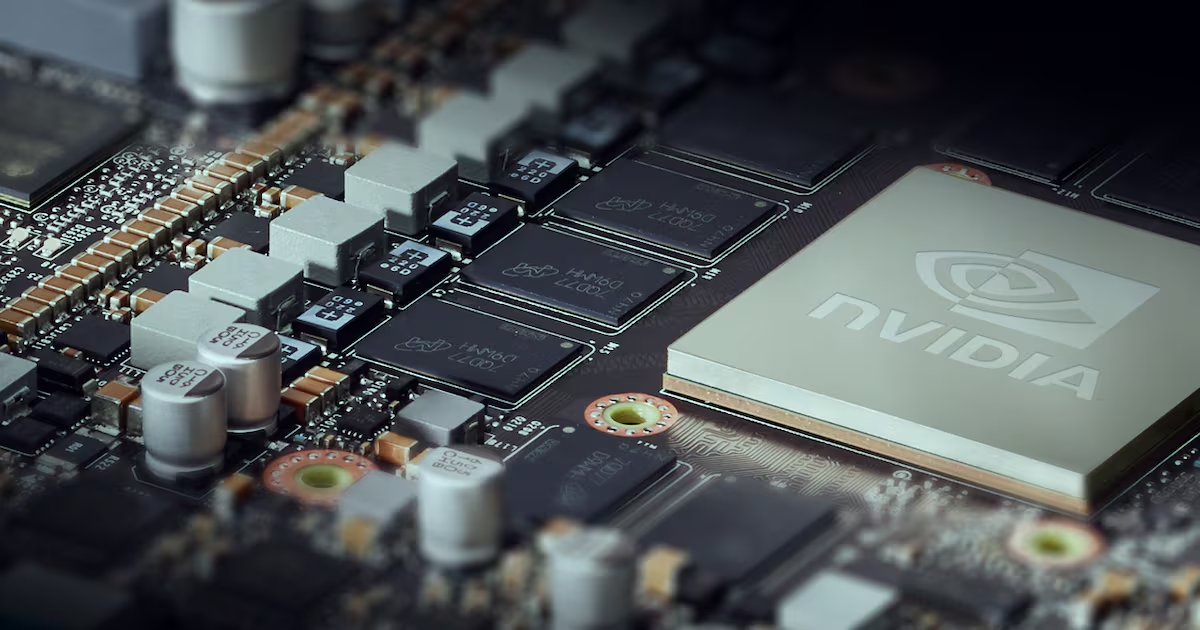
The big story in the first half of 2026 has been artificial intelligence (AI), but perhaps not in the way you’d expect. While the Magnificent Seven (Apple, Microsoft, Alphabet, Amazon, Meta, Nvidia and Tesla) hogged the headlines over the past few years, this year they’ve lagged the broader market as a group. There is one notable exception, Nvidia, which has continued to deliver and remains the undisputed engine of the AI infrastructure trade. However, outside Nvidia, the rest of the Mag7 have struggled to keep pace, and the S&P 493 (that’s everything in the S&P 500 outside those seven names) has delivered roughly double the returns of the Mag7 year to date. The market is broadening, and that’s a healthy sign.The real winners this year have been the companies building the picks-and-shovels of the AI revolution. Micron Technology has been a standout performer globally, driven by insatiable demand for the high-bandwidth memory chips that power AI data centres. Taiwan Semiconductor and SK Hynix have similarly surged, cementing their positions as the backbone of the AI infrastructure build-out. This has had a meaningful knock-on effect for emerging markets. The MSCI Emerging Markets (EM) Index has had a strong first half, but dig a little deeper and you’ll see the heavy lifting has largely been done by these semiconductor giants concentrated in Taiwan and South Korea. It’s an EM rally, but it’s wearing an AI badge.Closer to home, the JSE started the year on a confident note. Resources led the charge as commodity prices held up and investor sentiment towards South African equities remained broadly constructive. Industrials and financials added to the positive tone, with the market touching record highs in early February. Then came March, and the outbreak of conflict in the Middle East changed the mood swiftly. Resources, which had been the engine of the rally, gave back gains as metal prices pulled back and global risk appetite shifted. By the end of the second quarter, we’d seen a distinct rotation away from the risk-on, resources-driven trade that defined the opening months of the year towards a more defensive, risk-off posture. It has been a tale of two quarters.This time last year, the conversation was all about how quickly central banks would cut rates. Fast forward to 2026 and the script has been torn up. The Middle East conflict sent oil prices surging, and at its peak, Brent crude topped $110 a barrel, up close to 80% from the start of the year. Painful for everyone. That reignited inflation fears globally, and central banks that had been expected to ease found themselves either holding firm or, in some cases, hiking, including our own monetary policy committee, which raised rates in May.The picture is improving, but it isn’t resolved; it’s oscillating. Since the initial US-Iran ceasefire took shape in June, we’ve seen a pattern of on-again, off-again de-escalation: a truce forms, oil retreats, tensions flare, oil jumps again and talks resume. Brent has swung from more than $110 a barrel at the peak of the war back towards $70 during calmer weeks, then back up towards $80 whenever hostilities resurface, with the oil price effectively acting as the release valve for each turn in the conflict. Prices are quick to rise and slower to fall, but each cycle has, so far, landed a little calmer than the one before it, and inflation expectations remain more favourable than at the height of the war, with short- and long-term market measures still sitting below pre-conflict levels. The rate-hiking cycle may well prove to have been more bark than bite. That said, we’re not back to the “cuts around the corner” world of early 2025. Central banks remain in a cautious, data-dependent mode, watching closely because the war is not over, and markets should brace for more of the push-pull before it is.Despite a more complex backdrop, there are clear areas of value heading into the second half of the year. For investors wondering what to make of it all, a few things stand out.South African equities still have plenty going for them. The structural reform story is intact, financial sector earnings are holding up well, and the rand-hedge component of the local index provides a natural cushion should global volatility pick up. We remain overweight here.Bonds are a different story and one that calls for patience. With the South African Reserve Bank having hiked the repo rate to 7% in May and inflation rebounding to 4%, yields have repriced sharply. We’ve been trimming duration across our funds because we no longer feel duration risk is adequately compensated. We would rather wait than reach for yield.Listed property sits in an awkward middle ground. The income profile remains attractive, and the offshore component insulates the sector from the local rate cycle, but a higher-for-longer domestic rate environment caps the case for adding aggressively.Further afield, emerging market equities — Asia and Latin America in particular — continue to offer compelling valuations and meaningful growth differentials relative to developed markets. A weaker dollar has been a tailwind, and several key emerging economies now have room to cut rates as inflation eases.Developed markets call for more selectivity. Europe and Japan offer better value than the US right now, where concentration risk in passive allocations remains a real concern given how much index weight sits in a handful of names. That does not mean abandoning the US — we hold a neutral weighting there — but it does mean being deliberate about the mix of what you own within it.In global fixed income, high-quality credit looks better placed than government bonds, while emerging market debt continues to offer attractive yields.If the first half of the year has proved anything, it’s that market narratives can turn in a matter of weeks. That is not a reason to retreat, it’s a reminder that diversification and discipline, not prediction, are what carry portfolios through periods like these.Reuvers is MD of WealthStrat.Business Day
VICTORIA REUVERS | A tale of two quarters — reflecting on the first half of 2026
Diversification and discipline remain key as markets oscillate in 2026
990 words~5 min read