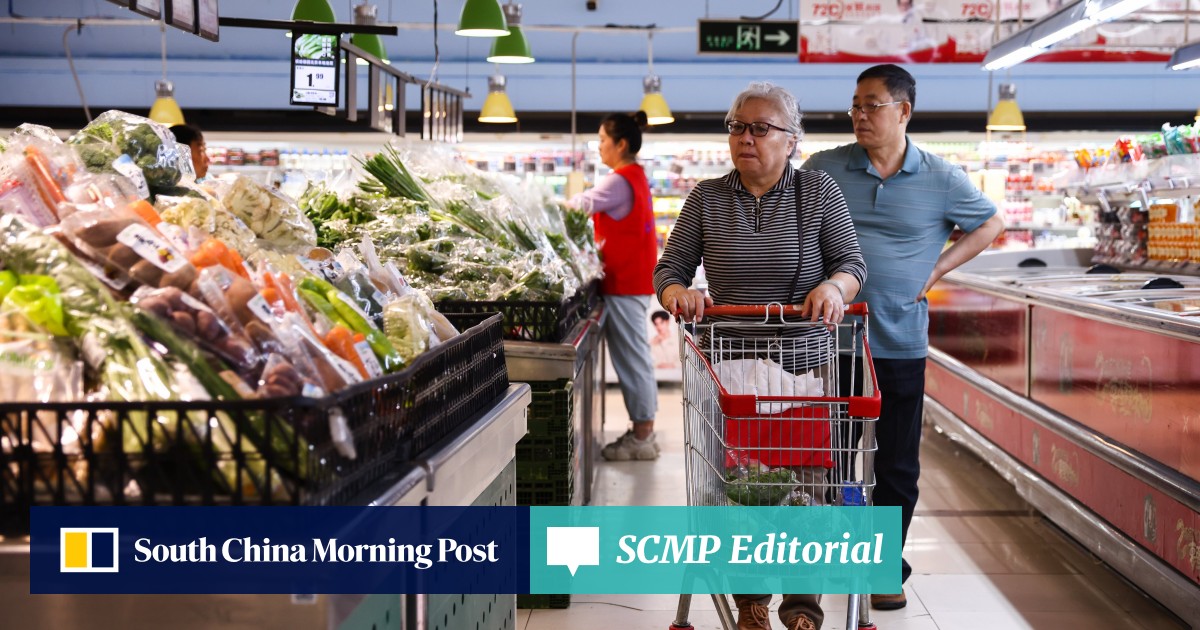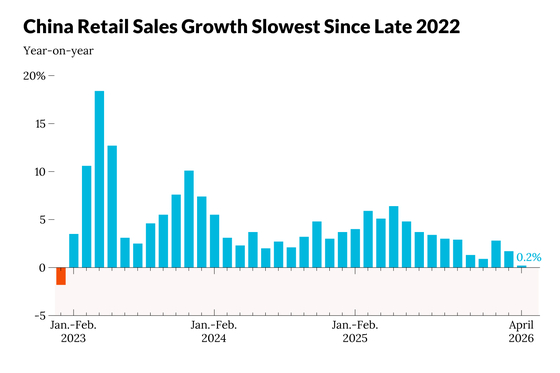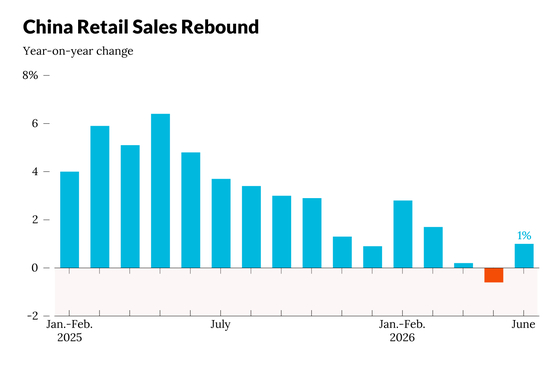
1. Official data published by the National Bureau of Statistics on Wednesday revealed that China's retail sales reversed a contraction to post a 1% year-on-year growth in June, surpassing market expectations and signaling a tangible revival in consumer momentum. [para. 1]2. This unexpected performance followed a stark 0.6% drop in May, the weakest reading in over three years. Economists in a Caixin survey had, on average, projected zero growth. [para. 2]3. Analysts attributed the rebound to a major mid-year e-commerce shopping festival and a lower base of comparison from the Dragon Boat Festival holiday. On a seasonally adjusted month-on-month basis, retail sales climbed 0.38%, ending a two-month decline and reaching the highest level in a year. [para. 3][para. 4]4. An accompanying chart titled "China Retail Sales Rebound" visualizes the year-on-year percentage change from July 2023 to June 2024, clearly showing the June figure at 1%. It notes that January and February data are combined and cites the NBS and CEIC as sources. [para. 5]5. A deeper investigation into the June retail sales figures reveals stark divergences across different sectors. When the volatile automobile sector is excluded, the overall retail sales growth rate improves significantly to a stronger 3% year-on-year. The auto sector itself remained a heavy drag on the headline figure, with sales declining sharply by 16.1% year-on-year. This significant drop was largely attributed to the reduction of tax exemptions for new-energy vehicles, which continued to dampen consumer purchasing enthusiasm. In a positive signal for targeted industrial policies, sales of durable goods promoted by government-sponsored trade-in programs showed broad improvement. Communication equipment sales were a standout performer, surging by a remarkable 16.5% in June. In stark contrast, spending on building and decoration materials contracted by 10.5%, providing a stark reflection of the deep and prolonged slump afflicting China's real estate market. [para. 6][para. 7]6. To provide a more holistic view of consumer spending, the National Bureau of Statistics has developed a new combined growth rate that encompasses both the retail sales of goods and the broader services sector. This initiative directly addresses the key limitation of the standard headline retail sales metric, which specifically excludes non-catering services. The purpose of this new measure is to present a more comprehensive and accurate picture of total consumption activity in the economy. For the first six months of the year, this newly defined metric recorded a 2.7% year-on-year increase. This figure represents a modest deceleration of 0.1 percentage points when compared to the growth rate observed in the January-May period. [para. 8]7. Additionally, data for the first half of the year strongly highlighted the enduring strength and resilience of the services sector. Service-related sales grew by an impressive 5.3% year-on-year, significantly outpacing the more modest 1.1% increase observed in merchandise sales. This trend underscores the ongoing structural transformation of the Chinese economy, shifting increasingly towards service-based consumption. [para. 9]AI generated, for reference only
China Retail Sales Post Surprise June Rebound
E-commerce promotions and favorable base effects help consumer spending beat expectations
480 words~2 min read