The prevailing assumption is that artificial intelligence (AI) is a threat to office demand — that as the technology automates routine work, employers will need fewer people and, by extension, less office space. For a city as exposed to global technology as Dublin, that reading should be cause for concern. However, based on the evidence in front of us, it’s an inaccurate perception .AI is not simply a headwind for the office. It is reshaping demand in two distinct directions. Indirectly, it is changing the type of work people do and raising the value of the in-person collaboration that justifies an office in the first place. Directly, it is generating an entirely new category of occupier – and Dublin, as the European base for many of the firms building this technology, is positioned to capture more of that demand than almost anywhere else in Europe.The fundamentals have changed alreadyIt is helpful to begin by looking at what the Dublin market is actually doing, rather than what commentary suggests it should be doing. The market has made a strong start to 2026, with several large-scale transactions reserved in the first half of the year. Take-up carried real momentum into 2026, underpinned by large-scale commitments from international technology businesses as well as Irish professional services firms. Average requirement sizes have grown rather than shrunk, which is the signature of occupiers planning for expansion, not contraction.Rents for new, high-quality, centrally located office buildings have risen significantly, with several major lettings agreed at levels of €75–€80 per sq ft for space due to be delivered in two to three years.With virtually no speculative office development currently underway in the city, it is difficult to envisage anything other than a prolonged period of undersupply, particularly for grade A stock in the central business district, where vacancy rates have fallen sharply over the past 12 months. As a result, the range of options available to occupiers, especially in core Dublin 2 locations, has diminished, with competition intensifying for the remaining space. This is not the profile of a market being quietly emptied by automation. If AI were already suppressing space requirements at scale, it would be visible in the numbers. Instead, the binding constraint in Dublin is not weak demand; it is the shortage of high-quality, well-located space to satisfy it.Neill McNicholas is head of tenant representation at Savills How AI changes work, and the workplaceThe fear that AI erodes office demand rests on a straight line from “fewer routine tasks” to “fewer jobs” to “less space”. History rarely runs in straight lines. The arrival of the internet was expected to make the office optional; instead, office-based employment in major European cities roughly doubled over the following 15 years, as productivity gains created new roles faster than old ones disappeared.AI will follow a similar pattern, though not without friction. There will be displacement in the short to medium term as the skills employers want shift and the workforce reskills around them. But the roles that prove most durable are the relationship-driven, judgment-led and creative ones – precisely the work that depends on people being in a room together. A notable global trend among AI companies is how frequently they use their office space. Unlike the broader tech sector, which has largely adopted hybrid working, AI firms are rapidly embracing four- to five-day in-office work. This shift is driven by the need to accelerate innovation, safeguard sensitive intellectual property and build strong connections with new client bases – prompting AI companies to actively secure premium office space.As AI absorbs the rote individual tasks, the office becomes more valuable, not less, as the place for collaboration, mentoring, problem-solving and decision-making. That is already reshaping how space is specified: more breakout and meeting space, more flexibility and a clear premium on quality and connectivity.This is the mechanism behind Dublin’s flight to quality. Sustainability-accredited, well-located space accounted for roughly two-thirds of city-centre take-up last year, because occupiers competing for scarce talent understand that the office is now a tool for attraction and culture rather than a cost line to be minimised. AI sharpens that logic. The more of the routine work that moves to a screen, the more deliberately the physical workplace has to earn its place.AI as a direct source of demandThe more immediate story is that AI is creating occupiers and Dublin is winning them. In the first half of 2026, it is anticipated that more than 100,000sq ft of traditional office space will be leased to some of the world’s most prominent AI companies. Several major AI firms established a presence in the city in recent years, with one arriving in 2023 to set up its European headquarters and continuing to expand hiring through 2026. Another followed in 2024, selecting Dublin as its EMEA (Europe, the Middle East and Africa) base and identifying the region as its fastest-growing market. Both organisations initially operated from flexible, co-working environments and are now widely believed to be pursuing significantly larger, long-term office space in the city. That is the textbook progression of high-growth occupiers – from a desk in serviced space to a long-term lease – and it is happening in real time on Dublin’s doorstep.That should surprise no one. Dublin already hosts the European hubs of Google, Meta, LinkedIn, Microsoft and TikTok. The same combination of talent, language, regulatory access and foreign-direct-investment track record that anchored the last technology cycle here is now drawing the AI generation. Savills analysis suggests that, in San Francisco, every €1 billion of generative AI venture capital raised has translated into around 4,000sq m (43,056sq ft) of additional office demand over a two-year period. Applying this to European AI venture capital fundraising suggests there could be an additional 230,000sq m (2.476 million sq ft) of demand from European-headquartered AI companies by mid-2028. A meaningful share of the European total will land where these companies choose to build their continental operations – and Dublin has a strong, demonstrated claim on that decision.The bottom lineAI will not move office demand in a straight line, in Dublin or anywhere else. It will change which companies take space and how that space is used. Traditional occupiers will need to be more agile about workforce structure and workplace strategy; a new cohort of AI-led occupiers will add demand the market did not have five years ago. In both cases, the winners are the same: prime, well-connected, sustainable buildings that support the high-value, human work AI cannot do.The risk for Dublin is not that artificial intelligence empties our offices. It is that we fail to deliver enough of the right space to house the demand it is creating. The development pipeline remains modest and the gap between what occupiers want and what is available is widening, not closing. The market is sending an unambiguous signal. The task now is to make sure the supply – and the planning and development certainty that underpins it – can answer it.Neill McNicholas is head of tenant representation at Savills
Why AI is more likely to fill offices than empty them
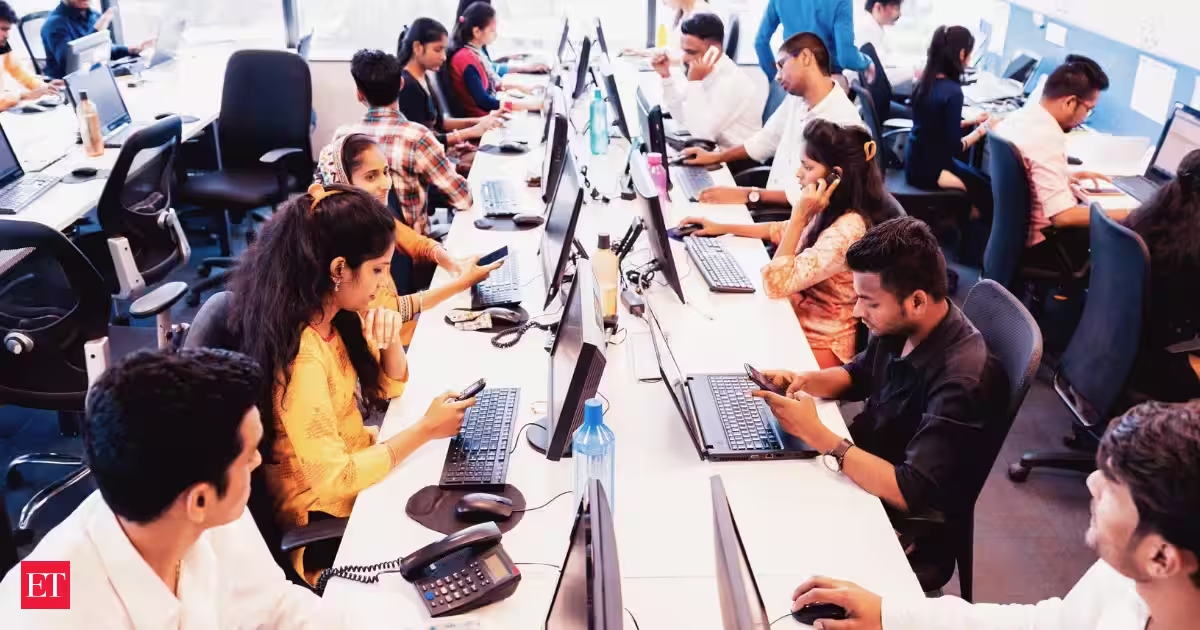
Unlike the broader tech sector, which has largely adopted hybrid working, AI firms are embracing four- to five-day in-office work
1,166 words~5 min read