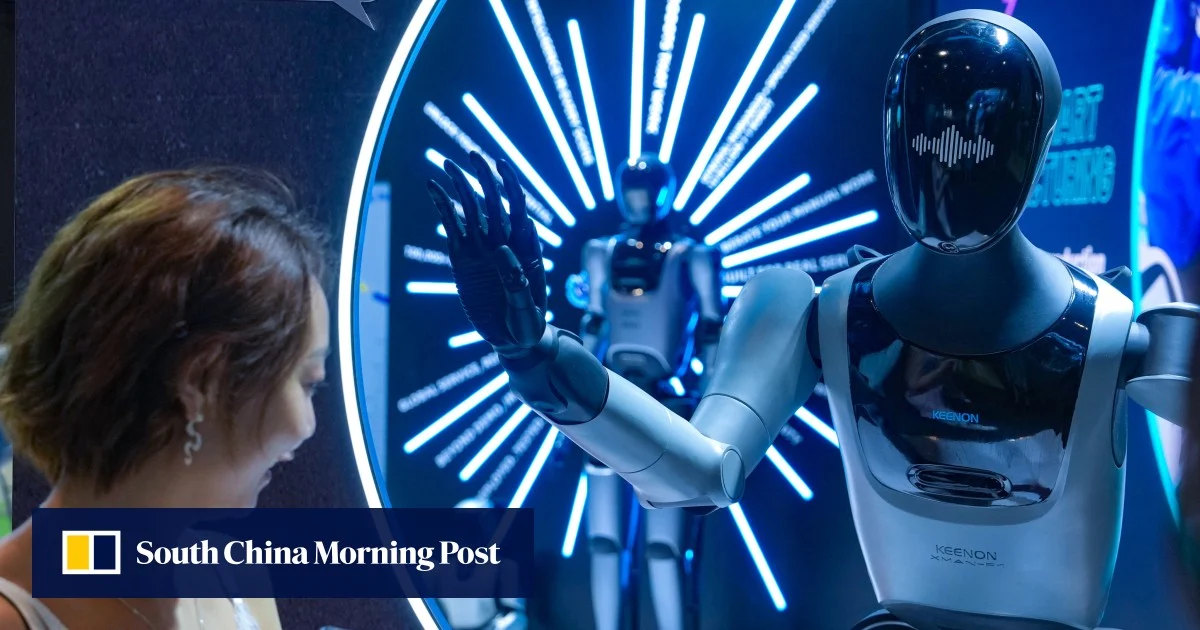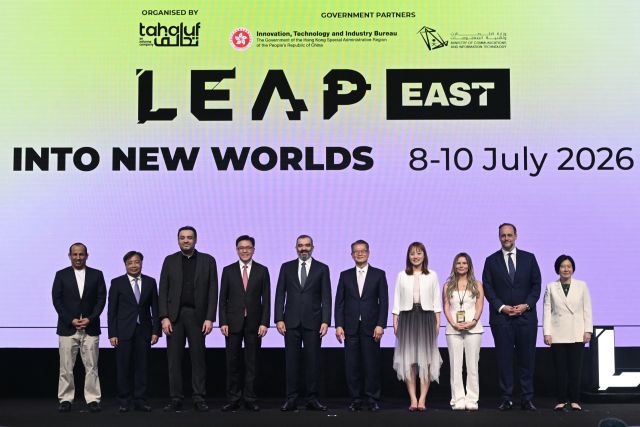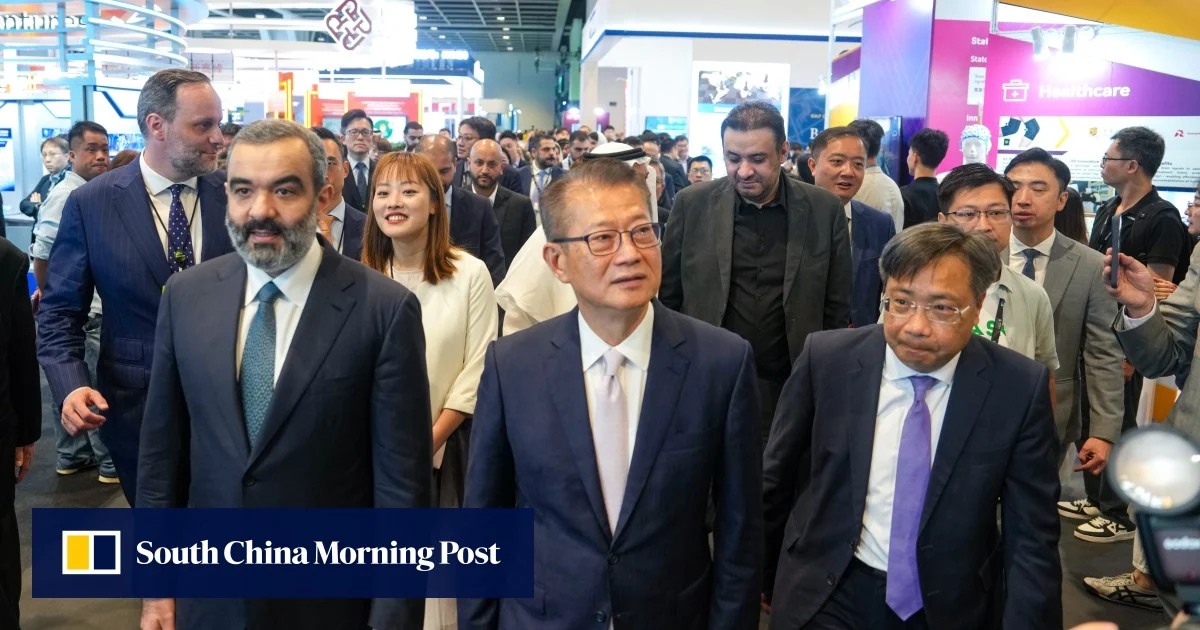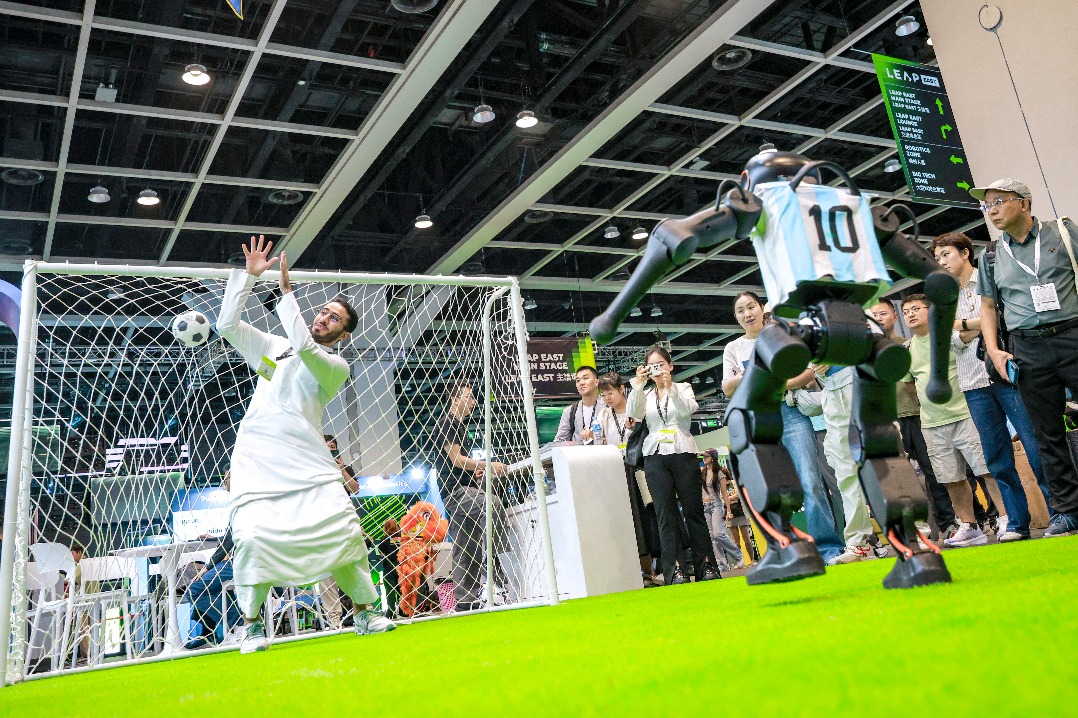
An exhibitor plays soccer with a robot during the inaugural LEAP East event at the Hong Kong Convention and Exhibition Centre on July 8. ANDY CHONG / CHINA DAILY
Companies doing business in the Middle East are urged to look into more opportunities in digital infrastructure, innovation partnerships and cross-border collaboration as these are now shaping the “modern” Silk Road and are emerging as the new Asia-Middle East and North Africa economic corridor, a technology forum heard on July 8.Kiki Zhang, chief financial officer at global robotics and technology firm FJDynamics, noted that when people talk about the Silk Road nowadays, it is no longer just about traditional elements like ports, roads, railways and physical trade.“The new Silk Road consists of AI (artificial intelligence), data, robotics, automation and industrial application,” said Zhang, who was among the three speakers at a panel discussion titled “Digital and Innovative Silk Road — the New Asia-MENA Economic Corridor” at the inaugural global Saudi technology event LEAP East, held in Hong Kong from July 8 to 10.“FJDynamics is a company focusing on the automation of robotic solutions. We have devoted ourselves for many years to some industrial application scenarios, including agriculture, construction, landscaping, and probably even the airport. And those sectors are not fancy per se,” Zhang said.“However I think those sectors are really where the labor shortage, the sustainability needs … and even the safety requirements are becoming very, very real.”From her company’s perspective, Zhang said that they do not treat the Middle East as “a simple sales destination”, as the region is becoming an important place in terms of innovation. The FJDynamics executive noted that the region has invested heavily in smart city infrastructure, food security and even urban planning for the future. “So for us, the Middle East means the demands are real,” Zhang said.China, on the other hand, she said, is good at turning technology into products and turning products into scalable development, especially for the Guangdong-Hong Kong-Macao Greater Bay Area, which she said has been very good at fast engineering and fast iteration. “We have very strong supply chain support and we even have a very practical thinking methodology,” Zhang said. She said Chinese companies are very relevant to the Middle East, a region looking for robust, cost-efficient and scalable solutions that can be applied to real working scenarios.“Hong Kong’s role is even more interesting. Hong Kong always thinks of itself as a super-connector, but for us, Hong Kong plays a role like a validator.” She shared that FJDynamics, which is headquartered in Hong Kong, deploys a lot of construction solutions from the sector in Hong Kong to the Middle East and other regions. Hong Kong’s construction industry is one of the most advanced, she noted, crediting the Hong Kong government’s spending and encouragement to bring advanced technology to every working site in the city.“So, once your solutions get validated in Hong Kong, it gives a lot of confidence to your Middle East counterparts … we bring (a) very advanced 3D scanner to every construction site to build 3D model. And we bring the autonomous solutions to every single excavator in Hong Kong (making them fully autonomous),” Zhang said.Another speaker, Martin Zhu, co-founder and CEO at i2Cool, said they expanded their technology not only in Hong Kong and the Greater Bay Area, but also to the Middle East “because they are a good market for us”.Zhu’s business journey began after years of research, which later saw him attending a 2017 conference in Egypt, which he said “is also a Silk Road” country. There, they found out about the Saharan silver ant, which survives the extreme desert heat by using its unique hair structure to reflect the sun and release heat.Not long after, inspired by the Saharan silver ant, they founded i2Cool to commercialize their cooling technology.Last year, the United Arab Emirates accounted for around 30 percent of i2Cool’s revenue, said Zhu, adding that their technology helped reduce the cooling load of hotels and shopping malls, including the Dubai Mall and those in Abu Dhabi.“So, I think the Silk Road countries … we can work together using the outcome and technology from (Hong Kong). Then we can use our technology to improve the infrastructure and environment in the Middle East so they can have high sufficiency to support their green transition,” Zhu said.