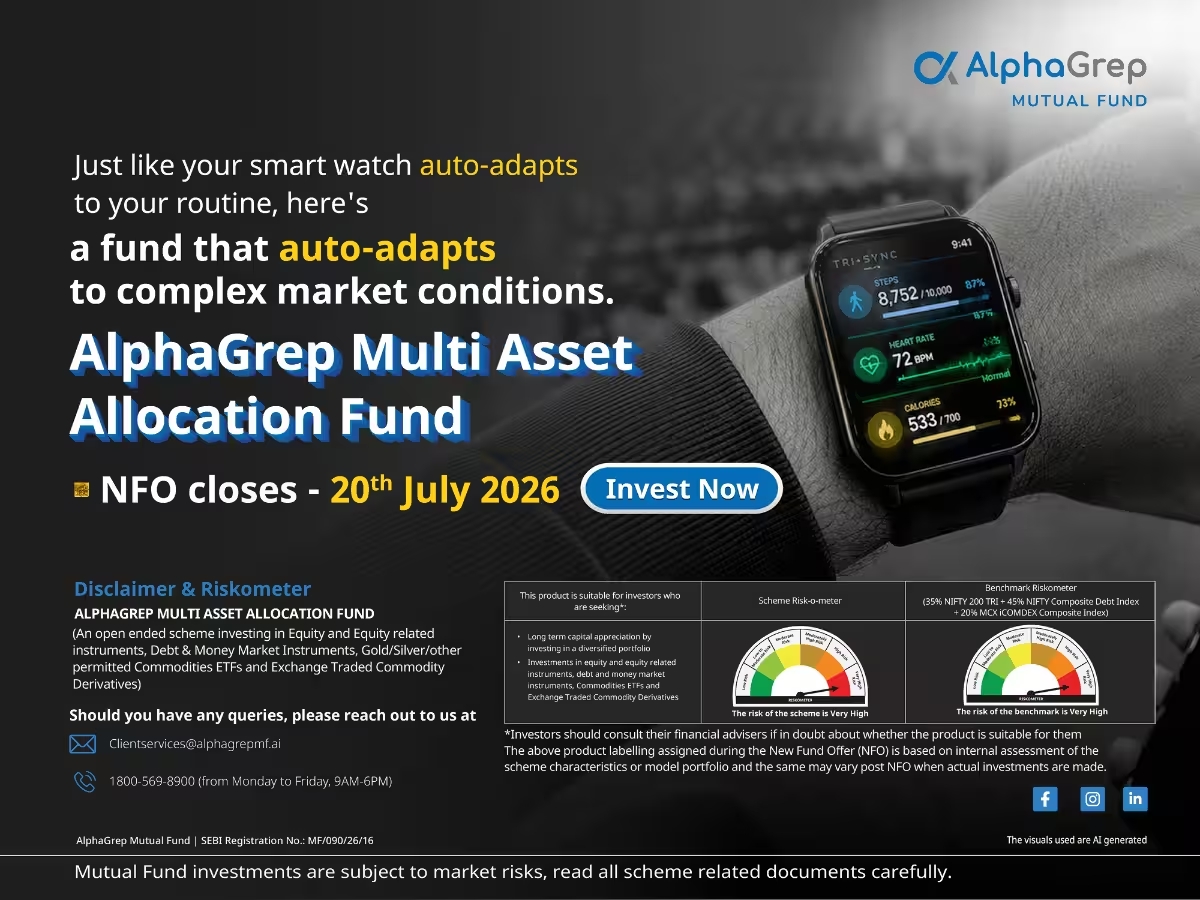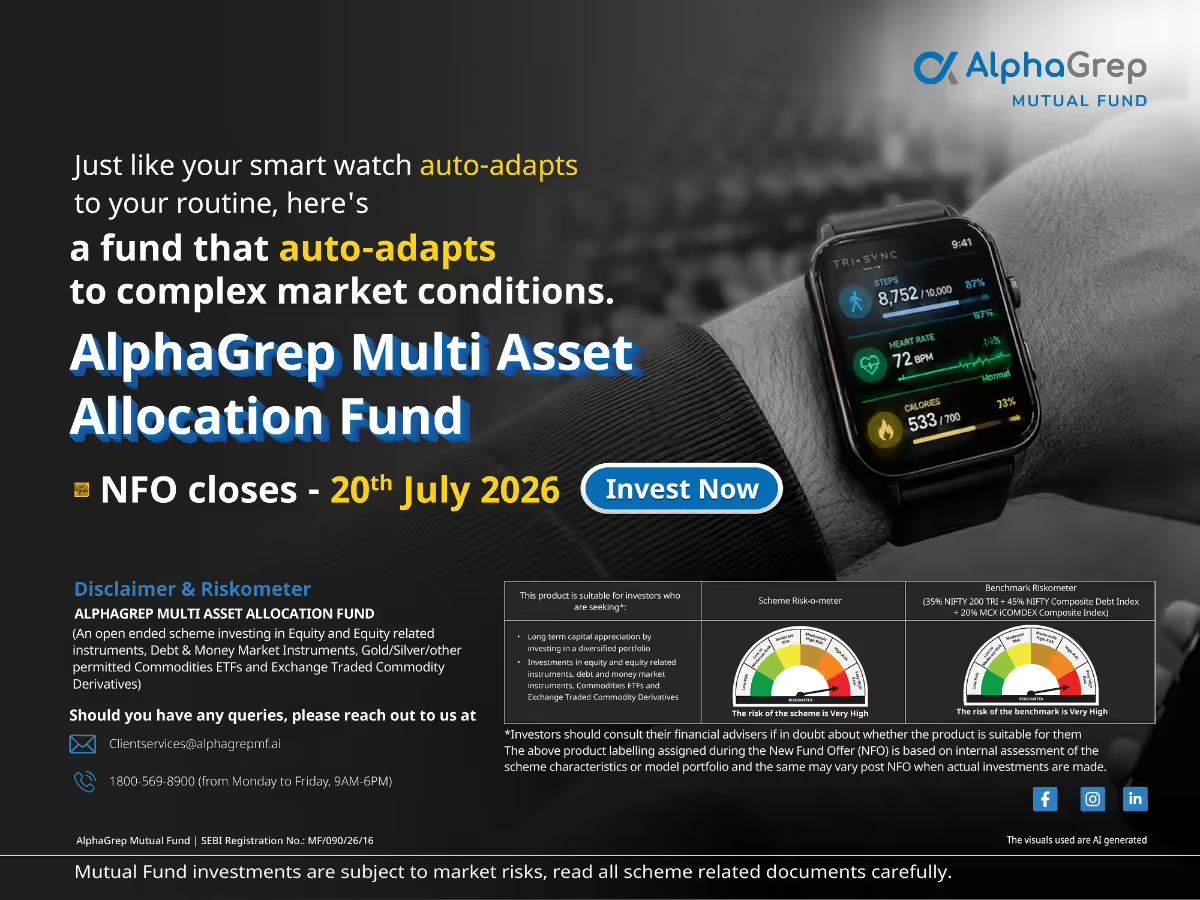
For decades, investors have relied on a fairly familiar playbook: allocate money across equities, debt, and gold, stay invested through market cycles, and trust that diversification will do its job. However, market movements in recent years have challenged some of the assumptions inherent to that approach.In less than two decades, investors have lived through the ebb and flow of economic cycles that included the Global Financial Crisis, the Eurozone debt crisis, the taper tantrum, a pandemic-induced market slowdown, an inflation shock, wars that shook commodity markets, and a series of geopolitical disruptions that repeatedly challenged assumptions about risk.Can dynamic allocation make multi-asset investing more resilient? Hear it from AlphaGrep Mutual FundMaking a case for a dynamic multi-asset allocation fund, Bhautik Ambani, CEO, AlphaGrep Mutual Fund, said that the firm’s MAAF framework is formulated not to predict the next winning asset class but to reduce dependence on any single asset class and seek more consistent outcomes over time. Appearing on an ETMarkets podcast, Ambani discussed how AlphaGrep analysed roughly 20 years of market data, dividing the period into around a dozen economic cycles that included episodes such as the Global Financial Crisis, the Eurozone crisis, and the taper tantrum. Making sophisticated institutional quantitative investing techniques accessible to retail investors, AlphaGrep’s MAAF model adapts to evolving market regimes. Watch the podcast to understand how and why it matters.The challenge for investors, today, is not merely identifying the next winning stock or asset class. It is navigating a market environment where familiar assumptions about how asset classes would behave do not necessarily work. Bonds and equities, long viewed as natural counterweights, have occasionally fallen together. Gold, traditionally considered a safe-haven asset during periods of uncertainty, has not always moved in the direction investors anticipated.It was against this backdrop that Bhautik Ambani, Chief Executive Officer, AlphaGrep Investment Management Pvt. Ltd., a quantitative investment firm,, appeared on an ETMarkets podcast. Ambani made the case for a different approach to investing: one that shifts the focus away from predicting which asset class will outperform next and towards building a process capable of adapting as leadership changes. For Ambani, the appeal of a multi-asset approach begins with a simple observation about investor behaviour. “I don’t think investors kind of wake up every day thinking, you know, I want to invest in equities, I want to invest in gold. Or should I be investing in fixed income today? What they’re generally looking for is can I get an investment which gives me a smoother investment journey and reduces my anxiety? And which is exactly why what we thought was that why should an investor just rely on one asset class to make money from that? And hence, a multi-asset product actually gives all three asset classes enough and more opportunity to kind of perform, and offers greater adaptability and resilience for an investor’s portfolio.”In other words, the case for a multi-asset allocation fund is not built on the belief that one asset class can consistently outperform, rather on the recognition that leadership rotates across market cycles. The role of the fund, therefore, is not to predict the next winning asset class but to reduce dependence on any single asset class and seek better risk distribution over time. Why no single asset class can be the answerThe argument gains weight when viewed through the lens of market history. According to Ambani, AlphaGrep analysed roughly 20 years of market data, dividing the period into around a dozen economic cycles that included episodes such as the Global Financial Crisis, the Eurozone crisis, and the taper tantrum.The exercise produced a finding that challenges the assumption that equities are always the dominant wealth creator.“What we’ve seen is that in only 50% of the times or six out of 12 cycles has equity outperformed the other two asset classes. And the balance 50% of the time is actually commodities, which has done better. So, contrary to our perception that, you know, gold has done well only in the last couple of years, because obviously we’ve seen an outsized rally in the last couple of years, it’s actually, you know, there have been multiple other periods where commodities have done better or outperformed equities,” Ambani said.That observation lies at the heart of the case for dynamic allocation. If leadership among asset classes changes across cycles, then investors may benefit from portfolios that can adjust exposure rather than remain anchored to predetermined weights.“Which means that if there are periods when let’s say equity risk is going up, if the portfolio can kind of rebalance, adjust, adapt to market conditions at that point of time, there is a possibility that you may have a better outcome. By having greater portfolio flexibility, by having less exposure to equities at that point in time,” Ambani explained.The idea, therefore, is not merely to diversify across asset classes but to ensure that allocations are adapted in response to changing market environments. . Quantitative strategies seek to approach the problem differently by processing large amounts of data and responding more frequently to changing market conditions.Ambani argued that the rationale for such an approach has strengthened as historical correlations have become less reliable.He pointed to the experience of US markets in 2022, when both equities and fixed income declined sharply in the same year, an outcome that challenged the long-standing assumption that bonds would cushion equity losses. He also cited a recent geopolitical flare-up in the Middle East, when both equities and gold fell simultaneously, defying the conventional expectation that gold would rise during periods of crisis. “Every time equity markets have gone down in the US in a particular year, fixed income has managed to cushion the returns. And that kind of worked for decades. Then came the year 2022. In that year, equity markets in the US were down close to 18%. Fixed income in the same year was down 12-13%. Something that had never happened for decades. And there was a clear understanding that there is a certain correlation between equity and fixed income, which will continue to run the same way. And that correlation got broken,” added Ambani.For Ambani, the lesson extends beyond bonds and equities. It is a reminder that markets do not always conform to historical patterns. Speaking about correlations, Ambani explained: “So just coming back to your point in correlations, when we run with historical correlation and assumption of those correlations, it’s not necessary that that’s going to play out in the future as well. And that’s precisely the reason why we are not basing our model just on valuations or historical correlation as assumptions. And that’s the reason for the statistical model, which looks at more relatively short-term data, and can keep adapting to the market situations.”This emphasis on adaptability reflects a broader shift taking place in asset management. Advances in computing power, data availability, and quantitative methods are increasingly influencing portfolio construction, an area traditionally dominated by discretionary fund managers.Building a model that adapts to market situationsAmbani framed the challenge as less about predicting every market move and more about building systems capable of responding when conditions change.“Markets are going to always remain the same. Our job is not to kind of predict every twist and turn, but our job is to kind of build a model which can keep adapting to market situations,” Ambani added.For investors, the appeal of such funds may lie in the possibility of building portfolios that can adjust to changing market conditions through a data-driven and structured framework. In a world where geopolitical events can reshape markets overnight and established correlations can break without warning, the ability to adjust exposures dynamically is increasingly being presented as a feature rather than a luxury.Whether dynamic multi-asset funds ultimately deliver on that promise will be tested in future market cycles. But as investors grapple with a financial landscape defined by uncertainty rather than predictability, the debate is gradually shifting from choosing the right asset class to choosing the right process.As Ambani put it, “If the portfolio can kind of rebalance, adjust, adapt to market conditions at that point of time, there is a possibility that the portfolio may be better positioned to navigate changing market cycles”AlphaGrep Multi Asset Allocation Fund(An open ended scheme investing in Equity and Equity related instruments, Debt & Money Market Instruments, Gold/Silver/other permitted Commodities ETFs and Exchange Traded Commodity Derivatives)PRODUCT LABELThis product is suitable for investors who are seeking*:Scheme Risk-o-meter Benchmark Risk-o-meter (35% NIFTY 200 TRI + 45% NIFTY Composite Debt Index + 20% MCX iCOMDEX Composite Index)Long term capital appreciation by investing in a diversified portfolioInvestments in equity and equity related instruments, debt and money market instruments, Commodities ETFs and Exchange Traded Commodity Derivatives
When correlations break, can dynamic multi-asset funds offer investors better outcomes? - The Economic Times
Bhautik Ambani, CEO, AlphaGrep, explains why modern investing must take into account the limitations of predicting the market, and instead turn to a more agile adjustment of allocation and risk in response to shifts in markets.
1,692 words~8 min read