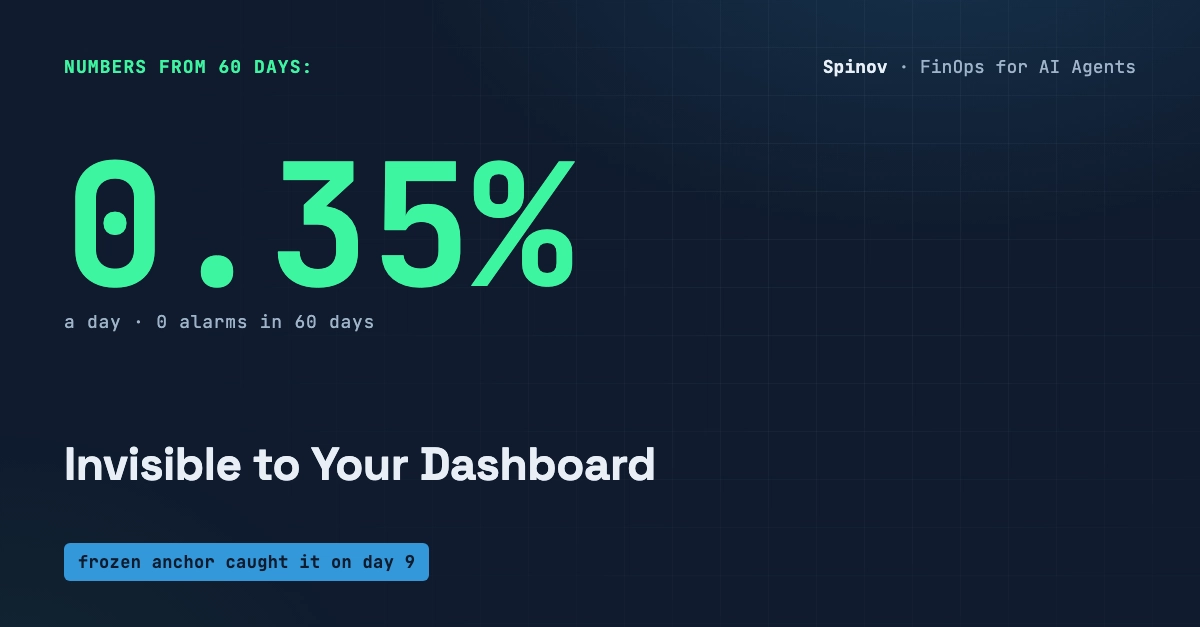
AI agent cost drift is the slow growth of your input floor — system prompt, tool schemas, CLAUDE.md, MCP servers — that a rolling baseline never catches, because the baseline climbs with it. drift_anchor_gate.py pins a frozen canary on day 0 and compares: a 0.35%/day creep raised zero alarms in 60 days; the anchor blocked it on day 9.
Your fleet dashboard fires when today's average run jumps 20 percent above last week. Your context floor grows 0.35 percent a day. Those two numbers never meet. I built six 60-day worlds and ran four rolling detectors over them, each at the tightest threshold that stays quiet on a flat fleet, and the slow creep raised zero alarms in all four, across 60 days, while the floor went up 22.6 percent. A frozen anchor caught the same creep on day 9.
AI disclosure: I wrote drift_anchor_gate.py and make_worlds.py with an AI assistant and ran them myself: Python 3.13.5, offline, standard library only, no network, no keys. Every number, exit code and sha256 below is pasted from a real local run. I ran the whole demo twice from a clean rm -rf worlds, and the two output.txt files are byte-for-byte identical (sha256 1772e695cb75f79d9e3f162ed4c49477a329703610cdf5ddff54cec2cc4da62a). The series are synthetic, and I say exactly how they are generated below. The one thing that is not synthetic is the arithmetic, and it is the part that does the work.