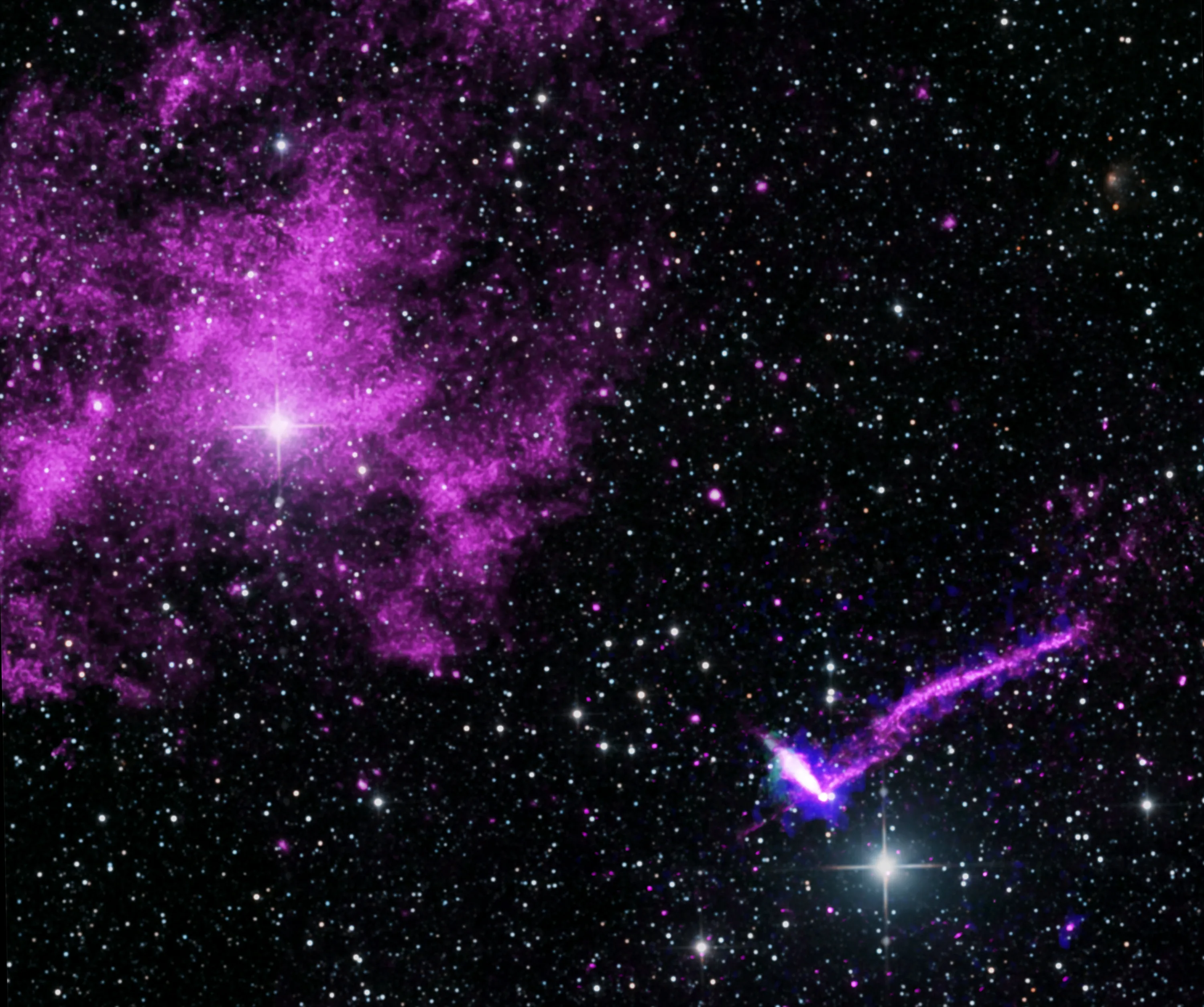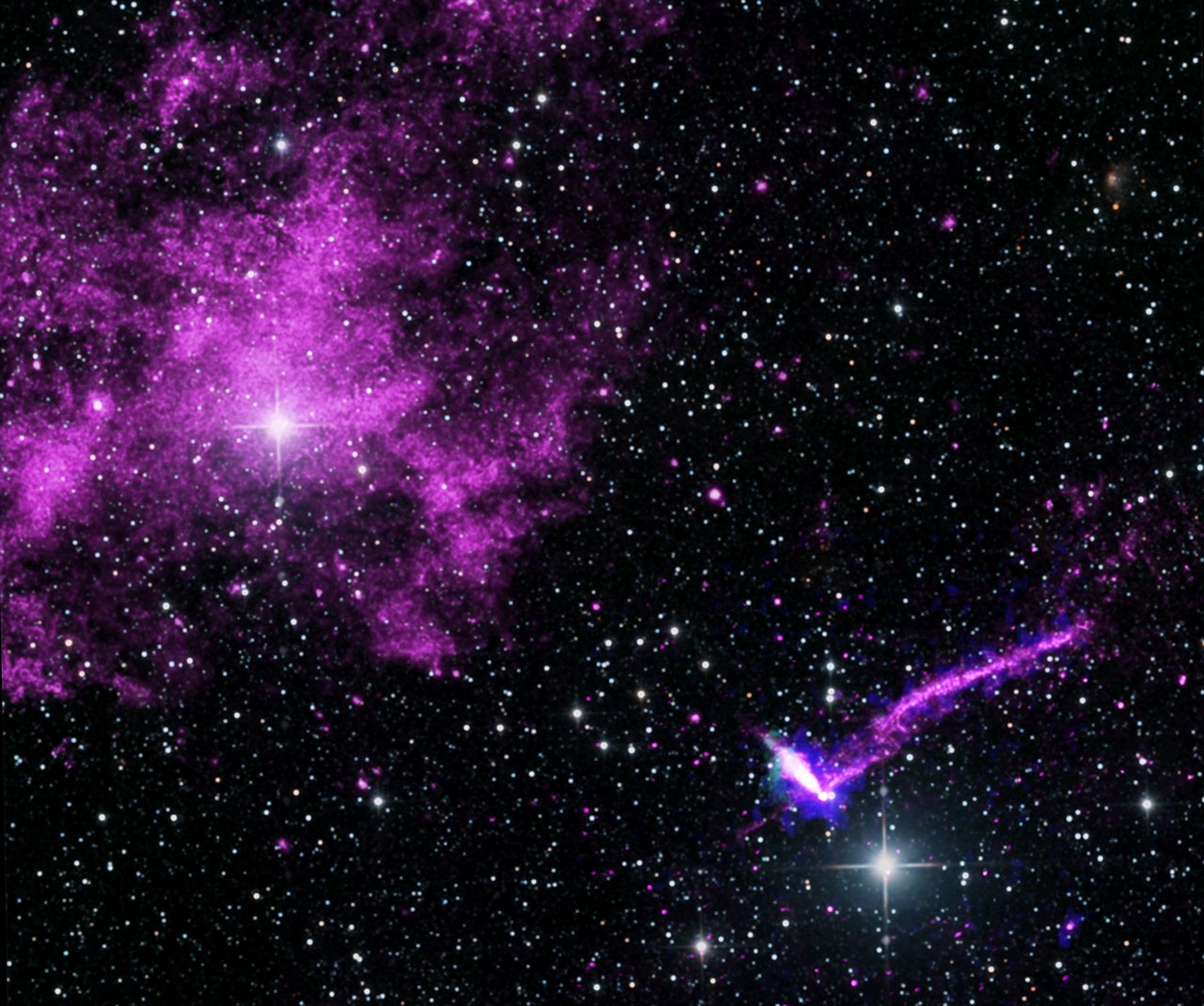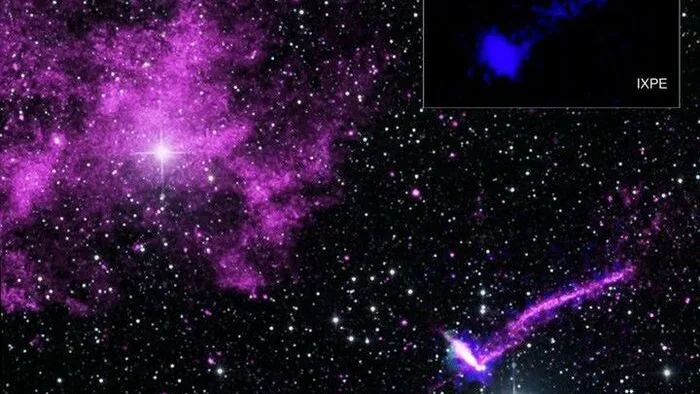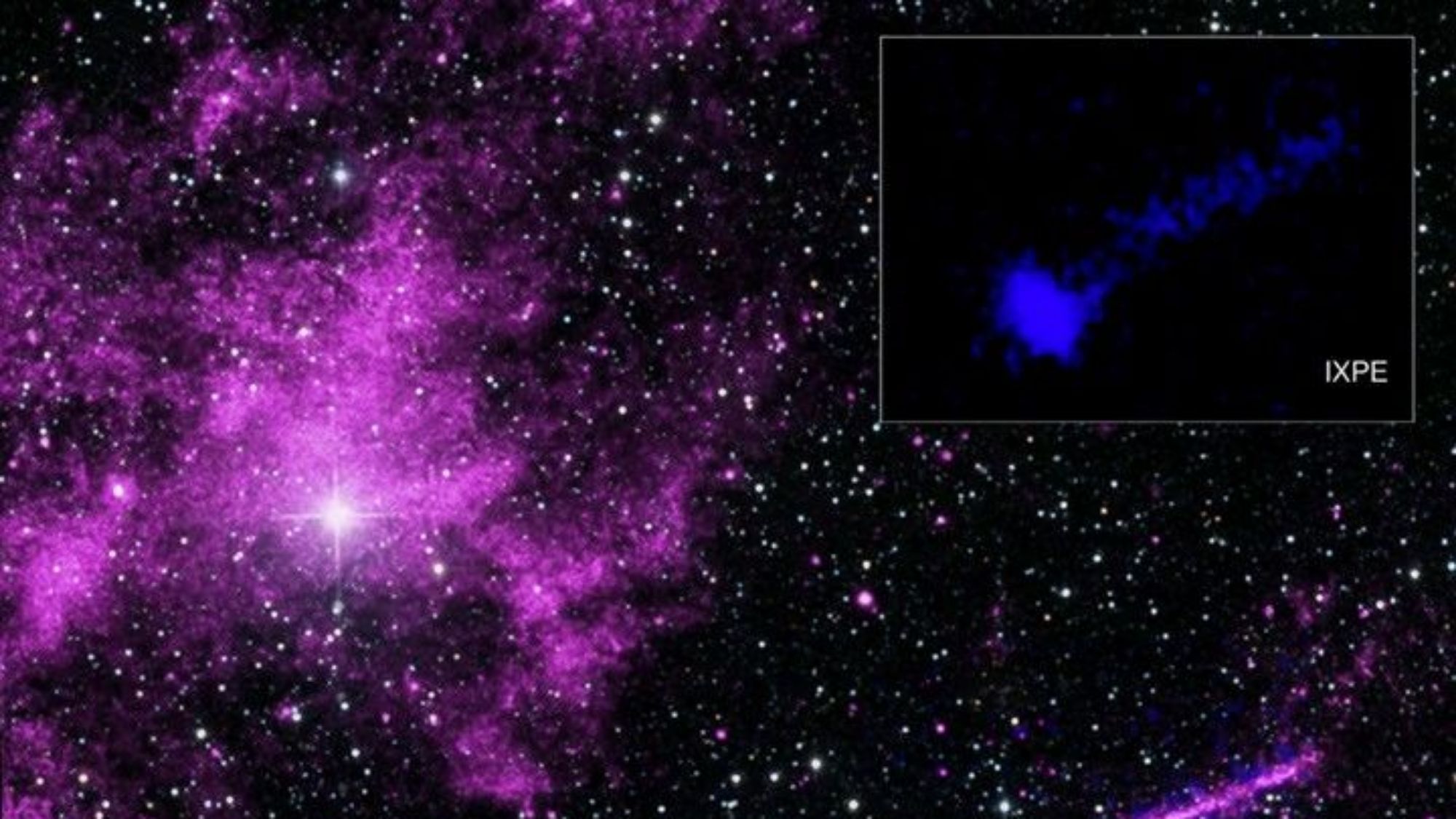
A crop of the composite view of the Lighthouse pulsar's nebula combines X-ray observations from NASA's IXPE (blue, highlighted in the inset), NASA's Chandra X-ray Observatory (purple), radio data from CSIRO (green), and optical observations from the 2MASS survey.
(Image credit: X-ray: Chandra: NASA/CXC/Stanford Univ./J.T. Dinsmore et al.; IXPE: NASA/MSFC/J.T. Dinsmore et al., Radio: CSIRO/ATNF/ATCA; Optical: 2MASS/UMass/IPAC-Caltech/NASA/NSF; Image processing: NASA/CXC/SAO/L. Frattare)
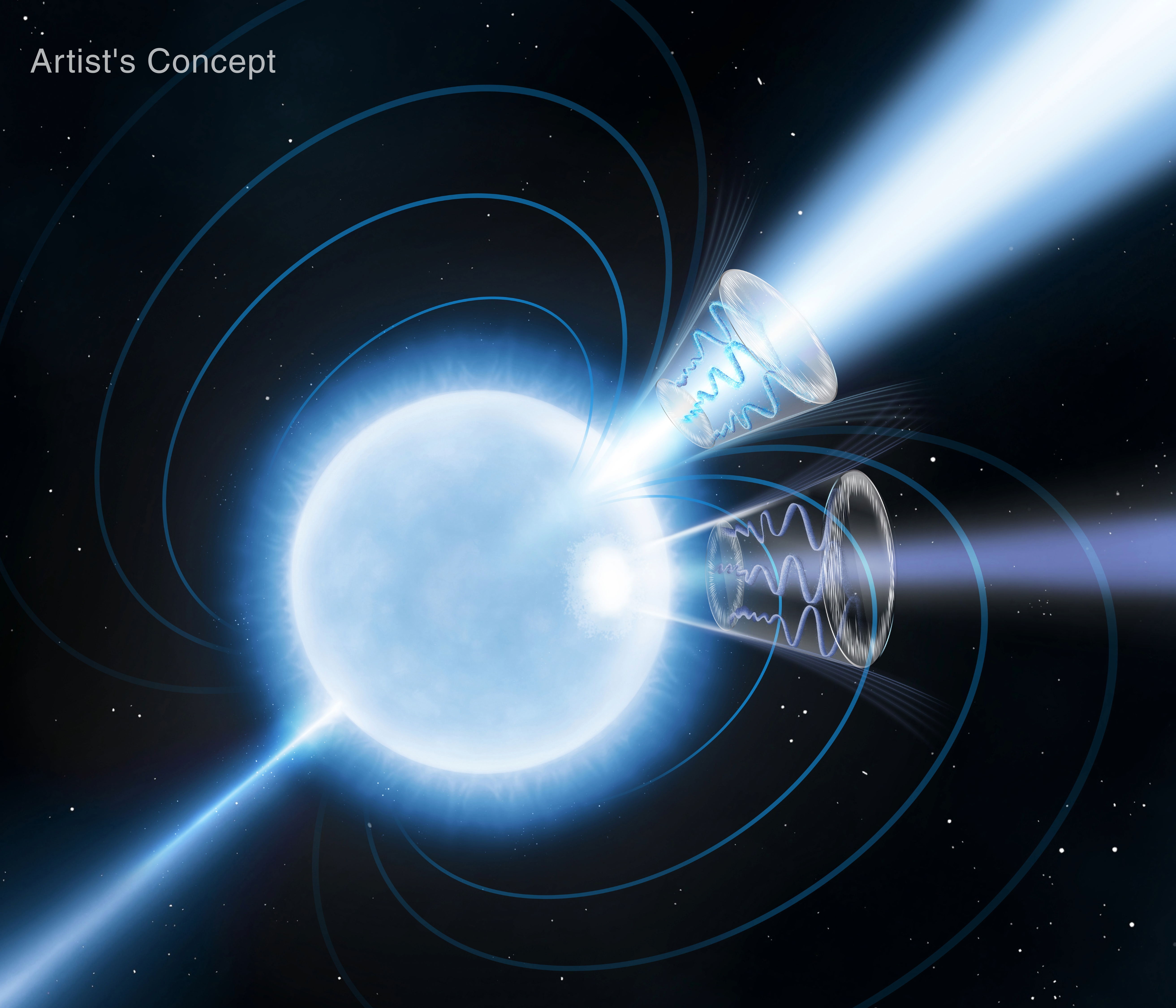
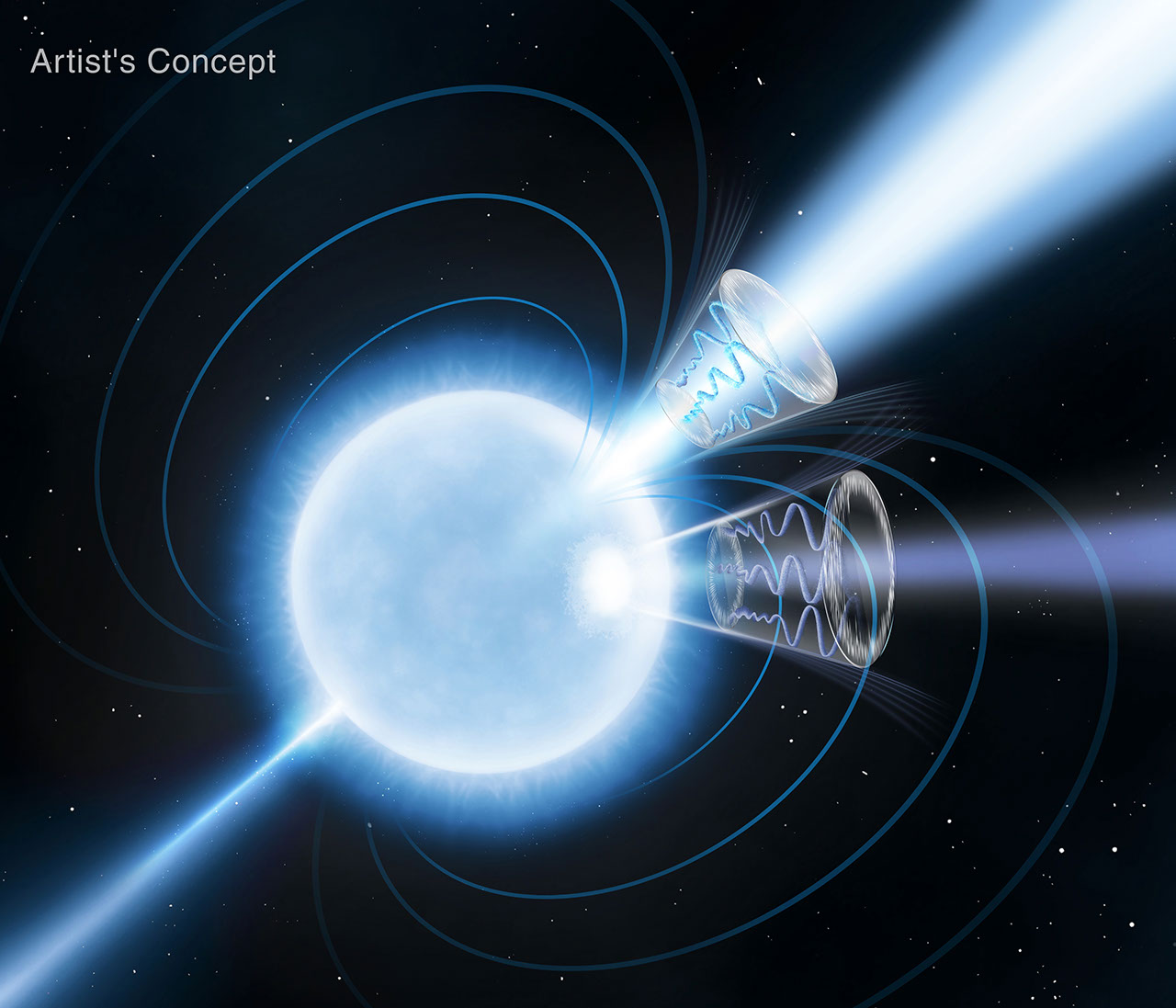
Astronomers have, for the first time, directly mapped the magnetic field surrounding an unusual "lighthouse" pulsar, revealing an invisible cosmic highway that channels particles blasted from the rapidly spinning stellar remnant.Using NASA's Imaging X-ray Polarimetry Explorer (IXPE) mission, researchers measured the magnetic field around the pulsar PSR J1101−6101 — nicknamed the "Lighthouse" — and confirmed a long-standing prediction that its high-energy particles stream along magnetic field lines extending through the Milky Way. This discovery offers a rare look at how some of the universe's most extreme objects accelerate particles to nearly the speed of light, according to a statement from the space agency.Pulsars are rapidly rotating neutron stars — the ultra-dense remnants left behind when massive stars explode as supernovas. Their powerful magnetic fields channel beams of radiation from their magnetic poles that sweep across space as the stars spin, much like the beam of a lighthouse.PSR J1101−6101, which is located at the center of the Lighthouse Nebula, spins about 16 times every second and is traveling at supersonic speeds after receiving a powerful kick from the supernova that created it. As it tears through interstellar gas, it leaves behind a bright X-ray tail while producing a narrow filament that juts out almost perpendicular to its direction of travel. Astronomers had long suspected this unusual structure traced energetic electrons escaping along the Milky Way's magnetic field."We wanted to test that theory,"Jack Dinsmore, lead author of the study and undergraduate student at Stanford University, said in the statement. "The 'smoking gun' would come by measuring the polarization of the light, which indicates the magnetic field direction. If the magnetic field points along the filament, that confirms that the filament's particles are flowing along the field."Unlike conventional X-ray telescopes, IXPE measures the polarization of X-rays — the preferred orientation of their electric fields — allowing scientists to reconstruct the geometry of otherwise invisible magnetic fields. Because the Lighthouse Nebula is relatively faint in X-rays, the researchers developed new analysis techniques to extract as much information as possible from the observations.