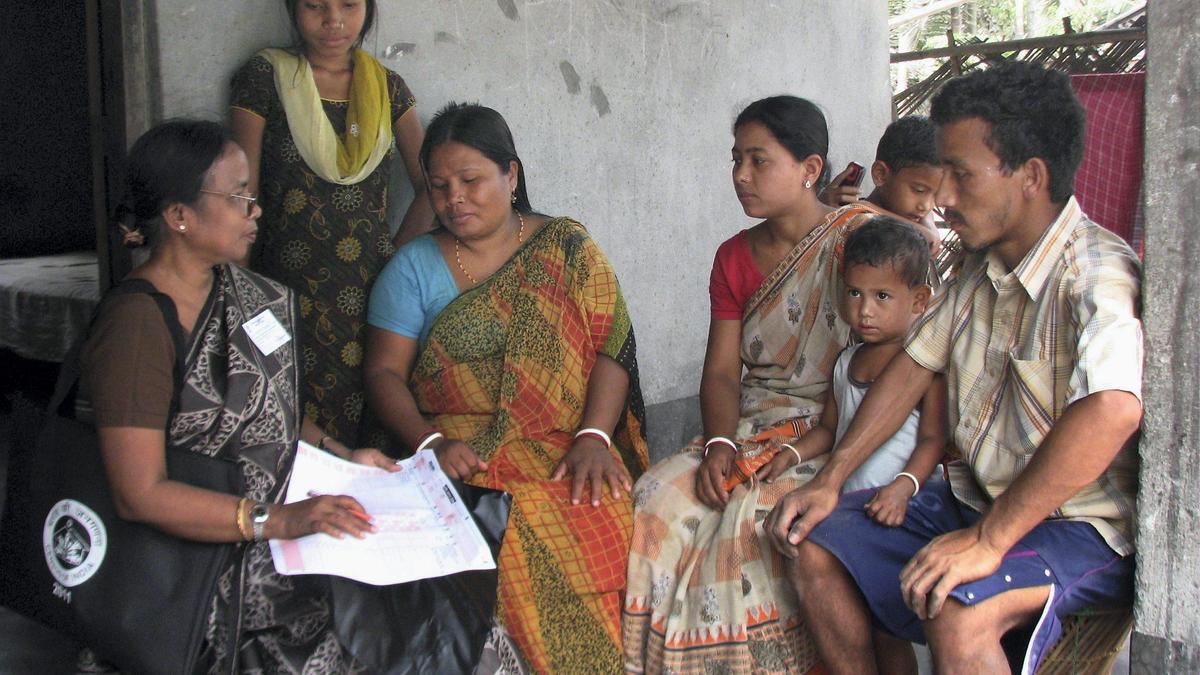
Can India’s official statistics detect large-scale undocumented migration? Undocumented migrants may evade law, but can they evade the Census? If millions of them are living in India, they must appear somewhere in the country’s official statistics. Union Minister of Parliamentary Affairs Kiren Rijiju told Parliament that “As per available inputs, there are around 20 million illegal Bangladeshi migrants staying in India”. Then, they must come across enumerators during the Census. Millions of such people then must be meeting enumerators during the decennial censuses of India. What might an undocumented migrant do in such an encounter?They can respond in three ways: avoid or duck the Census altogether, contributing to coverage error; be counted but report India rather than Bangladesh as the place of birth, creating measurement error; or report the place of birth truthfully.Each of these choices leaves a different mark in the data, which can be checked. Together, this provides a simple framework for asking whether India’s official data are consistent with the claimed scale of undocumented migration. But a framework based on birthplace has a built-in limit: the Census records where a person was born, not whether they entered legally. The same “born in Bangladesh” category contains citizens, visa-holders, and the undocumented alike, with nothing to tell them apart. What the data can speak to, then, is scale: whether a population of the claimed size exists at all.DuckingDucking is hiding from the enumerator altogether. But hiding is not the only way to duck. This is what a demographer would call coverage error. A subtler version, for example, is to deflect. For instance, tell the enumerator, “I don’t actually live here. I will be counted at my usual residence elsewhere” and then not to be counted at that other place either. Such an answer, given with no intention of being counted elsewhere, is legally no different from refusing to answer—both are offences under the Census Act—but in practice it is likely to go unnoticed. The outcome is an omission, which is exactly what the Census is built to detect via the Post Enumeration Survey (PES), an independent re-enumeration of a sample of blocks matched person-by-person against the Census. This has been conducted after every Census since 1951 to estimate coverage error—the people the Census missed—and the measurement error—the reasons for which they were missed.The 2011 PES found a net omission of 23 persons per 1,000 nationally, or 2.3%, unchanged from 2001 (up from 1.8% in 1991). The Eastern zone, with States bordering Bangladesh and where “infiltration” claim is concentrated, is best covered, as shown in the table below.
Is the undocumented migrant counted?
An analysis based on Census data suggests that there is no surge of undocumented migrants from Bangladesh, at least between 1991 and 2011
1,214 words~6 min read