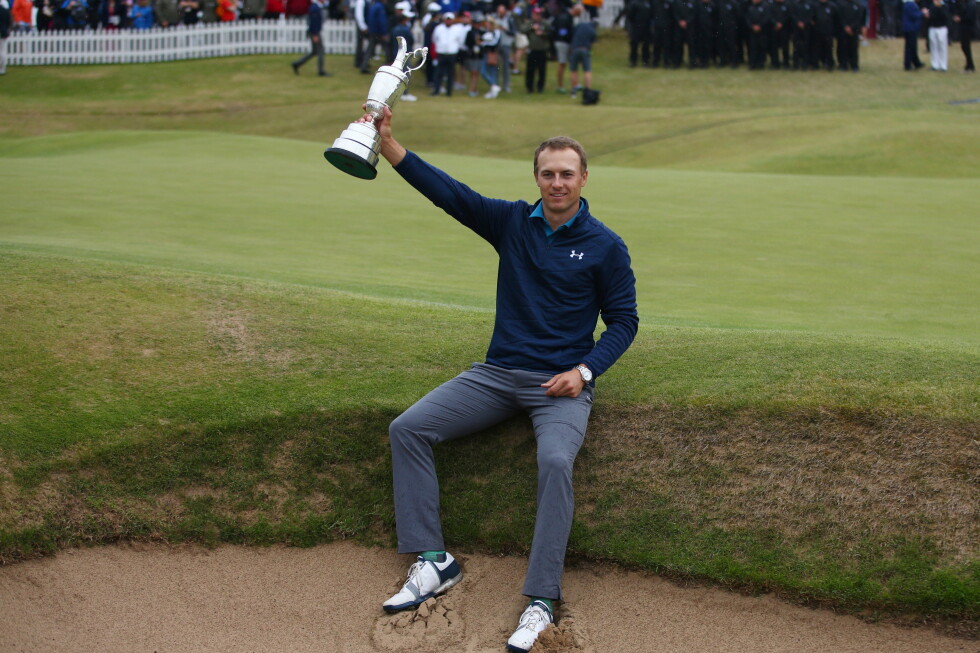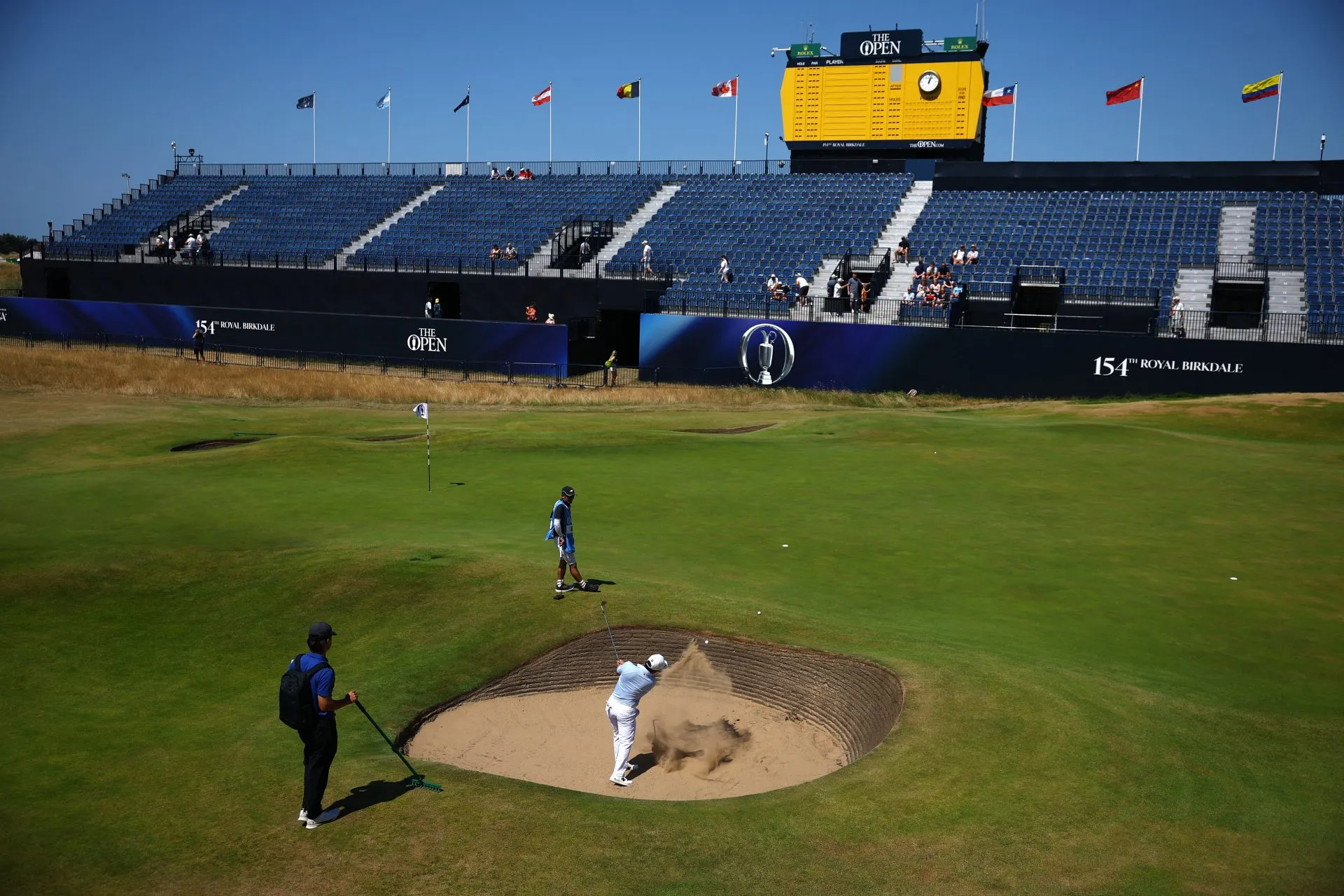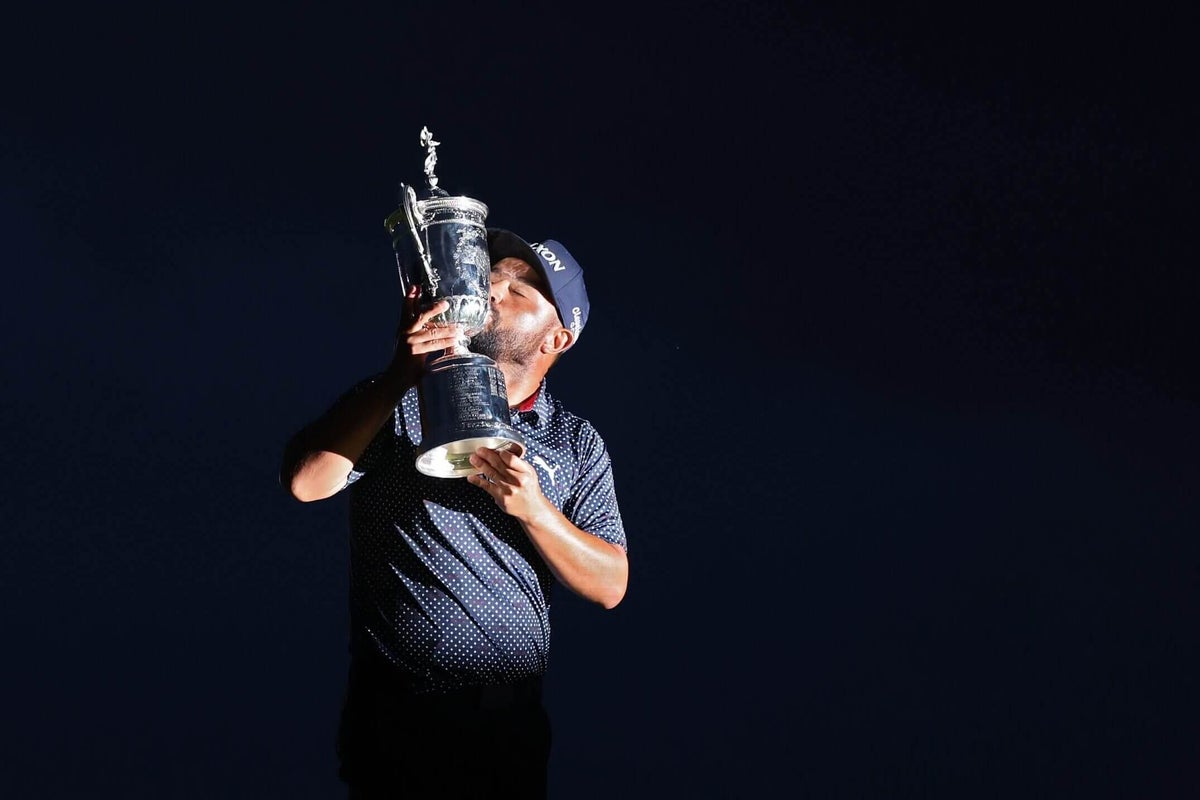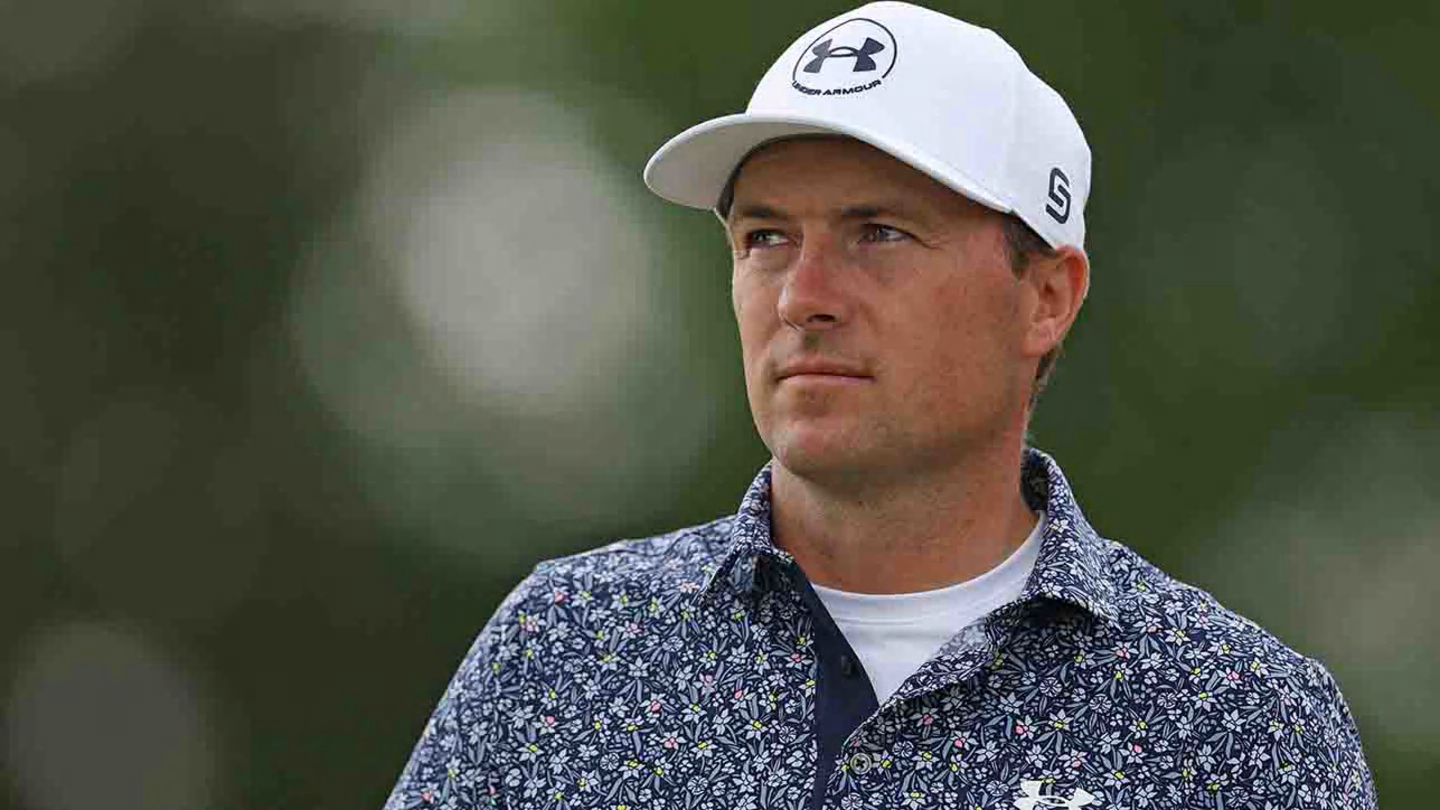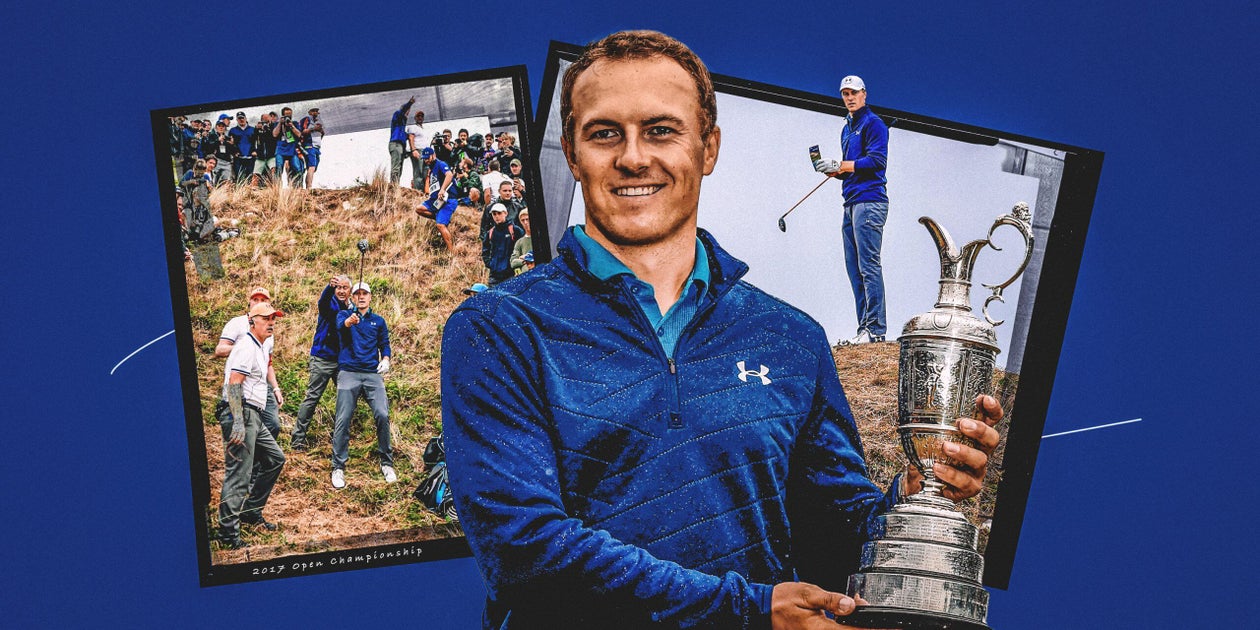
Jordan Spieth woke up on just two hours of sleep. He had flown overnight across the Atlantic, passing around the Claret Jug full of booze with friends and family. He was a few days away from turning 23. He wouldn’t be married for another year. Being a father was still a dream. Golf’s next big thing had just won his third major championship in one of the most eccentric ways possible. Nothing but good times in front of him.So, lying in bed in his Dallas home, sleep was not in the cards. Not on adrenaline like this.He texted his caddie, Michael Greller, who was sleeping in his guest room before a flight back to Seattle that afternoon.“Can you sleep?” Spieth asked.“No.”“Do you want to watch it?”It being that tournament less than 24 hours prior. Over in Southport, England, just north of Liverpool. The 2017 Open Championship, which Spieth won despite — perhaps because of — a 22-minute ordeal of confusion, patience and a whole lot of running up and down a steep hill of thick, shrubby dune grass. That sequence would be remembered as one of the more famous, hilarious stretches in recent golf history, maybe even the core memory of Spieth’s ever-entertaining prime. An errant tee shot. A lengthy ruling and deliberation. One hell of a bogey save from the driving range.Spieth and Greller had never rewatched a tournament together. Nor had they ever watched one alone. Even with the Open returning to Royal Birkdale this week, Spieth said he still hasn’t made it a point to watch again since that Monday morning. That impulse was as unusual as the day that had preceded it.“I don’t even think I will for another 20-something years,” Spieth told The Athletic as he revisited that epic Sunday in Southport.But just that once, Spieth and Greller knew they had lived through something wild. They sat on the couch and watched through the lens of “what just happened?” They remembered few details of what they said to each other. Greller confessed he fibbed about a crucial yardage to get the correct play. He lied about a motivational quote, too.And, of course, they tried watching that famous hole.“I had to fast-forward through the 13th hole,” Spieth said. “I couldn’t watch it. It was taking way too long.”On the other hand, he learned from watching just how absurd this scene was to viewers at home.“The aerial views were nuts. I was like, man, if I could have just had a drone, I’d have made this go a lot faster.”What he rewatched that morning was what the world saw on TV: A surreal scene featuring Spieth standing and pointing atop the steep hill like a conquering general and maneuvering through equipment trucks on the driving range to establish a makeshift drop zone. All while the other competitor in the arena, Matt Kuchar, stood and waited, with the biggest round of his life on the line. So, before the Open tees off Thursday for the final major championship of the year, let’s relive that 13th hole with the help of the man himself.We played all 18 holes of the Open Championship courseGregg Evans and Rachael TindeSpieth sat down Saturday evening with a three-shot lead, a game in control and the sporting world still wondering if he’d blow it. Five of the 11 questions reporters asked Spieth that night centered around handling a lead. They asked if he could close. They wondered if he’d gotten over past failures.Let’s be honest. They were asking about the 2016 Masters.It was just 14 months earlier that Spieth, the best player in the world and defending champ, had a five-shot lead on the back nine at Augusta National, and he collapsed. Fell apart. Choked. Bogey, bogey, quadruple bogey with two in the water on No. 12 to seal his defeat. He played solidly the rest of the year, but it was a clear dip from his all-time 2015 run. He was the golden boy, the next one-name star, and the difficult part about everybody willing you to win is facing their disappointment when you don’t meet their expectations.Spieth said the anticipation at Augusta National was what killed him. Contrary to what you might assume, he believes playing when you have your A-game is far more stressful than when you don’t. When you’re not swinging it well, expectations are lower. Just make it work.“But when you have it, your own expectations go through the roof, right?” he said. “’Cause you’re like, I know that I have this, and so this is definitely mine to win.”And he had to wait at Royal Birkdale. From 7 a.m. until he went to the course in the afternoon, he sat in the rental house with his buddy Justin Thomas and watched the early coverage. How was the course playing? What was the wind like? That anticipation got to him a little. He kept worrying about the first tee shot. The wind would be pumping off the left all day, and he couldn’t hit driver because there was out of bounds on the right. He knew if he could just nail that first tee shot, he’d be out of trouble until the sixth hole.He had this “high toe power draw” with his 3-wood he loved at the time, where he turned down the face a little at address. He had full command of it. And with all the nerves, he hit it perfectly. What a relief.Wrong.Instead of bouncing off the side slope left of the fairway, it missed by maybe two yards and stuck.“I waited all day for that shot,” Spieth said. “I hit it exactly how I wanted to, and I thought I was gonna kind of get paid off for it, and it kind of stuck in the side rough and I ended up making bogey.”Jordan Spieth, right, and his longtime caddie, Michael Greller, had a plan of how to attack Royal Birkdale on that final round. (Stuart Franklin / Getty Images)That set the tempo. Bogey. Par. Bogey. Bogey. Birdie. Three more pars and a bogey to enter the back nine tied with Kuchar, who was seeking his first major championship. Nobody else was within four shots. The winner of the Open would be one of the two.“People think about kind of 13 on, but that front nine was a big-time roller coaster,” Spieth said. “I had lost the lead, tried to get it back. Got it back a little, lost it again, and all of a sudden we made the turn, and it was like, man, what just happened?”Spieth and Kuchar remained tied at 8-under as they approached 13.Spieth was not aiming for the 13th fairway, but instead the right rough.“We kind of had this strategy when the wind goes off the left and helping,” he said. “It’s a long hole, so you’d have to hit less than driver down the left side, and there’s bunkers guarding the whole thing. Or you could just blow it over the right bunker in the rough, and it was some of the lightest fescue.”It was raining. Water was accumulating. Kuchar was in the fairway. Spieth was already lining up pretty far right, as was the intended strategy.Then, he swung.“There’s a chance it was a little bit of a water ball,” he said, “there’s a chance that I was late into it or whatever.”Spieth immediately stepped back and held both his hands over his head, his mouth agape, like a little kid who just broke his parents’ window.“When you’re watching guys hit, especially pros, you have a window where you expect the ball to be,” said John Wood, Kuchar’s caddie at the time. “I looked up, and I didn’t see it.”The ball kept going right. And more right. And then even more right.What’s right of the right rough? “It never even crossed my mind,” Spieth said.When it was all said and done, Spieth’s third shot on the 13th hole came from the right of the Titleist truck. (Richard Heathcote / R&A via Getty Images)The scenes that would soon unfold were unclear as Spieth picked up his tee and started walking, all while a hundred or so fans in rain jackets flocked toward a large hill. Spieth thought, “Just give me a swing.”Spieth kept walking even when an R&A official told him they couldn’t find the ball. He wasn’t going to hit a provisional. The stubbornness that makes such an elite golfer doesn’t accept that.Eventually, some fans told the official it hit somebody in the head and rolled down the bank. Another official pointed out another ball. Mass confusion ensued. There was more talk of hitting a provisional, but Spieth refused. The crowd brought at least three random balls to Spieth’s attention, but they weren’t his. “We cannot make a double. Doubles are killers,” Spieth told himself, as frustration mounted.Spieth had to stay calm as he went through the proper steps. When they finally located his ball, it had indeed first landed atop a gentleman’s head and rolled down this thick, shrubby mound.“The ball’s gonna roll ’til it comes to something that’s gonna stop it,” Spieth said. “Well, whatever’s gonna stop it isn’t gonna be good, unless it’s a person. And this was past the people.”Spieth decided the ball sitting on a steep slope and potentially on a terrible lie wasn’t playable. “Then I just started to kind of go into problem-solving mode,” he said. “Like, all right, what are my options? What can I do here? Because we’re gonna try to do everything I can to make a five.”He looked around at his options, and two club lengths in either direction for a drop would still be problematic. So he ran back up to the top of the hill. It cannot be overstated how tall and steep this hill is. Everybody else on the terrain took each step with extreme care to avoid a tumble. Spieth? Full speed up and down. To be young.Greller kept suggesting he re-tee and, worst case, score a double-bogey six, but Spieth couldn’t accept that.Those were the two most common applications of the rules concerning an unplayable ball, but a third option was available to Spieth. He could drop the ball back as far as he wanted on a straight line, as long as the original ball’s position remained directly between the new drop spot and the hole.So as he stood on the hill, he found his path — back. Farther and farther back. Until, a thought: What about the driving range?“I was 23, but I had been through already essentially a career’s worth of major championships in all kinds of positions,” Spieth said. “I remember being calm. I was just trying to be super efficient. Let’s just get moving; the more this is becoming a thing, the worse it is for me, for everyone.”Meanwhile, Kuchar had already hit from the fairway, a great shot to 20 feet for a chance at birdie. Then, all he could do was wait. There were no hard feelings or annoyances. He and Wood knew everyone was just trying to get it right. But you also don’t know it’s going to go on for that long until it does.Once Spieth took the unplayable, the hill blocked any view of what was actually going on. But there was a large broadcast screen down the left of the fairway. So they saw the situation unfold like everyone watching on TV.“Matt was cool as a cucumber through the whole thing,” Wood said. “He wasn’t antsy, he wasn’t hurry up. He wasn’t, ‘What kind of a drop is this?’ He was just chatting. Telling stories.”Matt Kuchar, left, inspects the Claret Jug alongside Spieth. (Stuart Franklin / Getty Images)Once Spieth knew the range was in play, he knew exactly what he wanted to do — go way back to the range where the equipment trucks were, then get interference from the trucks to take a drop with a clear line. What really took so long was the officials deliberating over the nearest point of relief on the practice ground side. “I don’t think that was in the local rules sheet on potential options,” Spieth said.Spieth asked about going another 30 yards past the trucks, which he could. He also got approval to drop in between the trucks, which would allow him interference. Then another official rushed over and established that they needed to go farther left and closer to the hole. Spieth was disappointed because it removed some room for error, but oh well. At least he didn’t have to climb on the truck for the drop. All involved agreed he could drop to the nearest side of the trucks.Keep in mind, this all seemed like lunacy to those watching. NBC analyst Johnny Miller, who won the 1976 Open Championship at Royal Birkdale, said he would have gone back to the tee. But this is Jordan Spieth. He doesn’t do normal.The next challenge was the yardage. There’s no yardage book from the range.The one thing Greller knew for sure was that long was bad. Gorse bushes behind the green would mean another drop. Short was better. Spieth suggested it was 270 to the front of the green. Greller thought more like 230, maybe 240. Greller paced out a walk to the top of the dune to get at least a sense, and it further confirmed his belief that Spieth was overestimating the distance. Greller talked Spieth into switching from the 3-wood to a 3-iron.“He was trying to hedge on the short side, and fortunately, he did,” Spieth said.When Spieth finally hit, after all that time, he was not happy. He was frustrated and turned around in annoyance.“I hit it a little high on the face,” he said. “So it was definitely coming out, and again, remember I thought I had further.”That’s the key. In Spieth’s mind, he thought even a good shot would be short. So when he hit it a little fat, he thought the worst. In reality, Greller’s read was right. If Spieth had hit it well, it would have rolled right up to the green. Instead, his shot cleared a shrubby ridge and rolled to the first cut for a short chip.Spieth immediately went to Kuchar, explaining the entire ordeal. The latter was understanding, which made the former feel a little better.From there, Spieth still had a difficult chip with a bunker in front of him and a mound working down toward the pin. And he performed Spieth magic. He clipped it. Zero divot. A floppy little chip that bounced off the top of the mound and slowly rolled down the slope for an eight-foot putt. Once Spieth made it to save par, Greller knew what was about to happen. He visibly laughed as Spieth handed him his putter. “I knew that this was going to be just an absolute blast to the finish line — a total peace, and just buckle up. And I sensed it in him,” Greller told Golf Digest in 2018.One moment, it looked like Spieth would double while Kuchar had a chance at birdie, a potential three-shot swing. Instead, Spieth trailed by just one with five to go.“It felt like I gained a shot off of what I deserved,” Spieth said. “Which is typically mentally, you know, it’ll make you feel the same way going to the next.”From there, Spieth played five of the best holes of his career. A “flow state,” he called it.Kuchar had never won a major. Spieth respected the man 16 years his elder, but Spieth knew he had this edge. He kept telling himself, “Just have the closer putt on every hole.”And he did exactly that, hitting approaches inside of Kuchar on each remaining hole. He put his approach on 14 just four feet from the pin for birdie. On 16, he made a 30-footer. On 17, it was seven feet. And on 18, he had an easy par while Kuchar bogeyed.But it was on the par-5 15th that Spieth unveiled the most famous line of his career.Spieth made a miraculous 50-foot eagle putt to give himself a two-stroke lead. But amid the roar of the Royal Birkdale crowd, Spieth didn’t celebrate. He backed away, pointed at the hole and shouted, “Go get that!” to Greller, a grin across his face the whole time.“Go get that,” Spieth said, pointing to his putt that essentially clinched the 2017 Open. (Stuart Franklin / Getty Images)The story goes that Spieth was working out earlier in the Birkdale gym while old Opens played on the TV, and he noticed the caddies would grab the ball out of the hole for players. For some reason, that stuck in his mind and he couldn’t help himself in his biggest moment.At some point on those final holes, Spieth also went to Wood to apologize for 13. Wood replied that he should apologize for making all those putts.What seemed like a Spieth collapse in the making turned into a three-shot win at the Open Championship.Kuchar’s wife and kids were waiting on the 18th green, there to surprise him during what they hoped would be his moment of triumph. Instead, their reunion was filled with hugs and tears.And Spieth, the boy wonder, got his third leg of the career Grand Slam. As he sat down for the Open Champion news conference, he had some jokes.“We’re going to skip the first 12 holes, right?”
Jordan Spieth relives the 2017 Open Championship and his driving range drop
The morning after his last major win, Spieth and caddie Michael Greller watched it together. They couldn't believe what had just happened.
2,893 words~13 min read