Dark matter has long been one of astronomy's greatest mysteries. It cannot be seen or touched, yet its gravitational influence helps shape galaxies and the large scale structure of the universe. For decades, scientists have relied on the "cold dark matter" model to explain how galaxies formed and evolved. But as telescopes and observations have become more precise, researchers have uncovered several puzzling features that the standard model struggles to explain.
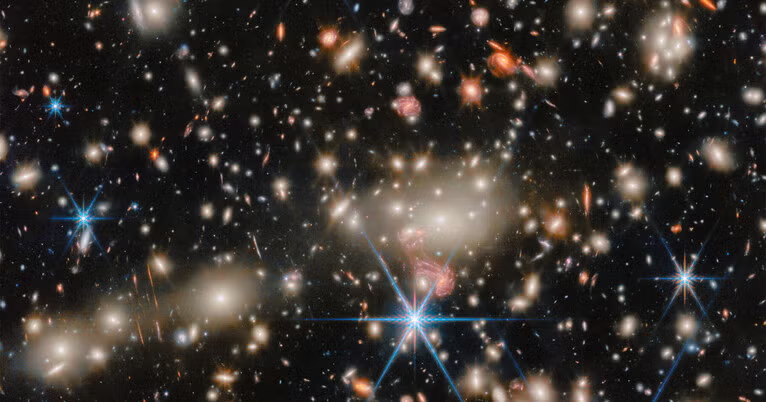
Among the biggest mysteries are the surprisingly low concentrations of dark matter found at the centers of some dwarf galaxies and the unexpectedly dense dark matter clumps inferred from strong gravitational lensing. Although these observations seem to point in opposite directions, a new study suggests they could share the same underlying explanation.
A New Theory for Dark Matter
Physicists at the Purple Mountain Observatory of the Chinese Academy of Sciences (CAS) propose that dark matter may not consist of a single type of particle. Instead, it could be made up of particles with different masses.
Their new "two component self interacting dark matter" model includes at least two kinds of dark matter particles, one heavier and one lighter. In addition to interacting through gravity, these particles can also collide directly with one another. Those interactions lead to a process called "mass segregation."