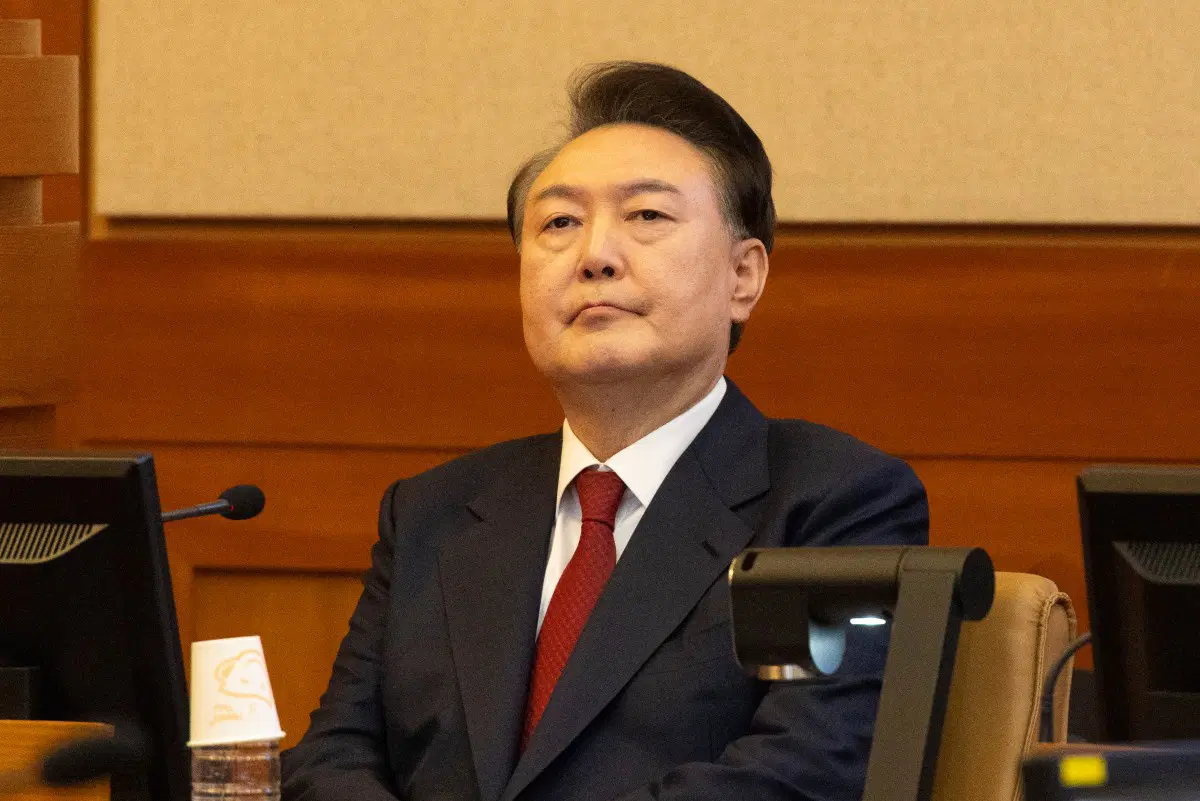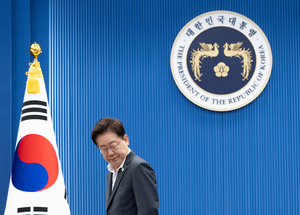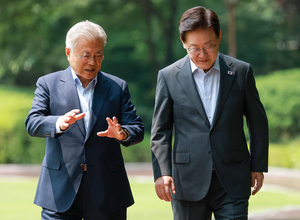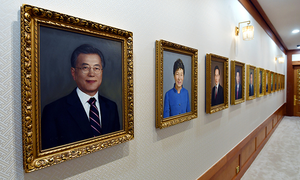
Political scientist says former presidents’ recurring legal troubles reflect the presidency’s expansive appointment and budgetary powers A portrait of former President Moon Jae-in (first from left) hangs among the portraits of other former presidents in Cheong Wa Dae. (Herald DB) Former President Moon Jae-in’s bribery case returned to court Tuesday, adding the latest chapter to South Korea’s long history of former presidents facing criminal investigations after leaving office.The Seoul Central District Court resumed preparatory proceedings after a six-month hiatus in a case accusing Moon of receiving 217 million won ($145,000) in bribes from former lawmaker Lee Sang-jik, founder of budget carrier Eastar Jet.Prosecutors allege the money was indirectly provided through salary and housing expenses paid to Moon’s former son-in-law, who worked for Thai Eastar Jet between 2018 and 2020. They contend the payments were made in return for political favors extended to Lee, who joined Moon’s 2017 presidential campaign before taking public and elected office.Moon has denied wrongdoing, arguing that prosecutors improperly treated benefits received by an independently living family member as bribes paid to him.His indictment in April 2025 made him the seventh former South Korean president to face criminal charges since democratization and revived attention to the so-called “curse of Cheong Wa Dae,” a phrase describing the repeated prosecutions, imprisonment and family scandals surrounding the country’s leaders.A long history of presidential downfallThe expression gained widespread currency in the 2010s as former Presidents Lee Myung-bak and Park Geun-hye were prosecuted and imprisoned, though the pattern predates the term itself.Former military rulers Chun Doo-hwan and Roh Tae-woo were arrested in 1995. They were convicted the following year of mutiny, treason and corruption over the 1979 military coup and the violent suppression of the 1980 Gwangju Democratic Uprising.Chun was initially sentenced to death and Roh to 22 years and six months in prison, though both sentences were later reduced. They were pardoned in 1997 by then-President Kim Young-sam.Kim Young-sam and Kim Dae-jung avoided prosecution themselves, but corruption scandals involving their sons tarnished both presidencies. Kim Young-sam’s son was imprisoned for bribery and tax evasion, while two of Kim Dae-jung’s sons were convicted of accepting illicit payments.Perhaps the most tragic episode came after Roh Moo-hyun left office in 2008.Prosecutors questioned Roh in April 2009 as part of a bribery investigation involving payments allegedly made to members of his family. He died by suicide the following month without being indicted, and the investigation was closed after his death.His successor, Lee Myung-bak, was convicted of embezzlement and bribery and sentenced to 17 years in prison before receiving a presidential pardon from Yoon Suk Yeol in 2022.Park Geun-hye became South Korea’s first president to be removed from office after the Constitutional Court upheld her impeachment in 2017.She was later convicted of bribery and abuse of power stemming from the influence-peddling scandal involving her longtime confidante Choi Seo-won, formerly known as Choi Soon-sil.Park received a combined 22-year prison sentence before Moon pardoned her in 2021.Moon’s successor, Yoon Suk Yeol, declared martial law on Dec. 3, 2024, but withdrew the order about six hours later after lawmakers voted to reject it.Yoon was impeached in 2025 and convicted of leading an insurrection and sentenced to life imprisonment in February 2026.Moon’s indictment meant that every South Korean president elected since Roh Moo-hyun had either faced criminal prosecution or, in Roh’s case, a criminal investigation involving his family.Why does the pattern persist?Lee Sun-woo, an associate professor of political science at Jeonbuk National University, said the pattern is rooted less in fate than in the structure of South Korea’s presidency.South Korean presidents wield unusually broad powers compared with presidents in many other presidential systems, including the United States, Lee said.“South Korean presidents have exceptionally broad personnel and budgetary powers,” Lee told The Korea Herald. “That makes both presidents and those around them more vulnerable to corruption during their time in office.”Such powers also make it difficult for presidents to oversee everyone within their political networks, increasing the risk that misconduct involving appointees, aides or family members later becomes the subject of investigations.Lee cautioned, however, that describing South Korea as having an “imperial presidency” oversimplifies its political system.While presidents exercise enormous influence over appointments and budget allocation, their policymaking authority is often constrained by the single five-year term and periods of divided government, when opposition parties control the National Assembly.Lee also said presidents have traditionally exercised broad influence over investigative agencies through their appointment powers.That has fueled accusations that investigations into former presidents are politically motivated, particularly after changes in government. Lee said recent administration efforts to separate investigative and prosecutorial powers could weaken presidential influence over law enforcement.The pattern now casts a shadow over the presidency of Lee Jae Myung.In an interview with The Economist in June, Lee acknowledged that it was “pretty likely” he could eventually face a similar fate.“His legacy will thus in part depend on whether he can break the curse of the Cheong Wa Dae,” the magazine wrote.
‘Cheong Wa Dae curse’ returns with Moon Jae-in trial
Former President Moon Jae-in’s bribery case returned to court Tuesday, adding the latest chapter to South Korea’s long history of former presidents facing crimi
822 words~4 min read