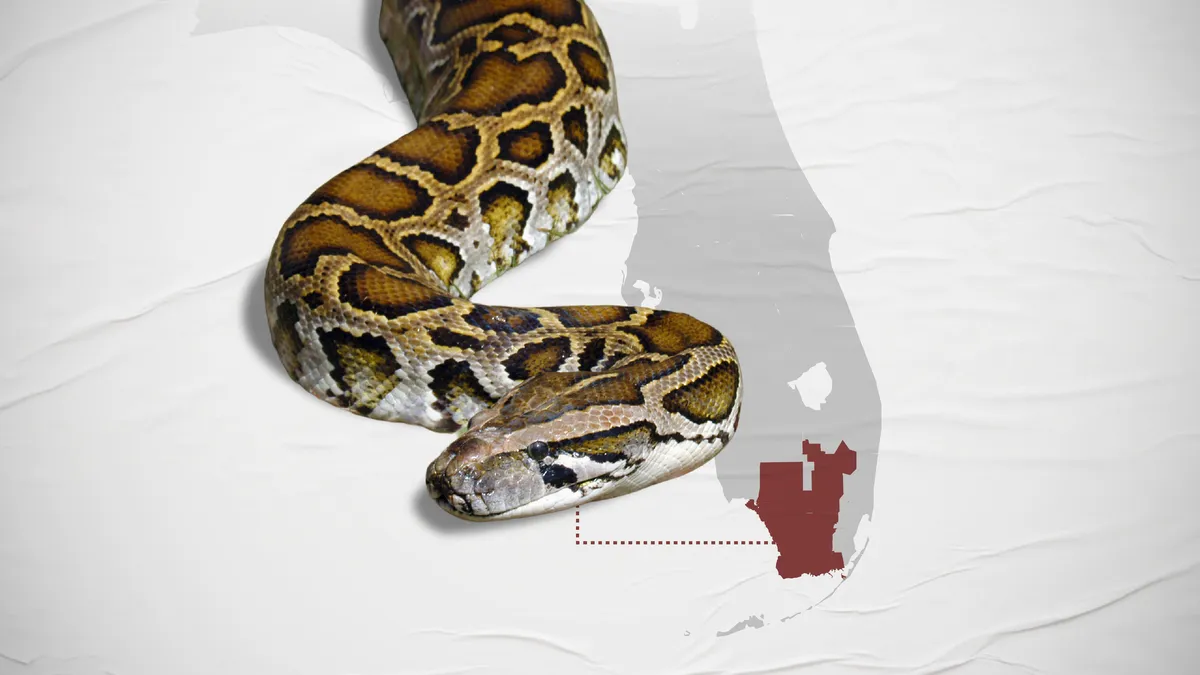
The annual Florida Python Challenge is set to begin.Starting at 12:01 a.m. ET July 10 and concluding at 5 p.m. July 19, participants have the chance to win over $25,000 in prizes by removing invasive Burmese pythons from South Florida.These non-native snakes pose a threat to local wildlife, primarily residing in and around the Everglades ecosystem, where they prey on various birds, mammals and reptiles. The event, organized by the Florida Fish and Wildlife Conservation Commission, aims to protect the Everglades and its native species by reducing the population of these invasive reptiles. Contestants have a window of 10 days to capture and kill as many Burmese pythons as they can.How many pythons are removed each year in the Python Challenge?In 2025, participants in the Florida Python Challenge removed 294 invasive Burmese pythons from the Everglades. More than 934 people from 30 states and Canada registered for the competition.After the Challenge last year, Rodney Barreto, Florida Fish and Wildlife Conservation Commission Chairman said "The record number of invasive pythons removed from the Everglades during this year’s competition is a big win for native wildlife. With over 1,400 pythons removed during all Florida Python Challenge events to date and over 16,000 pythons removed by FWC and South Florida Water Management District contractors since 2017, collective efforts are the key to continue addressing the threats Burmese pythons pose to Florida’s native wildlife and ecosystems."Unable to view our graphics? Click here to see them.Where will the python challenge take place?This year, the event returns to Everglades National Park as a partner and one of eight official competition locations for the Florida Python Challenge.Where do Burmese pythons live?Originally from Southeast Asia, the Burmese python was introduced to southern Florida either through accidental escape or intentional release of captive animals.In 1979, the first observation of a Burmese python in the wild in South Florida was recorded in Everglades National Park. The heaviest python ever caught in Florida was an 18-foot, 215-pound snake. It was caught by a biologist with the Conservancy of Southwest Florida in Naples in 2021.Size of the Burmese pythonThe Florida Fish and Wildlife Conservation Commission keeps track of length and weight of Burmese pythons after sightings are reported. The longest Burmese python ever captured in Florida, in July 2023, measured more than 19 feet.What are the rules of the Florida Python Challenge?Contestants must carry a printed or digital copy of their Florida Python Challenge registration notification email while hunting.Contestants must complete required online training and receive a unique completion code.Only Burmese pythons removed from competition locations are valid entries.The use of firearms is prohibited.The use of dogs or other animals to search, capture or kill is prohibited.Air guns and captive bolts are allowed.Python carcasses must be kept chilled or frozen, then turned in to the nearest Florida Python Challenge check station within 24 hours of capture.What should you do if you see a Burmese python?Summer is the season when you're most likely to encounter a Burmese python in Florida. During the hot daytime hours, these snakes tend to stay in one place, but at night, they become more active and are often seen crossing levees or roads.If you spot a Burmese python, take a photo, mark your location and call the Exotic Species Hotline at 888-483-4681. You can humanely kill Burmese pythons on private land at any time with a landowner's permission. You don't need a permit to kill the invasive species. Live transport of pythons is not allowed.There are multiple ways to humanely euthanize a python, but here are the basic guidelines from the fish and wildlife commission:Step 1: Immediate loss of consciousnessUse a captive bolt, firearm or air gun to shoot directly to the brain.Step 2: Destroy the brainMake sure the python is unconscious.Insert a small rod, like a screwdriver, spike or pick, into the cranial cavity and twist it to ensure the entire brain is destroyed.SOURCE: USA TODAY Network reporting and research; Florida Fish and Wildlife Conservation Commission
Florida Python Challenge is back. Why the state wants more snake hunters
Florida is launching its annual Everglades hunt to track down and remove invasive Burmese pythons.
662 words~3 min read