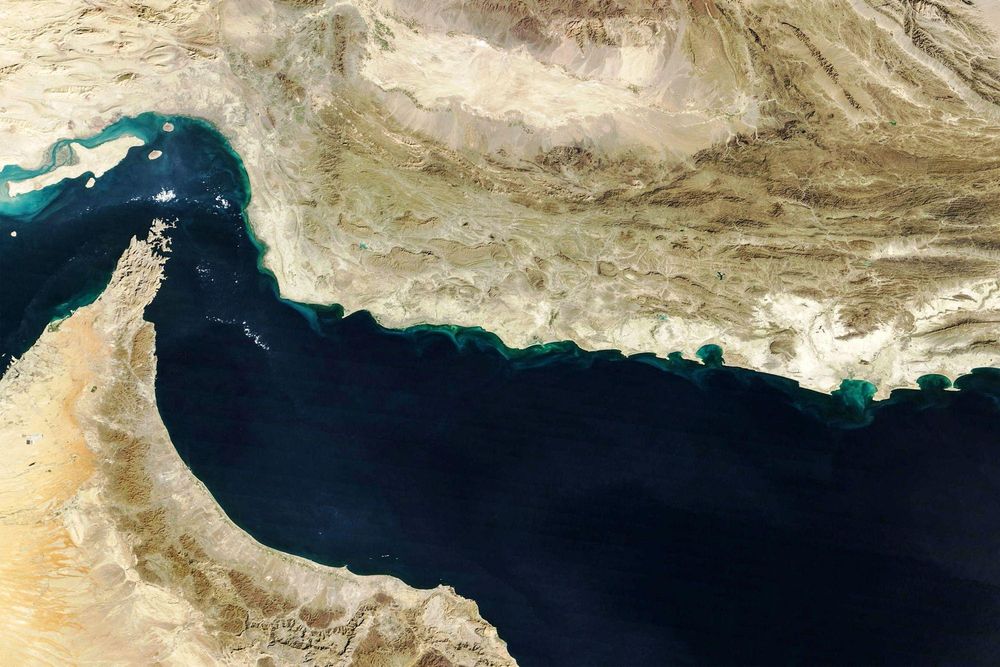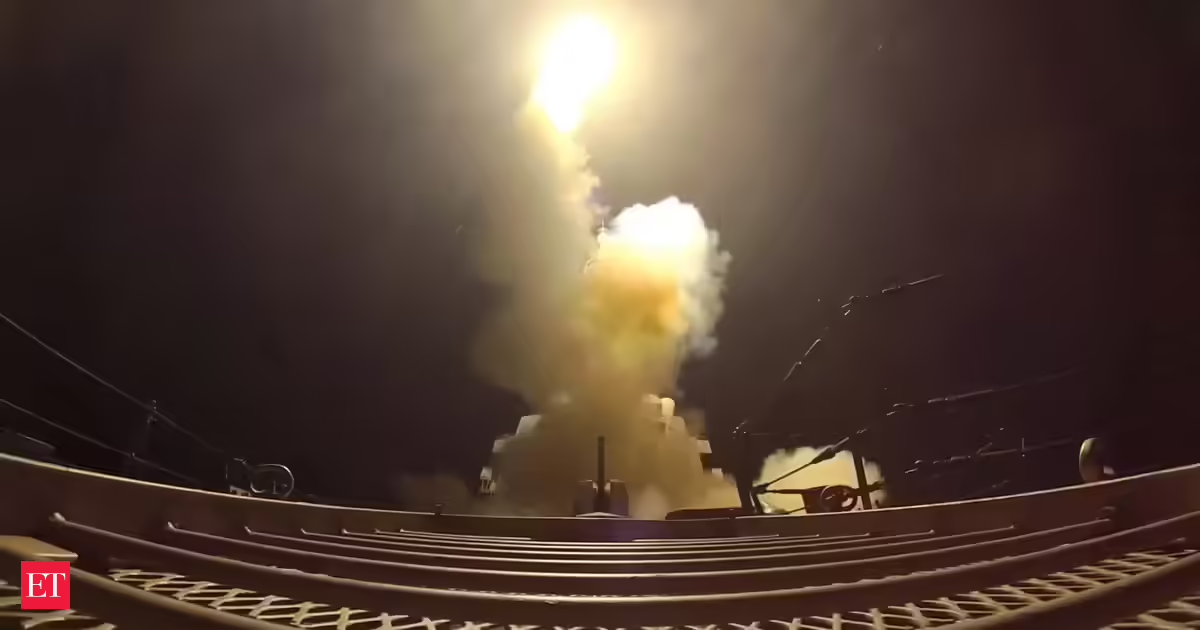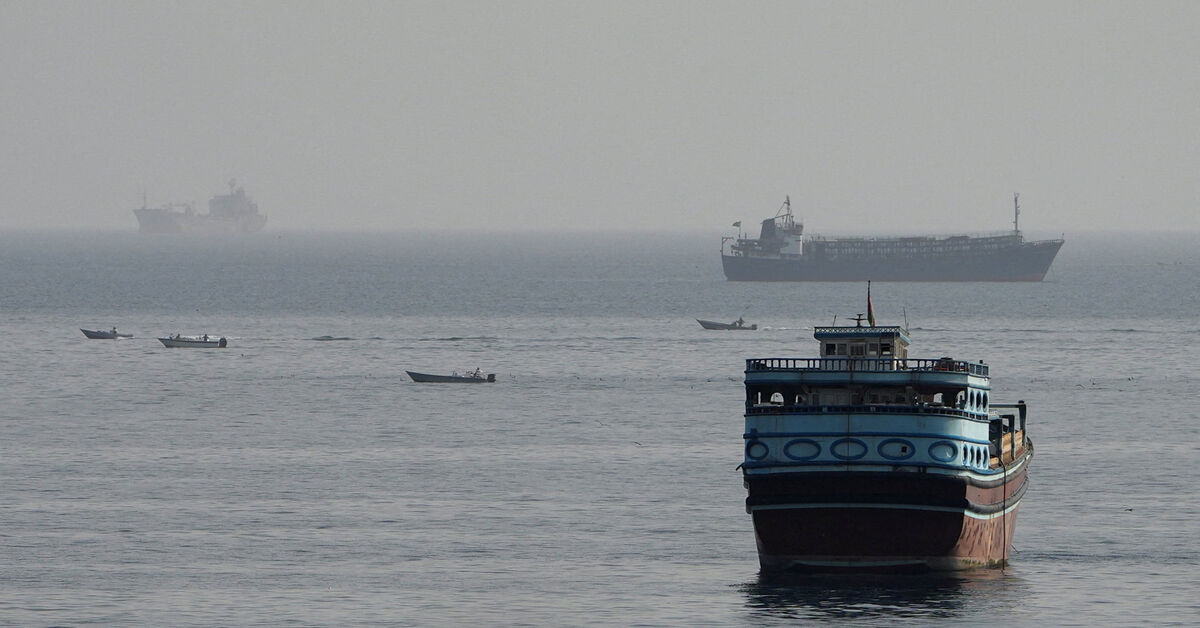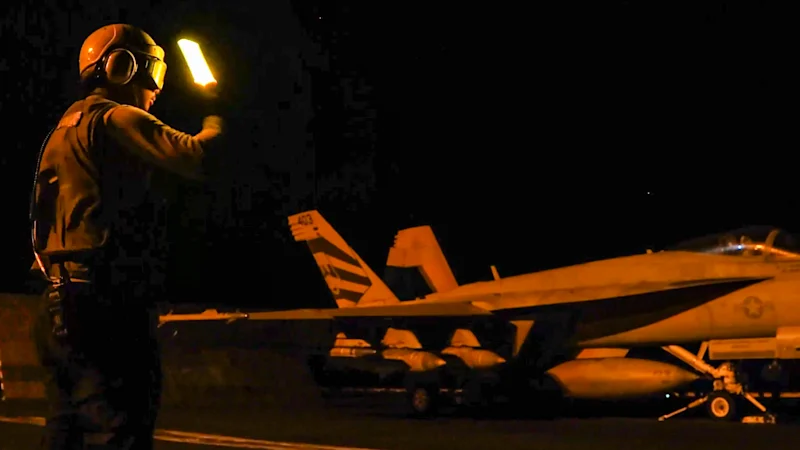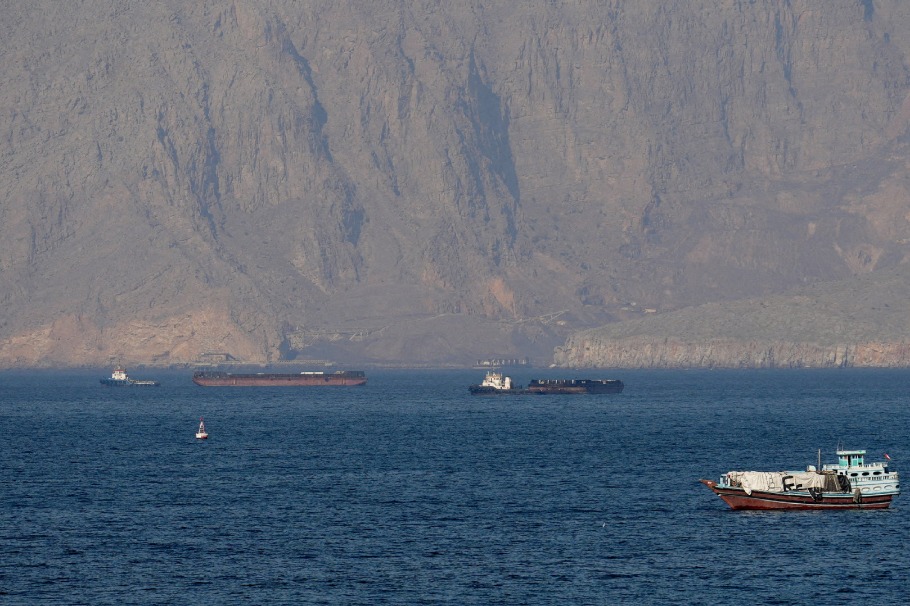
BATTLE FOR HORMUZ: Over the weekend, Iran and the United States traded taunts that could be summed up as: “We control the Strait of Hormuz,” “No, you don’t,” “Yes, we do,” “Nuh uh. WE control it.” They also traded attacks. On Saturday: “U.S. forces hit approximately 140 Iranian military targets with precision munitions launched by land- and sea-based fighter aircraft, drones, and naval vessels. Targets included Iranian missile and drone sites, naval capabilities, ammunition storage facilities, communication networks, and coastal surveillance locations,” according to the U.S. Central Command, bringing the total since hostilities resumed to 300 targets.Then on Sunday, Iran hit a container ship as was transiting the strait along the the coast of Oman, prompting the U.S. to launch a “new wave of offensive strikes … “hitting dozens more targets,” CENTCOM said, insisting in a statement, “The Strait of Hormuz is a vital maritime corridor for global trade. Iran does not control it.”
“The Strait of Hormuz is open to all vessels seeking to lawfully transit the international waterway. U.S. forces are positioned and prepared to ensure that freedom of navigation remains available despite unwarranted Iranian aggression, harassment, threats, and arbitrary declarations,” CENTCOM said in a post on X. “Iran does not control the strait. Traffic is flowing.”“The Strait of Hormuz is our territory, and we will not allow a rogue and child-killing army from the other side of the world to continue its illegal interference in it,” Iran’s Islamic Revolutionary Guard Corps responded, launching strikes against U.S. sites in Kuwait, Bahrain, Qatar, and its neighbor Oman, which accounting the now defunct MOU, is supposed to working out “arrangements” to administer the strait.”On Friday, President Donald Trump posted on Truth Social, “The Islamic Republic of Iran has asked us to continue ‘talks.’ We have agreed to do so, but the United States has stated to them, in no uncertain terms, that the Cease Fire is OVER!”US LAUNCHES ADDITIONAL STRIKES ON IRAN AFTER TEHRAN EXPANDED ATTACKS IN THE GULFMCKENZIE: ‘THESE STRIKES ARE GOING TO CONTINUE’: The former commander of the U.S. Central Command, retired Marine Gen. Frank McKenzie, argues the tit-for-tat strikes are not accomplishing the objective of opening the strait for the free flow of commercial traffic. “The fact of the matter is, the Iranians generally only respond to military force and to extreme pressure,” McKenzie told host Margaret Brennan on CBS’s Face the Nation. “We certainly have the capability to control the Strait of Hormuz if the president chooses to follow that course of action …That capability is resident in the U.S. military should the president elect to employ it,” McKenzie said. “That would include opening the Strait of Hormuz, maintaining the Strait of Hormuz open, and, in fact, seizing Kharg Island should we elect to do that.”“That’s something we should think about doing because possession of Iranian soil would be a significant factor in future negotiations with Iran, McKenzie said. “It would require putting warships up into narrow waters. But the U.S. Navy doesn’t love to do that, but they’re very good at it. And, if necessary, they can do it and they can do it well.”Last week, former Defense Secretary and CIA Director Leon Panetta made a similar argument. “I think the president has a tough decision to make whether he’s going to take control of the Straits of Hormuz and remove that leverage from Iran. That’s not easy, Panetta said on CNN. “It’ll involve casualties. It’ll involve military action. But I do not see any kind of clear path here as long as Iran controls the Straits of Hormuz.”“We had plans,” Panetta said, recalling his time at the Pentagon. “What it involved is basically boots on the ground, capturing about 50 miles on either side of the Straits, 100 miles in depth, and then using our Navy, obviously, to make sure we control access to the Straits of Hormuz.”“This is not a bloodless endeavor we’re embarked upon,” McKenzie said. “Bases are going to be hit and buildings are going to be destroyed and, tragically, people are going to die. And if we’re going to stay in this game and continue to confront Iran, which I believe is in our interest to do, we’ve got to be prepared for this.”“I mean, they could take Kharg Island. We have heard talk of that. People don’t recognize that Kharg Island isn’t even in the strait,” Rep. Seth Moulton (D-MA) said on CNN Saturday. “It might put some pressure on Iran. But guess what? Iran is just going to pummel our troops on the ground just off their shore. More American casualties is just going to get us drawn in deeper and make this situation even worse.”“So, once again, the big concern is that Trump has no plan, has no idea what he is doing,” Moulton said. “He never has. And if he actually tries to escalate his way out of this, it could make a bad situation even worse for the United States of America and cost more American lives.”OPINION: WHY DESTROYING OR SEIZING KHARG ISLAND IS A BAD IDEATRUMP PREPOSTEROUS, POSTHUMOUS PLAN FOR REVENGE: Trump seems a bit rattled by all of the Iranian threats to kill him in retribution for the assassination of Iran’s supreme leader and more than 40 other high-ranking Iranian officials in the opening days of the war.On Friday, Trump announced on Truth Social that he has left strict orders for the U.S. military to carry out a year-compaign of annihilation, should Iran succeed in taking him out.“1000 Missiles are Locked and Loaded and aimed at the Islamic Republic of Iran, with thousands of more to immediately follow, should the Iranian Government act on its threat, pronounced in many corners of the Globe, to assassinate, or attempt to assassinate, the sitting President of the United States of America, in this case, ME!” Trump said. “Orders have already been given, and the U.S. Military is ready, willing, and able, for a one year period of time, subject to extension, to completely decimate and destroy all areas of Iran.”The one flaw in the plan is that should Trump die, his posthumous standing order would have no legal standing, and the response would be up to the new president, which in this case would be Vice President JD Vance.Trump’s attempt to deter Iran with threat of a “Doomsday scenario” comes after Iran’s new Supreme Leader Ayatollah Mojtaba Khamenei — who has yet to be heard or seen in public — posted a lengthy call for revenge on his official X account.“We pledge to avenge your pure blood and the blood of all the martyrs of these two [recent] wars by taking revenge against the criminal, disgraceful murderers. This vengeance is what our nation is demanding, and this must definitely be done,” the post said. “The criminal, disgraceful murderers of the martyred Leader, whose names are fully documented from the highest to the lowest ranks, will carry their dream of a peaceful death in bed to the grave.”MOJTABA KHAMENEI VOWS REVENGE FOR HIS FATHER’S ASSASSINATIONGood Monday morning and welcome to Jamie McIntyre’s Daily on Defense, written and compiled by Washington Examiner National Security Senior Writer Jamie McIntyre (@jamiejmcintyre) and edited by Keely Bastow. Email here with tips, suggestions, calendar items, and anything else. Sign up or read current and back issues at DailyonDefense.com. CLICK HERE TO SIGN UP OR READ BACK ISSUES OF DAILY ON DEFENSEHAPPENING TODAY: UKRAINE’S SEA OF AZOV CAMPAIGN: Ukraine is using its long-range drone capability and taking advantage of Russia’s depleted air defenses to decimate its fleet of commercial oil takers in the Sea of Azov that are the main source of fuel for Russian troops in eastern Ukraine as well as civilians in Crimea.“A total of 76 vessels were struck over six days,” Robert “Magyar” Brovdi, Ukraine’s top drone commander, posted on X Saturday, along with thermal images of ships being struck by Ukrainian drones. “The shadow oil fleet is visibly shrinking. A week of default continues. It appears traffic through the Kerch Strait has come to a halt.”“The technological humiliation of the empire continues. It will fall because of Crimea,” the post by Magyar’s Birds boasted. “We will stand. Moscow will fall. Crimea will be fed back up and rebuilt.”Among the ships disabled, were “four ferries and 10 tankers that Russia uses to transport oil and petroleum products and circumvent sanctions,” the Institute for the Study of War said in its latest update, noting “Ukrainian strikes against Russian seaborne gasoline transports over the past week represent a new phase in Ukraine’s efforts to isolate occupied Crimea from the Russian logistics network and to disrupt Russian seaborne shipping routes.”In addition over the weekend, with Russia’s air defenses now deployed to protect Moscow and the Kerch bridge, Ukraine was able to hit the Syzran Oil Refinery, 500 miles deep into Russia, for a third time. It’s the latest low to Russia’s refining cavity which has produced a critical fuel shortage and long gas lines across the country.WITH UKRAINE AND RUSSIA DEADLOCKED, TRUMP MAY FINALLY HAVE A REAL SHOT AT ENDING THE FIGHTINGTIMES REPORTERS SUBPOENAED: After exposing Trump’s fishy cover story for why he was unable to fly his new luxury Air Force out of of Ankara after the NATO Leaders summit last week, the Trump administration has directed the Justice Department to subpoena four New York Times reporters who revealed the real reason for the plane switch, namely a security threat, and the lack of defensive systems on the new plane.The journalists, citing anonymous sources, reported that the new Air Force One, “lacked some of the advanced security features of the older aircraft, including antimissile capabilities.” Trump denied to reporters on Air Force One returning to the U.S. that there was any security concern — “No, no. Why would there be?” — and insisted the new plane was “going to go to a couple of bases, stop, so the soldiers can see it because, it’s truly magnificent.”That turned out to be untrue. Although U.S. troops at Mildenhall, in the U.K. were mustered out for a group picture in front of the Qatari-donated Boeing 747-8, before Trump boarded it for the flight home.Now the DOJ wants the outlet’s reporters to give up their sources. “Our journalists report the facts and advance the American public’s right to know how their government is operating and their taxpayer dollars are being used,” David McCraw, the New York Times’s top newsroom lawyer, said in a statement on Friday night. “This brazen act should be seen as nothing more than an attempt to prevent the public from knowing what is happening in their country by intimidating journalists from doing their jobs.”“Donald Trump is one of the weakest, most thin-skinned individuals the world has ever seen,” Sen. Chuck Schumer (D-NY) posted on X. “Reporters have the right and duty to report the truth. It’s not their fault his foreign-gifted plane is a national security threat. This subpoena is a gross overreach and a disgusting misuse of federal law enforcement resources that should alarm every American.”READ MORE FROM THE WASHINGTON EXAMINERTHE RUNDOWN: Washington Examiner: US launches additional strikes on Iran after Tehran expanded attacks in the GulfWashington Examiner: Iran will target Israel if US continues strikes after ceasefire collapses, official warnsWashington Examiner: Iran returns to no-limits Gulf State target list after declaring Strait of Hormuz closedWashington Examiner: Iran hits cargo ship in Strait of Hormuz as CENTCOM announces new strikesWashington Examiner: Mojtaba Khamenei vows revenge for his father’s assassinationWashington Examiner: With Ukraine and Russia deadlocked, Trump may finally have a real shot at ending the fightingWashington Examiner: Defense industrial base goes into overdrive for US and European productionWashington Examiner: Hegseth’s uneven application of rules and standardsWashington Examiner: Patel says FBI helping local authorities after Lindsey Graham’s sudden deathWashington Examiner: Trump says Lindsey Graham was ‘a little tired’ in phone call ‘shortly before’ deathWashington Examiner: Trump orders all US flags lowered to half-staff in honor of late Lindsey GrahamWashington Examiner: Lindsey Graham’s risk of heart attack heightened by family historyWashington Examiner: Graham’s reputation as major foreign policy voice exemplified by final day in UkraineWashington Examiner: US on track to intercept 16 times as many suspected terrorists at border under Trump thanks to cartel designationsWashington Examiner: How Putin is exploiting Poland and Ukraine’s oldest woundWashington Examiner: Opinion: Why destroying or seizing Kharg Island is a bad ideaWall Street Journal: The War in Ukraine Is Shifting Against Putin but He Isn’t Giving InReuters: Kremlin Says Russia Is in Touch with Turkey on Fate of Russian S-400 MissilesNew York Times: How Putin Turned Japan Into a Den of SpiesThe Atlantic: CIA Officers Can Sense the Threat WithinWashington Post: Survivors of Iranian attack that killed 6 U.S. troops say generals ignored warningsNew York Times: Times Journalists Subpoenaed as Trump Escalates Pressure on MediaWashington Post: Iraq’s prime minister Ali al-Zaidi: Why I’m coming to WashingtonWashington Post: He fleeced the Navy for millions, then fled the country. Now he wants a pardon.Air & Space Forces Magazine: F-22s Become Latest USAF Combat Aircraft to Leave Middle East Despite Iran TensionsDefense News: ‘Testing Is Now Underway’: Zelenskyy Confirms Progress on Major US Defense DealsAir & Space Forces Magazine: Analysis: How Ukraine Is Reimagining Strategic AttackBreaking Defense: Air Force Pushing Contractors to Purge Anthropic by Sept. 1: MemoDefense Scoop: DARPA Gearing Up for Heavy-Lift Drone CompetitionAir & Space Forces Magazine: Aircraft Procurement, Space Launch Could Pay for Unexpected Personnel CostsBreaking Defense: The Autonomous CCA Wingmen of 2030 May Look Nothing Like Today’s AssumptionsAir & Space Forces Magazine: Boeing’s Ghost Bat Drone Flew with F-35 and More in Pacific ExerciseTask & Purpose: Pararescue Team Parachutes in 700 Miles Out at Sea to Save a Fisherman’s LifeTHE CALENDAR: MONDAY | JULY 13 1 p.m. — Carnegie Endowment for International Peace virtual discussion: “Is Israel Losing America?” with S.E. Cupp, host of “Battleground NYC: The Fight For Your Vote”; Ron Brownstein, CNN senior political analyst; and Aaron David Miller, senior fellow, CEIP American Statecraft Program https://carnegieendowment.org/events/2026/07/is-israel-losing-americaTUESDAY | JULY 14 8:45 a.m. 2168 Rayburn— Progressive Policy Institute discussion: “Ukraine, Europe, and the U.S.: A Shifting Balance,” with Melinda Haring, senior adviser, Razom for Ukraine; Torrey Taussig, director, Atlantic Council’s Transatlantic Security Initiative; Tamar Jacoby, director, PPI’s New Ukraine Project; and Paul Glastris, editor in chief, Washington Monthly https://www.progressivepolicy.org/event/ukraine-europe10 a.m. — Center for a New American Security virtual discussion on the release of a report: “Forecasting the Future of the Axis of Upheaval: The View from Moscow,” with author Andrea Kendall-Taylor, senior fellow and program director, CNAS Transatlantic Security Program; Nicole Grajewski, assistant professor at Sciences Po’s Center for International Studies; Marcin Kaczmarski, senior lecturer of security studies at the University of Glasgow https://events.cnas.org/forecastingthefutureoftheaxis10 a.m. — Center for American Progress virtual discussion: “Building Resilience in Ukraine: Humanitarian Response and Recovery,” with Bernadette Castel-Hollingsworth, U.N. High Commissioner for Refugees representative in Ukraine https://www.americanprogress.org/events/building-resilience-in-ukraine12 p.m. — Foreign Policy virtual discussion: “Is Trans-Atlanticism Dead? A Debate,” with German Marshall Fund President Alexandra de Hoop Scheffer; Nathalie Tocci, director of Istituto Affari Internazionali; and Ravi Agrawal, editor in chief of Foreign Policy https://foreignpolicy.com/live/tocci-de-hoop-scheffer-trump-europe2 p.m. — Association of the U.S. Army and the Center for Strategic and International Studies Strategic Landpower Dialogue,” with Lt. Gen. Frank Lozano, portfolio acquisition executive for fires; Tom Karako, director, CSIS Missile Defense Project, and senior fellow, CSIS Defense and Security Department, retired Lt. Gen. Leslie Smith, AUSA vice president for leadership and education at AUSA https://www.csis.org/events/strategic-landpower-dialogue3 p.m. — Strobe Talbott Center for Security, Strategy, and Technology at Brookings virtual discussion: “The FY 2027 defense budget: How much is enough?” with Todd Harrison, senior fellow, American Enterprise Institute; Mara Karlin, visiting fellow, Brookings; David Wessel, senior fellow and director, Hutchins Center on Fiscal and Monetary Policy, Brookings; and Michael O’Hanlon, senior fellow, and director, Strobe Talbott Center for Security, Strategy, and Technology, Brookings https://www.brookings.edu/events/the-fy-2027-defense-budget-how-much-is-enough6:30 p.m. EDT Aspen, Colo. — Aspen Institute 2026 Aspen Security Forum with former U.S. Ambassador to China Nicholas Burns; former Defense Secretary Mark Esper; former Secretary of State Condoleezza Rice; former Commerce Secretary Penny Pritzker; Robert Lightfoot, president, Lockheed Martin Space; Heather Pringle, CEO of the Space Foundation; Dan Smoot, CEO of Vantor; Kari Bingen, director, Center for Strategic and International Studies Aerospace Security Project; and Jarrod Agen, executive director, White House National Energy Dominance Council https://www.youtube.com/c/aspeninstituteWEDNESDAY | JULY 15226 Dirksen — Senate Judiciary Committee hearing on the nomination of Todd Blanche to be attorney general. http://judiciary.senate.gov7:45 a.m. 1700 Army Navy Dr., Arlington, Va. — D.C. Chapter, National Defense Industrial Association 2026 Defense Leaders Forum on “Service Budget Priorities,” with Vice Adm. John Skillman, deputy chief of naval operations for integration of capabilities and resources; Brig. Gen. Robert Meade, assistant deputy Marine Corps commandant for programs and resources; Brig. Gen. Joshua Olson, director of programs at the Air Force Office of the deputy chief of staff for plans and programs; and Lt. Gen. David Miller, deputy chief of space operations, strategy, plans, programs and requirements at U.S. Space Force https://www.eventbrite.com/e/2026-7-16-ndia-dc-chapter8 a.m. Federalist Society for Law and Public Policy Studies virtual discussion: “What Would the Founders Think of the War in Iran?” with Martin Flaherty, visiting professor at Princeton University’s School of Public and International Affairs; Jeremy Rabkin, professor emeritus of law at George Mason University Antonin Scalia Law School; and former Assistant Homeland Security Secretary for Trade and Economic Security Sohan Dasgupta https://fedsoc.org/events/what-would-the-founders-think-of-the-war-in-iran8:15 a.m. 151 St George Boulevard, Oxon Hill, Md.— Defense Strategies Institute Maritime Security Summit, with Serena Dietrich, deputy chief financial officer, Coast Guard; James Juster, executive director, Navy Department’s Rapid Capabilities Office; William Toti, performing the duties of the Navy undersecretary; and Adm. Karl Thomas, commander, U.S. Fleet Forces Command https://maritime.dsigroup.org10 a.m. 390 Cannon — House Select Committee on China hearing; “Protecting American Innovation: The Federal Research Security Enterprise,” with testimony from Jeremy Ison, chief of staff to the undersecretary of energy for science; Patricia Valdez, chief extramural research integrity officer, National Institutes of Health; Rebecca Keiser, acting chief of staff and chief of research security policy and strategy, National Science Foundation https://www.youtube.com/@ChinaSelect/streams10:30 a.m. — Mitchell Institute for Aerospace Studies virtual discussion with Lt. Gen. Steve Whitney, director of force structure, resources and assessment of the Joint Staff; and retired Air Force Lt. Gen. David Deptula, dean of the Mitchell Institute for Aerospace Studies https://www.mitchellaerospacepower.org/events/lt-gen-steve-whitney/3 p.m. — Federalist Society for Law and Public Policy Studies virtual discussion: “What Would the Founders Think of the War in Iran?” with Martin Flaherty, visiting professor at Princeton University’s School of Public and International Affairs; Jeremy Rabkin, professor emeritus of law at George Mason University’s Antonin Scalia Law School; and former Assistant Homeland Security Secretary for Trade and Economic Security Sohan Dasgupta https://fedsoc.org/events/what-would-the-founders-think-of-the-war-in-iranTHURSDAY | JULY 16 8:15 a.m. 151 St George Boulevard, Oxon Hill, Md. — Defense Strategies Institute Maritime Security Summit, “Spearheading USCG Force Design 2028: Facilitating Sustained Maritime Readiness and Security for a More Agile, Capable, and Responsive Fighting Force,” with Coast Guard Vice Commandant Thomas Allan https://maritime.dsigroup.org/11 a.m. EDT Aspen, Colo. — Aspen Institute 2026 Aspen Security Forum, with Oleksiy Honcharuk, former prime minister of Ukraine and chair, Board of Directors of UFORCE; Stephen Biegun, former deputy secretary of State and vice chairman of the National Endowment for Democracy; and Kaupo Rosin, director general of the Estonian Foreign Intelligence Service; Akif Cagatay Kilic, chief adviser on national security and foreign policy to the president of Turkey; Ayman Safadi, deputy prime minister and minister for foreign affairs of Jordan; Sen. Christopher Murphy (D-CT); former Rep. Ted Deutch (D-FL), CEO of the American Jewish Committee; Rahm Emanuel, former U.S. Ambassador to Japan; Karl Rove, senior advisor and deputy chief of staff to President George W. Bush; and former Rep. Jane Harman (D-CA) https://www.youtube.com/c/aspeninstitute12:30 p.m.— Mitchell Institute for Aerospace Studies virtual discussion: “Autonomy and AI,” with former Air Force Secretary Frank Kendall, author of Lethal Autonomy: The Future of Warfare Whether We Like It or Not” https://afa-org.zoom.us/webinar/registerFRIDAY | JULY 1711 a.m. Aspen, Colo. — Aspen Institute 2026 Aspen Security Forum, with Annalena Baerbock, president of the U.N. General Assembly and former foreign minister of Germany; Mahmoud Kombo, Tanzania’s minister of foreign affairs and East African cooperation; Vincent Biruta, Rwanda’s minister of interior; Thomas Dans, chairman, U.S. Arctic Research Commission; Gen. Eirik Kristoffersen, Norway’s chief of defense; and Pasi Rajala, Finland’s political state secretary to the minister for foreign affairs and the minister of defense; Sen. Bill Cassidy (R-LA); and Sen. John Cornyn (R-TX) https://www.youtube.com/c/aspeninstitute12 p.m. — Mitchell Institute for Aerospace Studies virtual discussion: “The evolving threat environment and the Space Force’s ability to maintain space superiority for the nation and its warfighters,” with Lt. Gen. Gregory Gagnon, commander, U.S. Space Force Combat Forces Command; and retired Air Force Gen. Kevin Chilton, explorer chair, Mitchell Institute Spacepower Advantage Center of Excellence https://www.mitchellaerospacepower.org/events/lt-gen-gregory-j-gagnon