A no-code platform that generates code sounds like a contradiction. It isn't — but it pays to be precise. "No-code" actually covers two different worlds. There's wiring an app's logic together yourself in a visual interface — which is still, fundamentally, programming. And there's configuring pre-built blocks without ever touching the logic. We're firmly in the second camp. So when we generate code with an AI, it isn't to turn you into a programmer: it's to produce the one piece you're missing, the day your need outgrows the catalog.
Generating that piece, in 2026, is nothing special — everyone can do it. What kept us busy was the other end of the problem: what does it take for a piece of app generated by an AI to still be there — alive, safe, maintainable — long after the prompt?
The hard part isn't the generating
Let me say it again, because it's counterintuitive: the hard part isn't the generating. A model that spits out plausible code is everywhere now. What matters — and what's hard — is getting that code to fit in: to plug into the rest of the app, and to hold up over time.
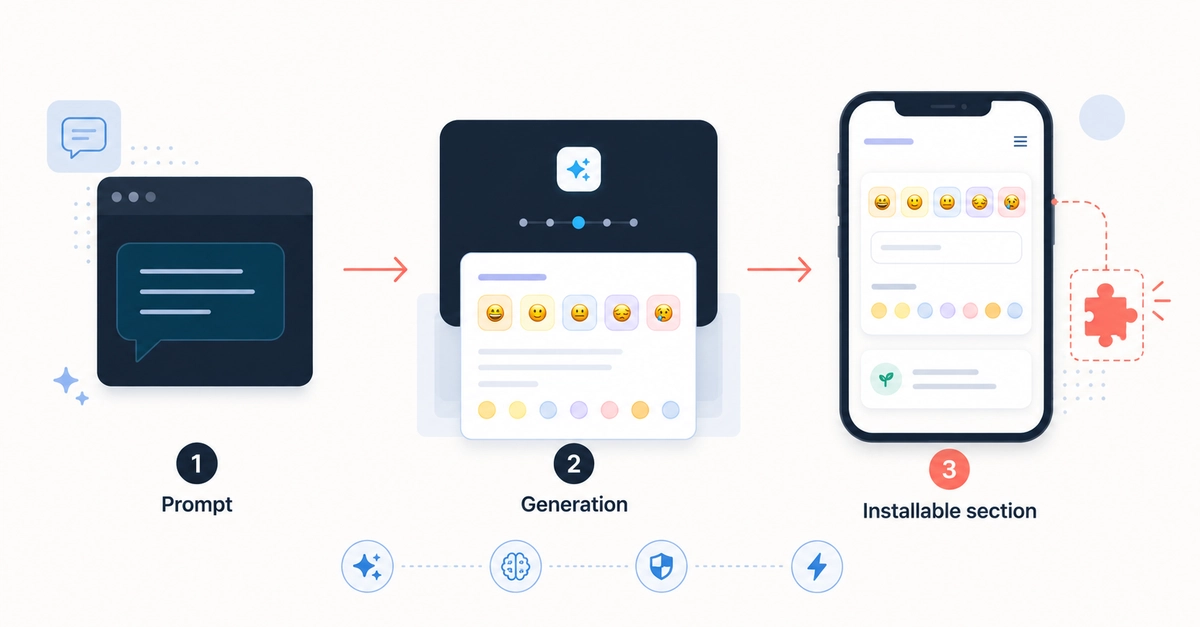
Here's the concrete flow, from the back office: you describe the section you want. The assistant generates it and renders it live, in context; you refine with the prompt, or edit the code directly when you want to take the wheel. So far, nothing you haven't seen elsewhere.