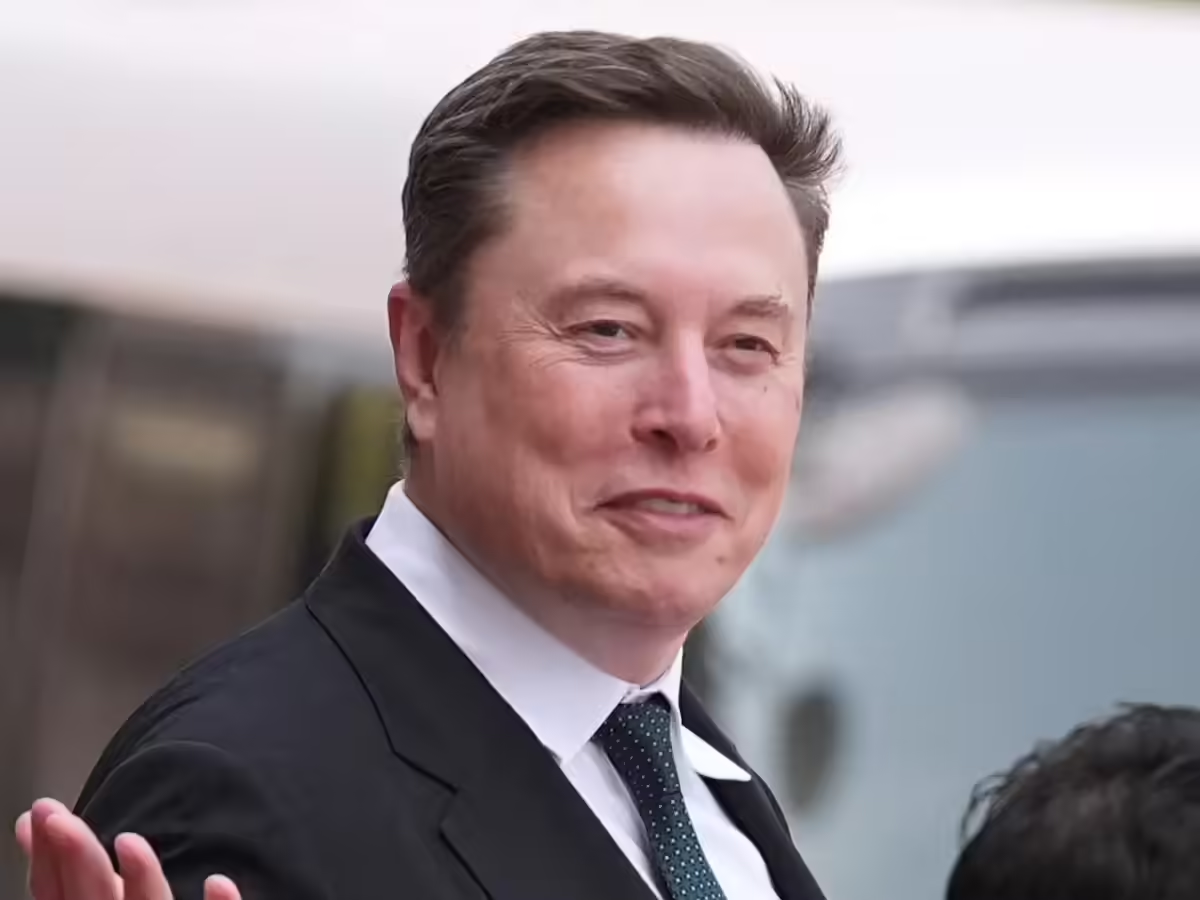
Elon Musk's trillion-dollar fortune exposes a tax system that struggles to keep pace with extreme wealth.
Renáta Bláhová is a partner at BMB Partners TAXAND, a member of the Advisory Board of the Slovak-German Chamber of Commerce, and the former head of the Health Care Surveillance Authority (ÚDZS).
Elon Musk has become the first person in history to surpass a net worth of one trillion dollars. Not because the world suddenly became wealthier, but because SpaceX, following a highly successful IPO, achieved a valuation that would have seemed absurd just a few years ago. This valuation is not based on the traditional method of estimating future cash flows and discounting them to present value – a standard approach that still dominates financial markets. Instead, it is built largely on the power of a compelling narrative, one that stretches far beyond what can be rationally quantified.
Musk is a master storyteller. Admirers and critics alike recognize his remarkable ability to sell not only the business of today, but also the business of tomorrow and even the business of a distant future that may never fully materialize. In Tesla’s case, that story begins with electric vehicles today, evolves into robotaxi services tomorrow, and ultimately extends to humanoid robots in the decades ahead. With SpaceX, he has followed a similar playbook: Starlink is the business of today; orbital data centres in space are presented as the business of tomorrow; and asteroid mining, interplanetary civilization-building, and the colonization of Mars belong to the far horizon. The company’s valuation reflects the successful marketing of this grand vision, distilled into a handful of powerful narratives. Yet in recent days, SpaceX’s valuation has become increasingly volatile as some investors reassess their expectations and adopt more realistic assumptions.