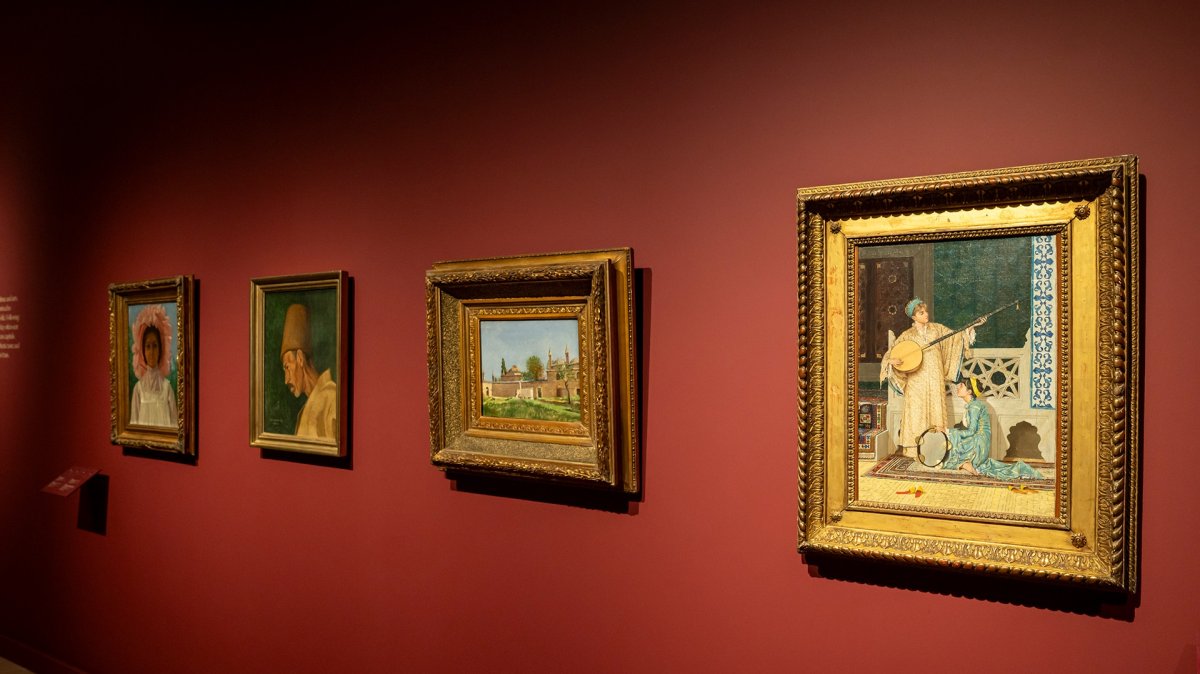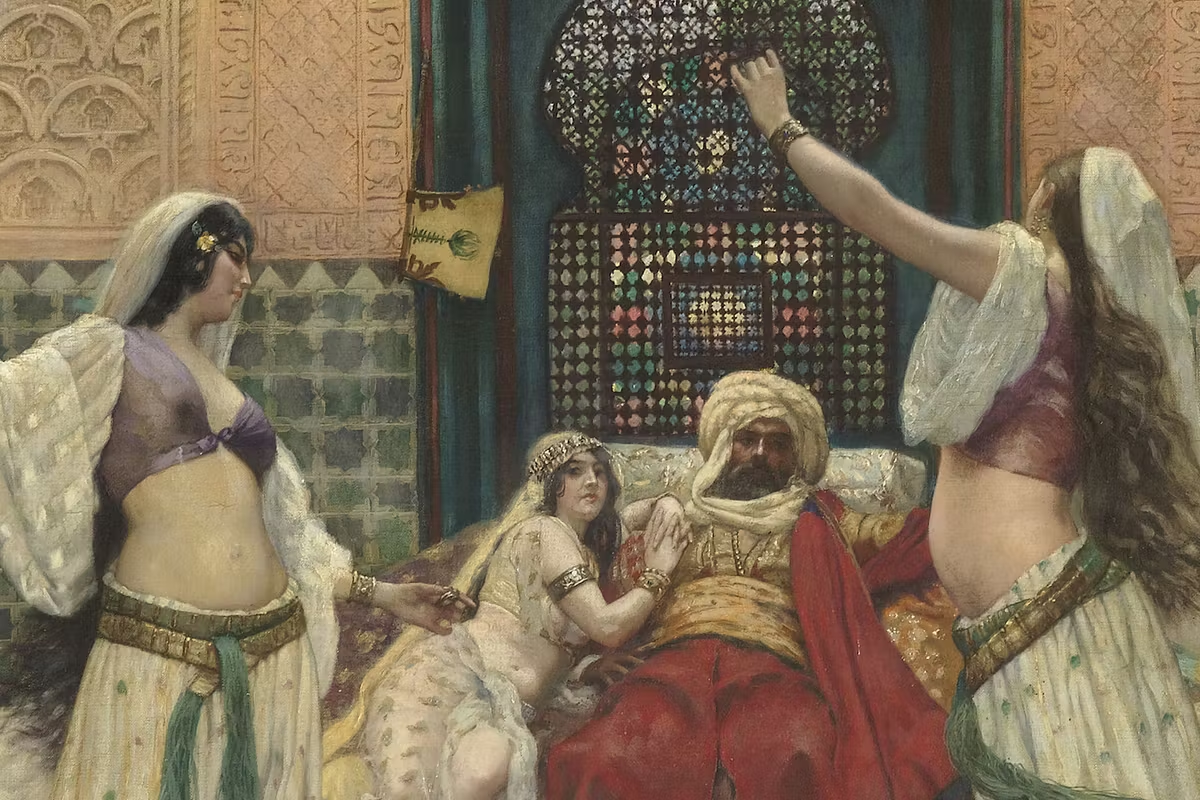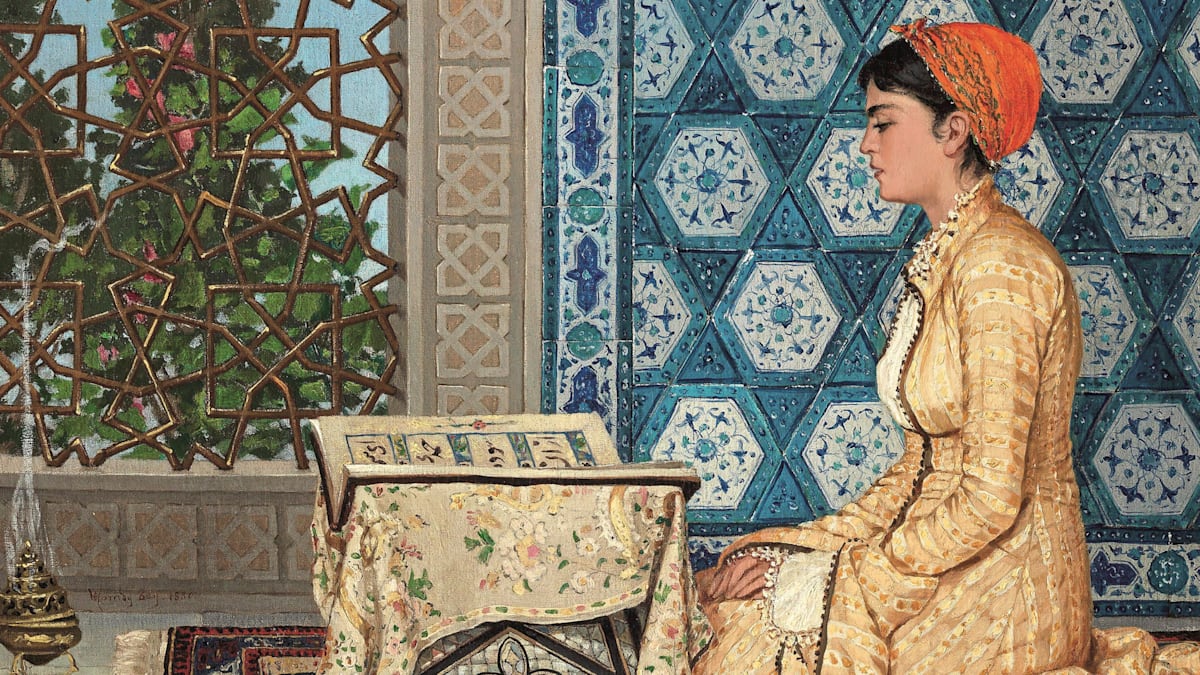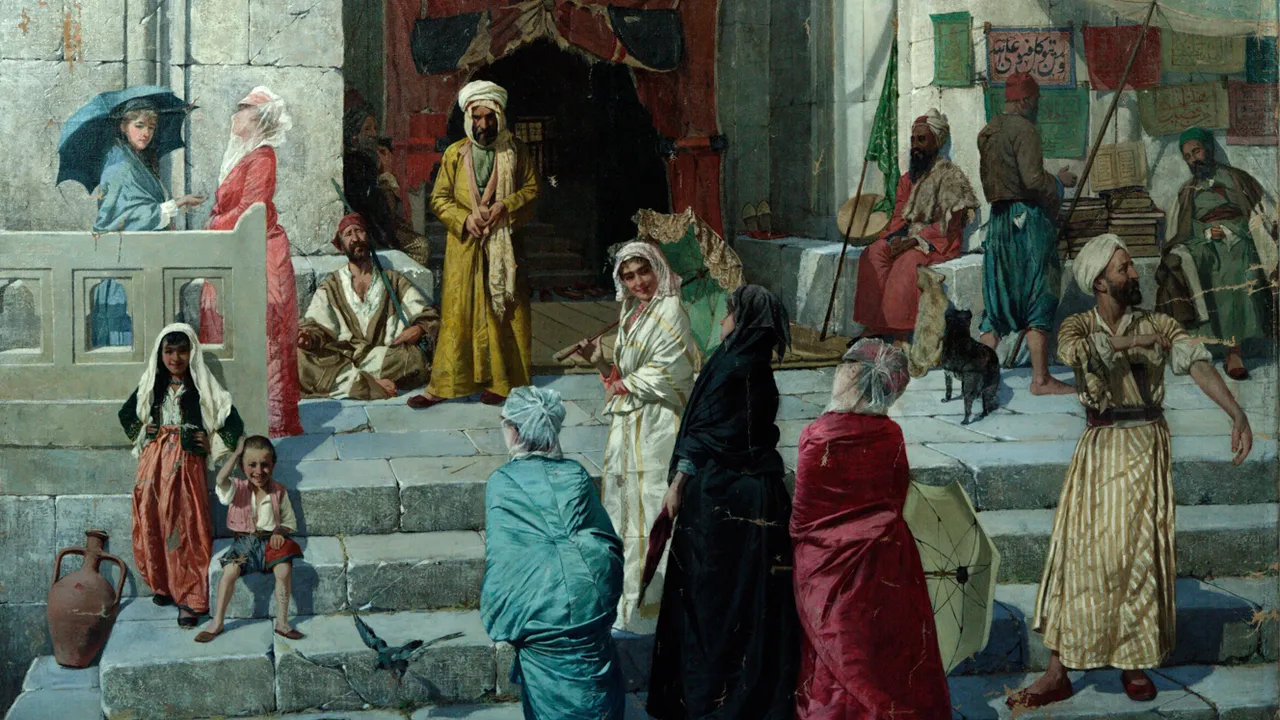
Few great writers have been as brainlessly happy as Gustave Flaubert in Egypt. From the moment he arrived, in the autumn of 1849, every detail pinched him with exotic perfection. The color of the earth reminded him of Nubian flesh, and the water looked like melted silver. He smoked long pipes while sprawled out on divans, wearing a red tarboosh. He slept with courtesans and dancers, and went to a bathhouse hoping to “skewer” a young boy. He also couldn’t get enough of the camels, the way they moved like turkeys and had necks like swans, and tired himself out trying to imitate their gargling noises. “I have found, clearly delineated, everything that was hazy in my mind,” he wrote. “Facts have taken the place of suppositions—so excellently so that it is often as though I were suddenly coming upon old forgotten dreams.”Flaubert’s case is one of many that Edward Said cites in “Orientalism,” his catalytic book from 1978. Without being too glib, one could summarize Said’s achievement as the diagnosis of a mass delusion hiding in plain sight. Orientalism—the study of the cultures and customs of the so-called East by the so-called West—compulsively rehearsed myths about the dark, violent, sensuous hordes of Asia and the Islamic Mediterranean. Said wasn’t the first to notice this, but he showed how scholars and writers had turned their own ignorance into an art form, creating an elaborate fiction—“the Orient”—to reduce vastly different cultures into an abstract, timeless unity that Europe and America could define themselves against and then feel good about dominating.A Persian swan-neck bottle, or ashkdan, from the nineteenth century.Art Work Courtesy Metropolitan Museum of Art“Orientalism: Between Fact and Fantasy” is the first exhibition at the Met to tackle the subject, rounding up paintings, drawings, ceramics, photographs, textiles, and a few guns and helmets. Surprisingly, it’s also the first major collaboration between the departments of European Paintings and Islamic Art. The show reads as a curious experiment in intra-museum diplomacy, tucked into four modest rooms that bridge the Islamic and European galleries. The focus is on the nineteenth century, when most of the world’s land fell under colonial rule, and when artistic styles cycled between East and West. Orientalism, the show suggests, wasn’t a one-way street but a traffic in misappropriation.The start of the exhibition is a bit jumbled. One section tracks the influence of the Alhambra complex, in Granada, where artists trekked to whet their appetites for the exotic. Another section gathers various candlesticks, mosque lamps, and bowls to show how European and American craftsmen cribbed Islamic designs to reform the ugliness of mass-produced goods in the West. The show sparks to life once it strikes two artists together: Jean-Léon Gérôme and Osman Hamdi Bey. There are other highlights—paintings by Géricault and Alexandre-Gabriel Decamps, a few Persian swan-neck bottles and their Tiffany glass imitations—but the gamble here is to play Gérôme and Hamdi off each other, the outsider and the insider. One was a Frenchman who dreamed of the Orient and made frequent trips to modern-day Turkey and Egypt (and, like Flaubert, developed a thing for camels); the other was a diplomat-painter who was born in Constantinople and educated in Paris, and then returned home to paint his world from within. Gérôme’s “The Snake Charmer” (ca. 1879) is the poster child of Orientalism and was put on the cover of Said’s book. Hamdi broke the auction record for a Turkish painting when “The Tortoise Trainer” (1906) sold in 2004, for roughly $3.5 million.Gérôme is the rare artist who’s easy to like and to hate. Every painting is a model of academic crispness and polish, filled with visual cues and prearranged emotional payoffs. “The Snake Charmer,” on loan from the Clark, in Williamstown, Massachusetts, shows a naked boy wrapped in an enormous snake while an old man plays a flute. We’re brought into the scene via the boy’s illuminated buttocks, and conducted to the background, where a crew of ten soldiers gawk at the spectacle. To the right, there’s a guy with a beatific smile who seems to be enjoying more than the snake, an enormous gun propped vertically between his legs. Tabulate the number of stiff objects in the painting (gun, stick, flute, sabre, etc.) and you’ll see that the whole thing is a festival of phallic abundance. Just in case you forget to feel aroused, Gérôme reminds you to.The snake charmer is, in effect, a stand-in for Gérôme, whose art relies on seduction and deception. Whether it’s a steamy bathhouse nude or a mosque scene, his paintings follow the cardinal rule of the Orientalist handbook, which is to use a mashup of decorative styles to yield a tantalizing essence. In “The Snake Charmer,” the Listerine-colored tiles in the background are inspired by Istanbul’s Topkapi Palace, the stone floor is drawn from architecture in Cairo, and the assorted costumes are from different times and places—an Ottoman helmet worn by a man on the left, for instance, is from the fifteenth century and personally belonged to Gérôme. (It’s in a display case here, next to a first edition of Said’s book.) As an establishment artist who taught at the École des Beaux-Arts and denounced the Impressionists, Gérôme has always been an easy target for serious artists and critics, who like to trash his “lightweight style” and his crowd-pleasing subjects. Émile Zola icily commented on Gérôme, “Here the subject matter is everything; the painting is nothing.”That’s a serious miscalculation, in my opinion. How do we account for the beauty of “Bashi-Bazouk” (1868-69)? The subject is just a man with a colorful headdress. Bashi-bazouks were a feared paramilitary outfit in the Ottoman Army, known for cracking skulls, and yet the sitter is a paragon of calm, not violence. He’s almost certainly a civilian whom Gérôme put in a costume. There’s a rifle on his shoulder, but it’s not shooting anytime soon; if anything, the mouth of the gun feels like a chimney inside the painting, letting out invisible puffs of psychological smoke. All the exquisite details—the man’s glowing salmon-pink tunic, the cherrylike tip of his headdress, the fluffy tassels—are an excuse for pure visual stimulation.Contra Zola, Gérôme’s talents as a draftsman, combined with his slick finishes and his touches of veracity in costume and design, show how style was just as important to him as any subject. If the aim of a successful Orientalist painting is to create a vehicle for escape, so that a textile manufacturer in France, say, can float out of his grimy industrial existence and swim into a golden dream of beauty or sex or violence, then the artist’s handling of paint has to be highly persuasive. Otherwise, the fantasy gets stuck on the canvas.“Bashi-Bazouk” (1868-69), by Gérôme.Art Work by Jean-Léon Gérôme / Courtesy Metropolitan Museum of ArtAt the end, the exhibition swings toward Hamdi. The curators present him as the more “authentic” Orientalist, less prone to stereotypes; instead of resorting to peepshows of exotic nudes, he faithfully documents mosques, Muslim scholars, dervishes, and quotidian scenes of the Ottoman capital. His most electric piece here is “At the Mosque Door” (1891). Approximately the size of a dining-room table, the canvas has fifteen people distributed along a set of stairs in front of a mosque, all of them flickering with very different kinds of life. A scrawny boy cracks a grin, a few women glide up the steps in silk robes, a man on the right rolls his left sleeve, another takes a nap, and the most impressive of them all, in a mustard-colored robe, shoots us a stern gaze.Hamdi trained with Gustave Boulanger, a colleague of Gérôme’s, and although the painting has the crisp lineation of the academic-realist mode, it also has the fresh pulse of Impressionism, which Hamdi began to absorb in Paris in the eighteen-sixties. You can see it in the relaxed brushwork of the silk dresses and in the even coat of sunlight over everything. There’s none of the sultriness of contrast played up by Gérôme for mystique, and also no timeless air. Every detail is quickened by a momentary fizz, perfectly articulated by two pigeons about to pierce the picture plane at center. There’s also a nice little postmodern quirk: at least three of the men depicted are self-portraits of Hamdi.Unfortunately, that’s Hamdi at his best. Much of his other work can be cloying or dull. “Dervish at the Children’s Tomb” (1903) is a heavy-handed portrayal of grief, and “Young Woman Reading” (1880), while theoretically interesting for its use of the spatial compression of Ottoman manuscript painting, doesn’t get beyond polite stasis. In general, Hamdi’s work has all the stage-managed feel of Gérôme’s, except with the heat of colonial lust plunged into an ice bath of poise. The exhibition’s framing of Hamdi as the conscientious Orientalist feels slyly designed to disarm judgment of his work, and even to neutralize his professional misdeeds. Hamdi was a powerful arts administrator who helped to approve excavation permits for foreign archeologists working in the Ottoman Empire, and what the exhibition alludes to as a “complex web of diplomatic exchanges” seems to be, quite simply, graft. Foreign art institutions and government officials, particularly in France, Germany, and the U.S., purchased Hamdi’s paintings and gave him awards in exchange for permits, and Hamdi, who wanted to succeed in Europe, seemed to appreciate the flattery. If his version of Orientalism entails paintings for permits, at the expense of cultural patrimony, does it really serve to benefit those whom it represents?To funnel the exhibition down to Hamdi and a group of mostly French artists, Gérôme above all, makes the project of Orientalism feel oddly bite-size. Although the curators have broadened the scope beyond paintings, many of the objects are here to corroborate what’s already in the paintings—hammam shoes and rifles in Gérôme, a wooden chest and gold ear ornaments in Delacroix, parasols in Hamdi—and, despite the impressive research and archival sleuthing, the result is a sort of empty forensic effect, like evidence being presented in a trial for nothing. The show is certainly worth seeing, though. There’s something remarkable about Orientalism, the way it stuns the mind and makes it impervious to nuance. Is there any other bad idea that has produced so many beautiful things? ♦
The Met Turns Orientalism Inside Out
In a new show, exotic fantasies are set beside paintings that depict the so-called East from within.
1,703 words~8 min read