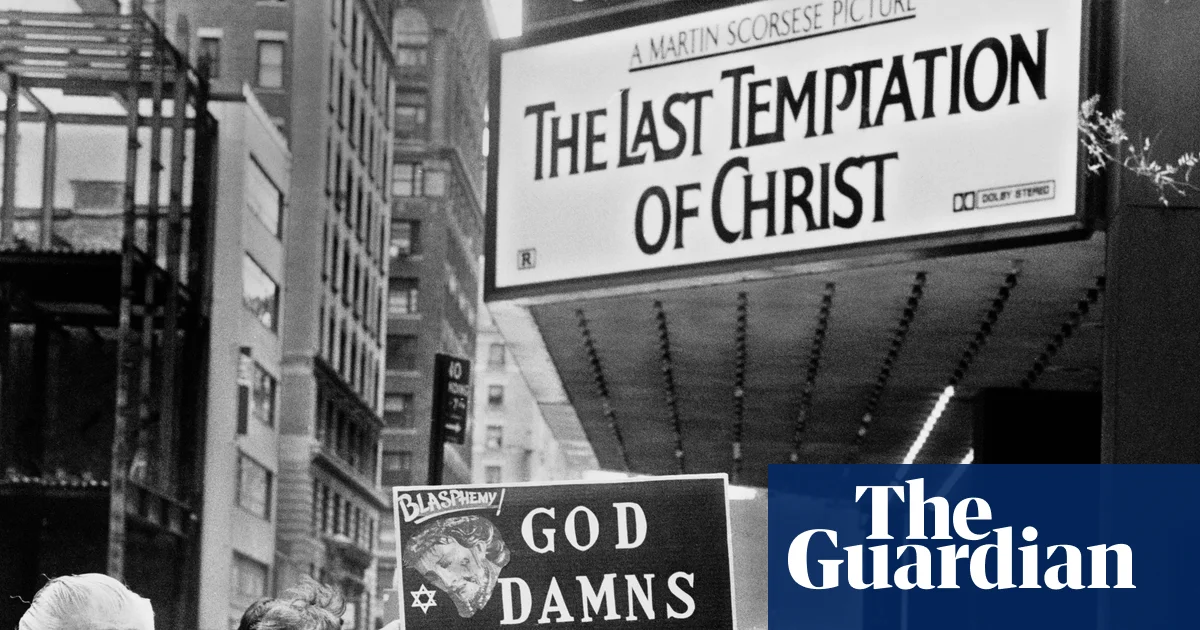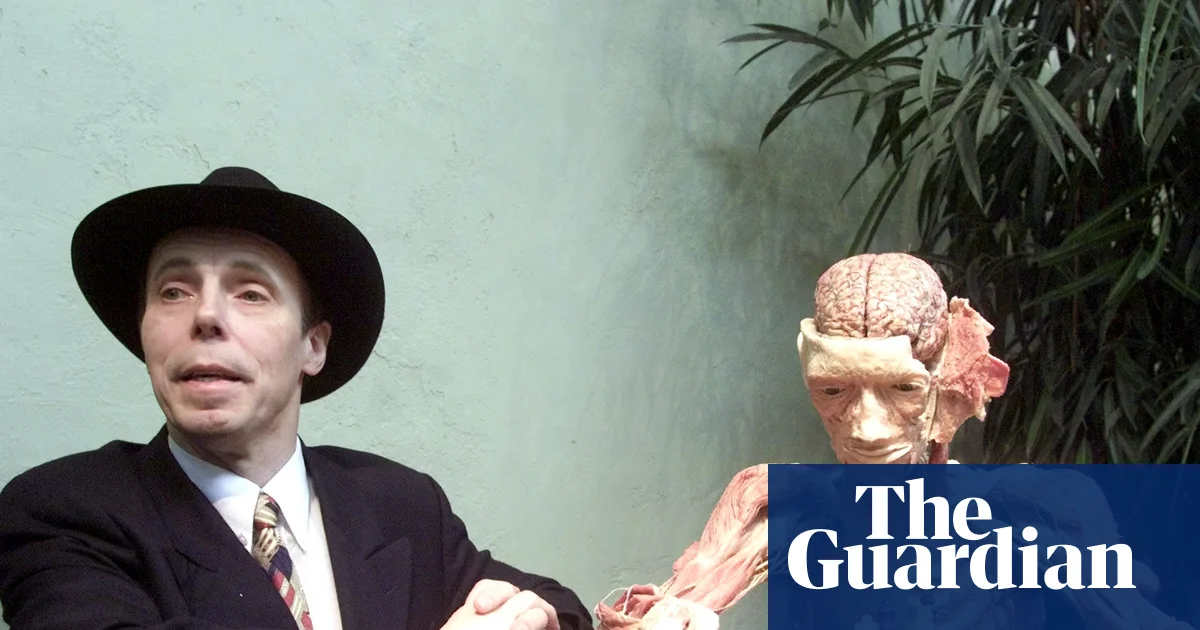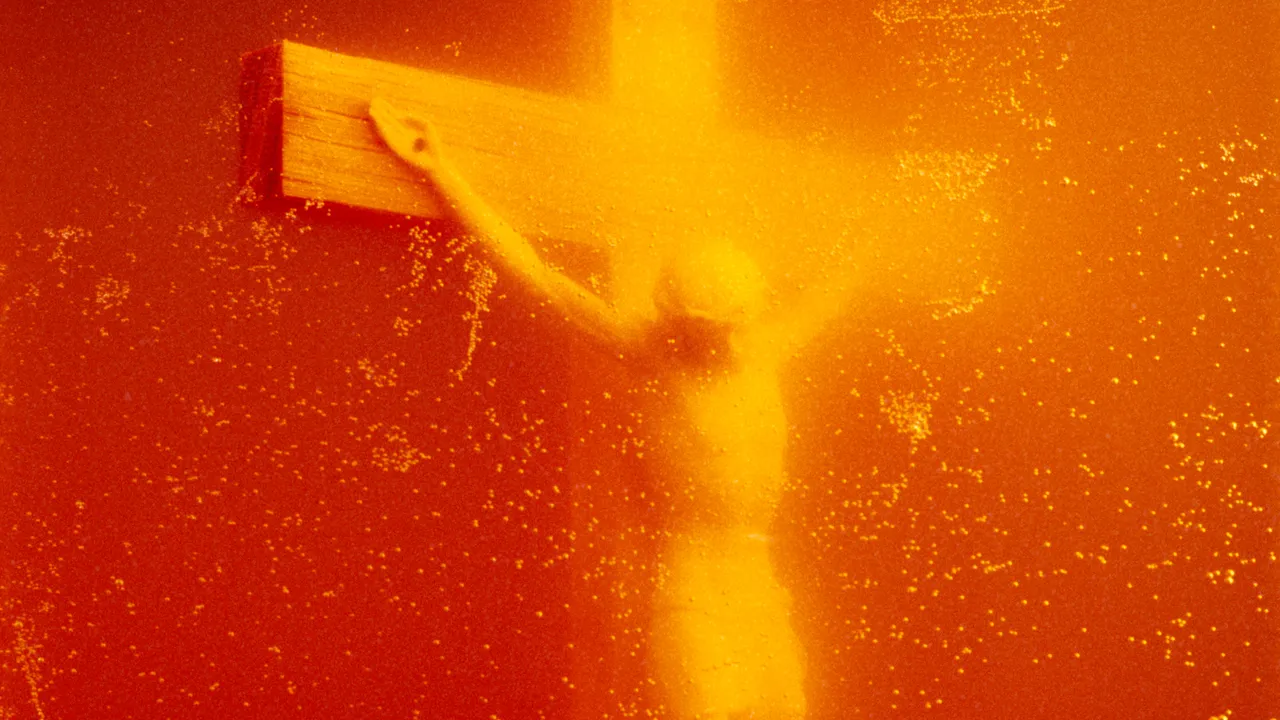
“Piss Christ” is a photograph of a crucifix immersed in a container of urine. Why would anyone make such a thing? The customary answer is that it’s social criticism—a commentary on the cheapening of the Christian faith—or a prank, like Marcel Duchamp’s urinal, meant to shock and subvert.But Andres Serrano, the man who made “Piss Christ,” seems to have had none of this in mind. He was doing what Jackson Pollock did when he threw paint on a canvas on the floor, or what Andy Warhol did when he copied the labels of thirty-two Campbell’s soup cans. Pollock wasn’t offering a thesis on the death of easel painting, and Warhol wasn’t satirizing consumer culture. They were just trying to create art.As an artist, Serrano is largely self-made. Born in 1950 and reared in Williamsburg by a mother who didn’t speak English and was hospitalized with psychotic episodes, he grew up Catholic. A school trip to the Met hooked him; by thirteen, he was visiting the museum on his own. He entered the Brooklyn Museum Art School at seventeen but left after two years and became a drug dealer and an addict in the East Village.After a decade, he realized that if he didn’t reform he’d never create art, and appears to have willed himself clean. He married the artist Julie Ault, a co-founder of Group Material, a Lower East Side collective producing politically progressive art about subjects such as American intervention in Central America. Artists associated with the group, including Barbara Kruger, Jenny Holzer, and Richard Prince, later became stars. Serrano took up art-making again, exhibiting in small galleries and artist-run spaces like the 4th Street Photo Gallery, a Bowery-area storefront that welcomed minority photographers. He was a downtown artist, and in 1979 downtown artists didn’t make art to make money.Convinced he had little talent as a painter or a sculptor, Serrano borrowed a friend’s camera and began taking pictures. He insists he isn’t a photographer, and he doesn’t develop his own prints. He thinks of himself as an artist who uses a camera. His early work was Surrealist-inflected tableaux; the sliced eyeball in Luis Buñuel’s “Un Chien Andalou” has the same mix of coolness and unpleasantness found in a Serrano photograph. He used Cibachrome, a process that yields waxy, saturated color and an illusion of depth. His contemporaries Nan Goldin and Jeff Wall used it.Religious iconography was on Serrano’s palette from the start. He collects religious artifacts and uses church pews as living-room couches. Like many nonobservant Catholics, he appears to be anticlerical but not anti-Christian. He isn’t trying to make religious art. He’s trying to make art using religious materials. He treats Christ, the cross, and the Madonna the way Monet treated haystacks: not for or against, just alert to their aesthetic potential.In 1985, Serrano was approached by William Olander, a curator at the New Museum of Contemporary Art, which had been founded as a venue for cutting-edge, issue-based art. Olander was planning a group show called “FAKE: A Meditation on Authenticity.” This was a standard topic of postmodernist interrogation. “In a global economy increasingly dominated by high technology capable of reproducing copies more ‘real’ than the real thing,” the catalogue explains, “for a fake to operate as a fake, it must pass as an original, circulating freely in our system of late capitalism.” That kind of thing.That kind of thing was not Serrano’s kind of thing. He isn’t a postmodernist. He makes art for traditional reasons—interesting materials, striking images. But the project gave him an idea: “fake paintings,” or photographs that look like paintings and gesture at famous ones. Among the earliest, made in 1986, was a photograph of two Plexiglas containers side by side, one filled with animal blood, the other with milk; he’d later also use breast milk, menstrual blood, and his own semen. The point was to make bodily fluids read as paint. The result, “Milk, Blood,” was meant to recall Mondrian. He then made monochromes: “Piss,” a container of urine echoing Yves Klein’s International Klein Blue paintings, and “Blut und Boden (Blood and Soil),” alluding to Anselm Kiefer. All these pieces are abstract, and at some point Serrano decided to reintroduce representation into his art. The first such work, made in 1987, was “Piss Christ.”Serrano seems to have picked the crucifix as something whose significance would be somewhat ambiguous. (A 1988 companion piece, “Piss Discus,” is boring by comparison—it lacks that ambiguity.) “Piss Christ” may also nod to Gauguin’s “The Yellow Christ.” Serrano first tried his wife’s urine, then switched to his own, judging it yellower. He built a two-gallon Plexiglas container himself; the crucifix inside is thirteen inches long, but the photograph is sixty by forty—large enough to function, on a wall, like an altarpiece.As many have noted, without the title no one would object to the image. The urine is transfigured: reddish gold, faintly effervescent, almost tearlike. The critic Wendy Steiner called Serrano’s work “some of the holiest images in contemporary art”—which certainly seems to be on the spectrum of legitimate responses to it. “Piss Christ” isn’t the most sophisticated art work ever made. But it was made by an artist, for artistic reasons.The photograph was first shown, in 1987, as part of an exhibition at the Stux Gallery, on Spring Street, which drew no notice and sold poorly. A year later, the director of the New Museum nominated Serrano for a fellowship administered by the Southeastern Center for Contemporary Art (secca), in Winston-Salem, North Carolina. He was one of ten winners and received fifteen thousand dollars. What happened next is the subject of Isaac Butler’s entertaining new book, “The Perfect Moment: God, Sex, Art, and the Birth of America’s Culture Wars” (Bloomsbury), for “Piss Christ” turned out to be the bomb that set off those culture wars.The term “culture war” derives from the German Kulturkampf, coined in the time of Bismarck for the conflict between the Catholic Church and the Prussian state. It seems to have entered the American vocabulary largely through the sociologist James Davison Hunter’s 1991 book, “Culture Wars: The Struggle to Define America,” and historians have been refining the story ever since: Daniel T. Rodgers’s “Age of Fracture” (2011) takes a wider view, tracing the breakup of older ideas about class, society, history, and collective purpose, while Andrew Hartman’s “A War for the Soul of America” (2015) covers ground closer to Butler’s, framing the culture wars of the eighties as a backlash against the sixties—notably the women’s, civil-rights, and gay-liberation movements. Butler trains his own lens mainly on a few years, from 1989 to 1992, when the National Endowment for the Arts was chaired by John Frohnmayer.Frohnmayer was brought in by the Bush Administration to keep what was still a small brush fire from reaching the White House. A lawyer from Oregon who’d chaired the state arts commission and taken First Amendment cases in private practice, he turned out to be too noble for the job. Although he was a Republican—his brother David was Oregon’s attorney general—he’d nonetheless voted for Michael Dukakis in 1988, because, he said, he couldn’t support a ticket with Dan Quayle on it. Which was a pretty good sign he wasn’t ready for the big rodeo. As he wrote in his memoir, from 1993, he believed he “could negotiate anything if people of good will simply got together, discussed the issues, and decided on the course that would most benefit the country.” That might work in Oregon. It does not work on Capitol Hill. Once in office, Frohnmayer got rolled from every direction—congressional enemies of the N.E.A., congressional friends of the N.E.A., the Administration, the art world, even his own staff. He admitted, in his book, that he felt like throwing up every morning before work.Frohnmayer’s dilemma was that he believed in artistic freedom and didn’t think Congress should dictate what the N.E.A. funded, but he also felt obliged, as a political appointee, to avoid funding work that Congress and the President found offensive. The result was flip-flopping—defending a grant one day, rescinding it the next—with no cover from an Administration he later described as “committed to almost nothing other than continuing to occupy the real estate at 1600 Pennsylvania Avenue.” He knew that, when trouble came, he’d be the first under the bus.Amid the Tiananmen Square protests, the fall of the Berlin Wall, and the invasion of Kuwait, Congress was debating whether to defund an agency that consumes less than 0.02 per cent of the federal budget. In retrospect, the culture wars were mostly a distraction.But, as distractions go, they were highly distracting. The ten SECCA award winners got a travelling exhibition, which arrived, as its final stop, at the state-owned Virginia Museum of Fine Arts, in Richmond. In March, 1989, the Richmond Times-Dispatch ran a letter citing “Piss Christ” and asking whether Christianity had “become fair game in our society for any kind of blasphemy and slander.”The letter reached Donald Wildmon, the founder of the American Family Association and a longtime decency crusader, and that’s how “Piss Christ” hit the national media. A former Methodist pastor in Mississippi, Wildmon commanded a mailing list of hundreds of thousands of conservative Christians, many of them politicized by fights over school prayer and sex education. Their favored weapon was the boycott. Wildmon had campaigned against the TV show “Three’s Company,” which he considered indecent, and in 1978 he and his followers pressured Sears to stop advertising on “Charlie’s Angels,” which he considered “smut.” In the mid-eighties, he led a two-year boycott that forced 7-Eleven to stop selling Playboy and Penthouse. A photograph by an unknown artist in a regional museum wasn’t obviously configured for collective action; Wildmon’s followers weren’t museumgoers anyway. Then he learned that five thousand dollars of Serrano’s fellowship had come from the N.E.A.—taxpayer money. That changed everything.Wildmon sent materials to the senators and representatives who oversaw the N.E.A., demanding that whoever had chosen Serrano be fired. (In fact, no one there had picked him; grants went through peer-review panels precisely to insulate the agency from political pressure.) Congress couldn’t touch the Virginia museum, but the N.E.A. was its creature. It confirmed the N.E.A.’s chair, held reauthorization hearings, and set its budget.On May 18th, Senator Alfonse D’Amato took the floor and called “Piss Christ” a “deplorable, despicable display of vulgarity,” tearing the offending page from the show’s catalogue and throwing it on the floor. Jesse Helms—a longtime N.E.A. antagonist who’d gone after the agency back in 1975 for funding Erica Jong’s novel “Fear of Flying”—rose to agree. Serrano “is not an artist,” Helms said. “He is a jerk.” Four days later, Pat Buchanan cited the work in a Washington Times column titled “Losing the War for America’s Culture?” On May 31st, Senator Slade Gorton made the inventive claim that “Piss Christ” amounted to the sort of “religious argument” the First Amendment barred Congress from funding, and he called for the N.E.A. to cut off SECCA for five years.Butler says that SECCA’s director, alarmed by the controversy, asked Serrano whether he could tell reporters the piece was “a protest against the commercialization of religious values.” “It’s not language that I would use,” Serrano replied, “but you could use it.” Since a work’s best defense against critics is that it expresses an idea, this improvised gloss became attached to “Piss Christ” as its get-out-of-jail-free card. Serrano later offered similar explanations. It’s also why the crucifix inside the container is so often said to be made of plastic, a detail implying cheapness and fakery. In fact, Butler tells us, it was made of wood and metal: a real crucifix, owned by a collector who treated religious artifacts as art objects, and not a gift-shop trinket.One more shoe had to drop for “Piss Christ” to become more than a political soapbox, and on June 13th it did: the Corcoran Gallery of Art, in Washington, D.C., announced that it was cancelling “The Perfect Moment,” a retrospective of photographs by Robert Mapplethorpe. Unlike Serrano, Mapplethorpe was an established art-world figure—he’d had a major Whitney retrospective—though by then he had died, of AIDS. The show included photographs of gay B.D.S.M. poses (fisting, bondage, water sports) and of partially unclothed prepubescent children. These would be hard to defend as “expressing an idea.” The Corcoran received government money and didn’t want to get pulled into the fight. “With considerable regret,” it announced, the board had voted unanimously to withdraw from hosting the show.The museum thought it was dodging a bullet; it had only painted a target on its back. Artists and arts organizations accused it of censorship. Nine hundred protesters gathered outside the gallery and projected Mapplethorpe’s images onto the façade. The Washington Project for the Arts, an alternative arts organization, picked up “The Perfect Moment,” and it ran there in July and August to record crowds. The Corcoran tried, too late, to get some of the toothpaste back into the tube by asking Group Material to organize a show on censorship which would include works by both Serrano and Mapplethorpe; Group Material refused.The art world was not incensed out of love for Robert Mapplethorpe. It was incensed because cancelling the exhibition put every arts organization receiving even indirect government funding on notice. Particularly vulnerable were regional and alternative spaces, which, unlike the Met or MOMA, couldn’t survive without it. As modest as the N.E.A. budget was (it was a hundred and seventy million in 1989 and is two hundred and seven million today), without government money, many smaller parts of the cultural ecosystem would wither and die. The too-big-to-fail museums like MOMA and the Met sailed through the culture wars untouched; from the perspective of the struggling artist, it was not their finest hour.The message of the Corcoran cancellation was that crossing some undefined line of decency gave the government license to come after you. And it did. After “The Perfect Moment” reached Cincinnati’s Contemporary Arts Center, the museum and its director were put on trial for pandering obscenity and using a minor in nudity-oriented material.Mapplethorpe’s work falls into a few categories: celebrity portraits and self-portraits, flowers, sexual imagery, photographs of the bodybuilder Lisa Lyon, and photographs of the musician Patti Smith. Mapplethorpe met Smith in 1967, when he was twenty, and they were together until 1972—the years she chronicles in her memoir “Just Kids” (2010). He later became part of the gay B.D.S.M. scene he photographed. Smith found that scene off-putting, but the two stayed friends. Some consider the Smith photographs his best work, precisely because they’re the least staged—the cover of her album “Horses” is one of them. His other work can feel formal, even academic. Where Serrano’s figures look waxen, Mapplethorpe’s look like marble. “They are alive but have no life force,” in Butler’s judgment.The sex pictures of the so-called “X Portfolio” aren’t candids; they’re meticulously composed photographs of men in deliberate sexual poses. For most viewers, they carry a certain sliced-eyeball shock, and Helms toted a black binder of them around the Senate for years, in his campaign against the N.E.A., asking women to leave the room before showing the images to his male colleagues. But Mapplethorpe, a student of photographic history, wasn’t conferring dignity on a taboo subculture; he was after great photographs, although he understood that one of the things that can make a photograph great is the charge of the forbidden. What unified his work, across subjects, was what the French call le glacis de la lumière—a polished, technically exacting finish. (Given that it was the lighting and contrasts that critics admired in his photographs, it’s notable that he didn’t develop his own prints, either.)That technical emphasis became central to the legal strategy at the Cincinnati trial, where the defense argued that subject matter was beside the point and the art lay entirely in composition. An expert witness described one image of a man urinating into another’s mouth as “a figure study,” and a photograph of finger penetration as “a very ordered, classical composition.” And so on. It worked. The jury acquitted in under two hours.Butler’s book tells many more art-war stories, some involving artists once notorious, like Annie Sprinkle, David Wojnarowicz, and Karen Finley. Finley became known as the performance artist who spread chocolate syrup on her body. But that was the least of it. She simulated defecation and smeared canned yams on her ass while reciting:Let me tell you how I take the yams!I stick it up my granny’s ass!She’s a real, real nice granny!And I’d never touch her snatch, ’cause she’s my granny!Oh and I love her ass, ooh I will take those Belgian waffles, and smear it up her crack.In 1990, Frohnmayer vetoed grants to Finley and three other artists—Holly Hughes, Tim Miller, and John Fleck—and they sued the N.E.A. for viewpoint discrimination.Other culture-war skirmishes formed a backdrop to the N.E.A.’s struggles: the removal of Richard Serra’s “Tilted Arc” from Foley Federal Plaza (March, 1989), the Supreme Court’s ruling in Texas v. Johnson that protected flag burning (June, 1989), and the Ayatollah Khomeini’s fatwa against Salman Rushdie for publishing “The Satanic Verses” (February, 1989).What were the culture wars about? Their overlap with the Cold War’s end invites the idea that they were a kind of Cold War redux, with the enemy now internal. That was part of the rhetoric, actually, but it wasn’t as if people were thinking, What are we going to do now that the Cold War is over? Hartman’s thesis that they were a post-sixties backlash is hard to dispute, though it doesn’t quite get us to “Piss Christ.” As Butler suggests at points, the N.E.A. fight was a battle less for America’s soul than for the Republican Party’s soul. Attacking the N.E.A. in 1989 meant attacking an agency that Republican Presidents had controlled for seventeen of the previous twenty-one years. Many conservatives who had supported George H. W. Bush when he ran, in 1988, to succeed Ronald Reagan thought that, as President, he had betrayed their cause.Buchanan led that backlash. When he challenged Bush in the 1992 New Hampshire primary, he campaigned, in part, on N.E.A. funding, specifically for “Tongues Untied,” a documentary about the gay Black experience, directed by Marlon Riggs. (As it happened, it was funded during the Reagan Administration, in which Buchanan had served.) Buchanan stunned everyone, including himself, by taking 37.5 per cent of the vote. Two days later, Frohnmayer was fired.Bush was renominated, but Buchanan was awarded a prime-time speech at the Republican National Convention, in August. He delivered a sermon. “There is a religious war going on in this country,” he cried. “It is a cultural war, as critical to the kind of nation we shall be as was the Cold War itself.” Yet the speech was a bridge too far (or maybe just a bridge too soon). In November, Bill Clinton was elected, defeating Bush by almost six million votes, and the temperature around the arts dropped. The fight was now about gays in the military and the Defense of Marriage Act—just as heated, but more consequential.In 1994, the N.E.A. largely ended grants to individual artists and sharply restricted sub-granting, the mechanism that had let SECCA pass money to Serrano. In 1998, the Supreme Court, in National Endowment for the Arts v. Finley, upheld a congressional requirement that N.E.A. grants weigh “general standards of decency” alongside “artistic excellence and artistic merit.” Justice David Souter was the lone dissenter. He argued that indecency is itself a viewpoint, the viewpoint of people who reject society’s definition of decency, and thus protected speech.One thing that’s odd in this story is that Frohnmayer never emulated his counterpart at the National Endowment for the Humanities, Lynne Cheney, who routinely vetoed grants she disliked and faced no reauthorization fights or lawsuits. (Being married to the Secretary of Defense probably didn’t hurt.) As an agency head, Frohnmayer could have done the same; his decisions, like hers, would have been effectively unreviewable. Instead, he boxed himself in. He made enemies of artists without satisfying anyone else, though pleasing artists was never the job.Should the government have funded individual artists at all? When the two endowments were created, in 1965, the arts were still largely understood in formalist, apolitical terms. “Artistic excellence” made sense as a standard independent of content. By 1975, that consensus was gone. When the culture wars broke out, contemporary art was already politicized, as it remains. In some places, “excellence” was considered an ideologically loaded concept.Serrano and Mapplethorpe were, by the standards of the moment, fairly aesthetically motivated, but their work could be given, and was given, political interpretations. The critical animus was heightened in the late eighties by the AIDS crisis, when many in the art world felt that the Reagan Administration had turned its back on what was happening. Artists thus found themselves in the position of complaining that they were being censored by a government they were attacking.Butler’s book is fair but not disinterested, as the author makes clear. He casts himself as a champion of creative freedom, opposed to any content restrictions that Congress might impose on the N.E.A. He is on the side of Andres Serrano and Karen Finley: if their work was recommended by a peer-review process, no matter how offensive it might be to some, it should have been funded. He gives no quarter to Donald Wildmon, Pat Buchanan, or even George H. W. Bush. He is sympathetic to Frohnmayer, but only when Frohnmayer is standing up to the White House.The war within the Republican Party was not principally an ideological war, though. It was a class war. A patrician like Bush was educated to accept that advanced art and literature could be offensive. Being offensive was its social role, harmless as long as the art was safely ensconced in a museum. If you didn’t like the art, you didn’t go to the museum. At one point, as things were going off the rails at the N.E.A., Bush wrote a note to Frohnmayer: “I do support you—difficult job. But Barbara and I are bothered about the raunchy stuff—urine . . . fist up rectum.” That’s a conversation I would love to have overheard.But for Wildmon and Buchanan, in-your-face avant-garde art was an insult to the average person, certainly the average American Christian. Those people did not want to pay for it, and it was their right to object, as one might object to one’s taxes being used to build a triumphal arch or to government funding of white-supremacist speech. In America, it is O.K. to object. If we stopped having these “wars,” we would be less of a democracy.What is slightly absurd about the N.E.A. culture wars is the amount of ammunition expended over a tiny amount of money and a tiny amount of art work. Individual grants were always a sliver of N.E.A. spending. Most of the agency’s money supports local and state cultural infrastructure. Butler tells us that, in the agency’s first thirty-five years, between 1965 and 2000, the number of local arts councils grew from four hundred to four thousand, nonprofit theatres from fifty-six to three hundred and forty, symphony orchestras from nine hundred and eighty to eighteen hundred, and dance companies eighteenfold. At roughly two hundred million dollars a year, that’s a modest price to pay for spreading the arts beyond the coasts, and a lot to give up over a few photographs. The German government spends 2.57 billion euros a year on the arts.Today, does anyone really care about “raunchy stuff” in art museums? Or anywhere? If you want raunch, you just open your browser or turn on HBO. A screaming match over a photograph of a crucifix immersed in urine seems almost quaint. ♦
How “Piss Christ” Became a Culture-War Bomb
The fight over Andres Serrano, Robert Mapplethorpe, and the National Endowment for the Arts became a preview of the politics that followed.
3,944 words~18 min read