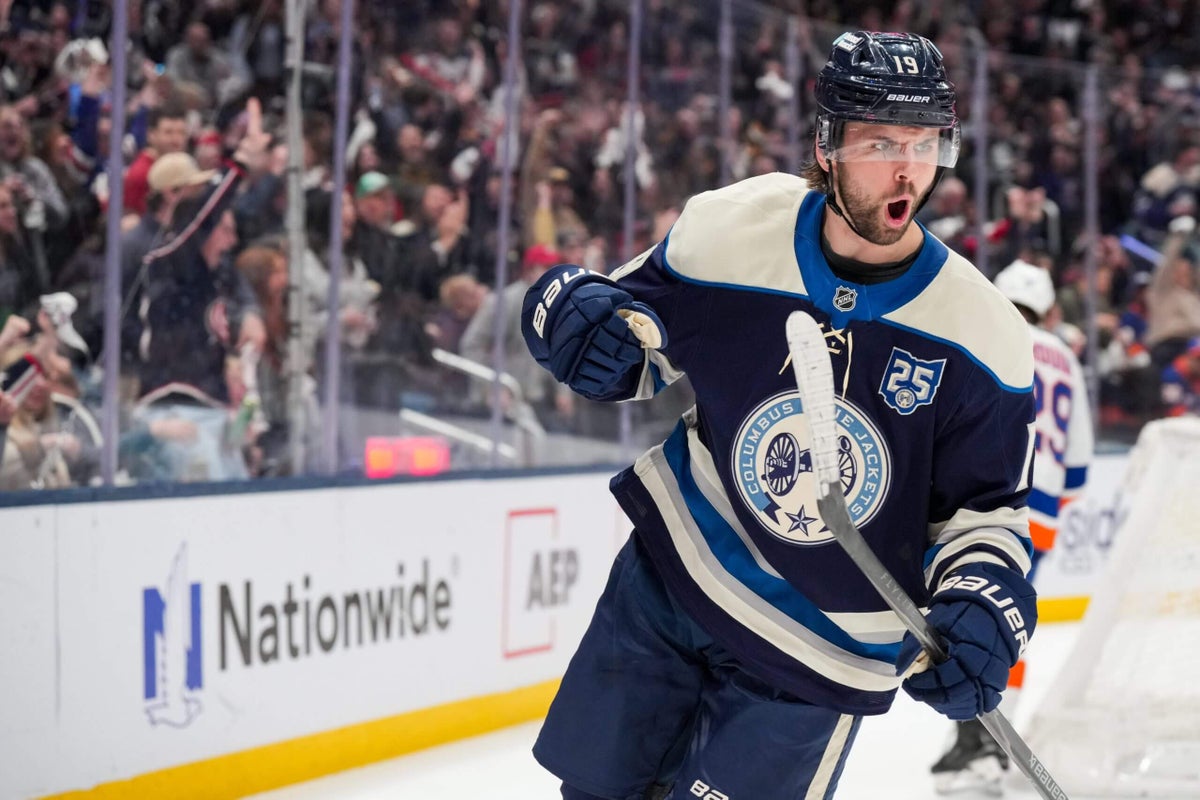
COLUMBUS, Ohio — A collection of notes, insights, ruminations and did-you-knows gathered throughout the week that was for the Columbus Blue Jackets:Item No. 1: RFA daysThe Philadelphia Flyers swung and missed on landing Leo Carlsson from the Anaheim Ducks. But the offer sheet they signed with Carlsson may have succeeded in forever changing the landscape for restricted free agents in the NHL.Or maybe the landscape had already started to change and the Flyers’ offer sheet with Carlsson was just the culmination of RFAs assuming considerably more power in today’s league.In case you’ve already settled deep into the offseason, the Ducks matched the five-year, $90 million offer sheet on Friday and will keep Carlsson, their No. 2 overall pick in 2023, as the centerpiece of their rebuild.Gone are the days when GMs could make take-it-or-leave-it offers to players who were leaving their entry-level contracts but not yet eligible for arbitration. Yeah, offer sheets have been a possibility for decades, but they were exceedingly rare.That’s no longer the case, with a new era of aggressive general managers and more clubs facing more pressure than ever to win immediately.Ducks GM Pat Verbeek has taken considerable criticism for not getting Carlsson under contract, either last summer when Carlsson became eligible to sign an extension, or early this offseason before he reached RFA status on July 1.Verbeek’s reputation for driving a hard bargain doesn’t help him here, but we should all consider the possibility that players as high-end as Carlsson didn’t want to negotiate with only Anaheim when they could use the fear of an offer sheet from 31 other clubs as a negotiating tool.When he commented this week after matching Carlsson’s offer sheet, Verbeek said he felt as if Carlsson and his agent had “slow-walked” the Ducks in their contract negotiations in order to hit the July 1 marketplace. It was a wise play, ultimately.This all comes back to the Blue Jackets, yes.Center Adam Fantilli, taken just one pick after Carlsson, has almost identical numbers as Carlsson in their first three NHL seasons. In 201 games, Carlsson has 61-80-141. In 213 games, Fantilli has 67-73-140.Asked if Carlsson’s offer sheet has changed the market, Blue Jackets GM Don Waddell did not hesitate.“For sure,” he said. “Yeah, for sure.”Waddell wouldn’t say if the Blue Jackets immediately upped their offer to Fantilli in the wake of Carlsson’s offer sheet, but did say, “We’re still talking, still going back and forth.”But Waddell’s sense last summer, and again this spring at the NHL combine in Buffalo, was that the agents for his RFAs were not interested in having serious negotiations before their players could hit July 1.And you can’t really blame them.If you were Fantilli, and you saw the money put before Carlsson — the 21-year-old Swede is now the highest-paid player in the league — you’d have to wonder if an offer sheet loomed out there for you, too.“I go back to what I’ve said before,” Waddell said. “You need two willing parties to get a deal any time of the year.“Multiple times I’ve met with all of the guys. They were all focused on July 1, even back to last year. It was ‘We’re not sure where the market’s going to go,’ all that stuff.”And get a load of this.If you look across the NHL right now, after most of the offseason moves have been made, there are only a few clubs that could realistically sign an offer sheet with Fantilli. Those clubs would need abundant cap space — let’s say $15 million — and four of their next five first-round picks as compensation should they land the player.There are three clubs that match those criteria, but several others that could make quick roster moves to make it happen.But, from Waddell’s perspective, it’s not quite that easy.“Teams have talked about this, and my partners around the league have told me this,” Waddell said, “that there are teams who would do the offer sheets, and if they get the player, they’d have a deal in place before the offer sheet is even signed, to flip the player to another team for X, Y and Z.”Let’s put this into practical terms:Say the Flyers wanted Carlsson, but didn’t have the draft picks or the salary cap to pay him the $18 million. A proxy club could step in and, with Carlsson’s full knowledge, sign him to the offer sheet with the full intention of simply flipping him to the Flyers — for a massive haul of draft picks and prospects and whatever — to finalize the deal.“One of the rules is that if you match an offer sheet (like Anaheim did on Carlsson), you can’t trade the player for a year,” Waddell said. “But if the offer sheet isn’t matched, there’s no protection on the player for the acquiring club.”That makes it infinitely more difficult to predict the threat of an offer sheet.As we move deeper into the summer, there’s less and less chance that Fantilli will sign an offer sheet. At that point, the negotiations will get more serious.But the Blue Jackets are now in the spot with right winger Kirill Marchenko that they were with Fantilli last season. Marchenko has one year remaining on his contract with RFA status pending next July 1.Asked if Marchenko is willing to negotiate an extension, Waddell said he’s had only “small talk” with agent Dan Milstein.“They want to see how the landscape has changed, so it’s ‘Let’s see how it all plays out’ when we talk,” Waddell said. It’s been reported that Milstein has informed the Blue Jackets that Marchenko doesn’t want to extend his contract in Columbus.But, at minimum, he may want to reach July 1, 2027, before having serious talks. Why not let the other 31 teams have access to you with an offer sheet?Waddell said he doesn’t expect to have Marchenko signed to an extension before this season starts.“No,” he said. “But we’ll certainly try.”The distinction between an RFA and an UFA is getting thinner.Item No. 2: Not so badNot too many years ago, arbitration was regarded as a last resort for getting a restricted free agent under contract. It was seen as a sure-fire way to burn bridges or at least bruise feelings between a club and its players.The two sides would sit across from each other — a GM and his staff on one side, the player and his agent(s) on the other — and get into the nitty-gritty of a player’s performance. The club, in search of a lower salary, could get downright negative and personal.It’s why the Blue Jackets were so proud that they’d never actually needed the process to get a contract signed. They came close a few times, but also avoided a hearing with an 11th-hour agreement.But the process — and the fear of it — are completely different now.Blue Jackets goaltender Jet Greaves and forward Cole Sillinger filed for arbitration by this year’s deadline. Unless a deal is reached beforehand, Greaves’ hearing will be on July 23 and Sillinger’s on July 27, both in a Toronto hotel.“I don’t have any problem with arbitration,” Waddell said. “You know you’re going to get a contract one way or another.”The Blue Jackets have requested a one-year finding for each player. They could have requested a two-year ruling, but two years would have walked both players right up to the start of their unrestricted free agency years.A one-year ruling could put Greaves, Sillinger, Marchenko and others back in arbitration next summer, and that’s not the end of the world, either.Several years ago, the NHL and NHL players’ association agreed that players no longer needed to be in attendance for the hearing. In recent years, Waddell said, some GMs have stopped attending, sending their assistants instead.“It’s all stat-driven,” Waddell said. “It doesn’t get personal like it used to.”Waddell said he plans to attend both hearings, if they actually take place. He’ll have vice president of hockey operations Laurence Gilman and senior manager of hockey operations Zach Abdou with him.Until then, Waddell said talks with Greaves and Sillinger continue.Item No. 3: Snacks• With the growing number of public trade requests, many have wondered if players with a no-move clause in their contract shouldn’t be forced to modify those clauses — either by adjusting to a 10- or 15-team no-trade clause, or by removing any trade control whatsoever — when a trade request is made.Turns out, that type of language can already be written into the contract as part of the negotiation process. It’s no different, according to the NHL, than the way the Blue Jackets and Waddell worked with Charlie Coyle to put a new addendum on his no-move clause when he signed a six-year, $36 million contract earlier this summer. Coyle’s no-move clause does not require the Blue Jackets to protect him in the event of league expansion, where, in the past, players with no-move clauses were automatically part of a club’s protected list.• We asked the NHL, specifically deputy commissioner Bill Daly, for confirmation on this. His reply: “Yes, that would be freely negotiable as between Player and Club.” The NHL would have to approve the language — that’s what the league’s central registry does before any contract is validated — but it’s not something that would need to be written into the collective bargaining agreement. Typically, a no-move clause or even a no-trade clause has been used as a “sweetener” in negotiations. It bears watching if the new language starts to make its way into contracts in the coming months.• Waddell and Bowness have said they want a cluster of players who spent last season with AHL Cleveland to come to training camp with their eyes set on winning a roster spot. But there’s something else to consider, too. The Blue Jackets may be forced to make a tough call on forwards Luca Del Bel Belluz, Mikael Pyyhtiä and James Malatesta, as well as defenseman Corson Ceulemans, a first-round pick (No. 25 overall) in the 2021 draft. All four would need to clear waivers before they could be sent to AHL Cleveland. Ceulemans is the only one of the four who hasn’t yet played in the NHL, but he had his best pro season in 2025-26 with the Monsters.• The Blue Jackets issued numbers to their new players this week. Winger Valeri Nichushkin, acquired in a trade with Colorado, will wear No. 43, while winger Ryan Lomberg, who signed as a free agent, will wear No. 94. Del Bel Belluz, who has worn No. 65 during his previous call-ups, is now wearing No. 93.
Blue Jackets Monday Gathering: RFAs, like Adam Fantilli, have gained enormous power
Offer sheets are reshaping the NHL's RFA market, and the Blue Jackets are watching closely amid Adam Fantilli, Kirill Marchenko talks.
2,113 words~10 min read