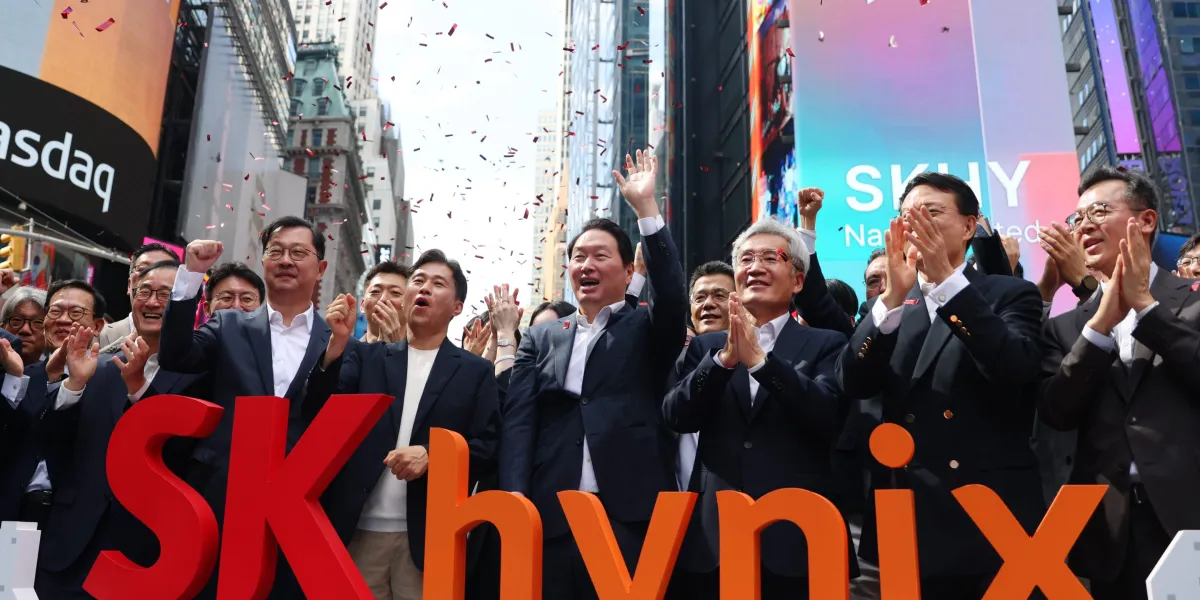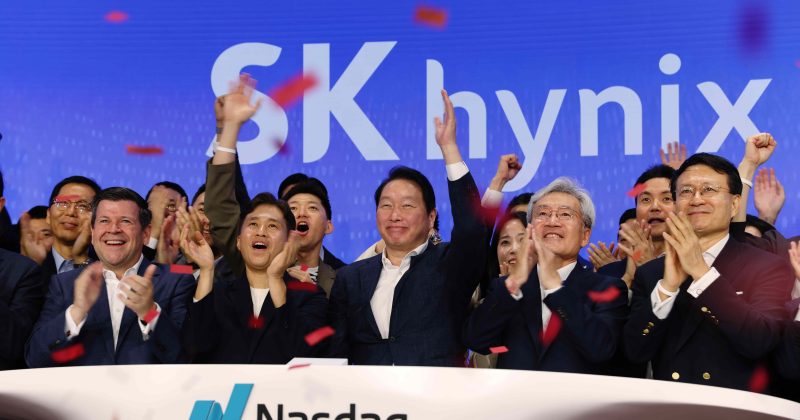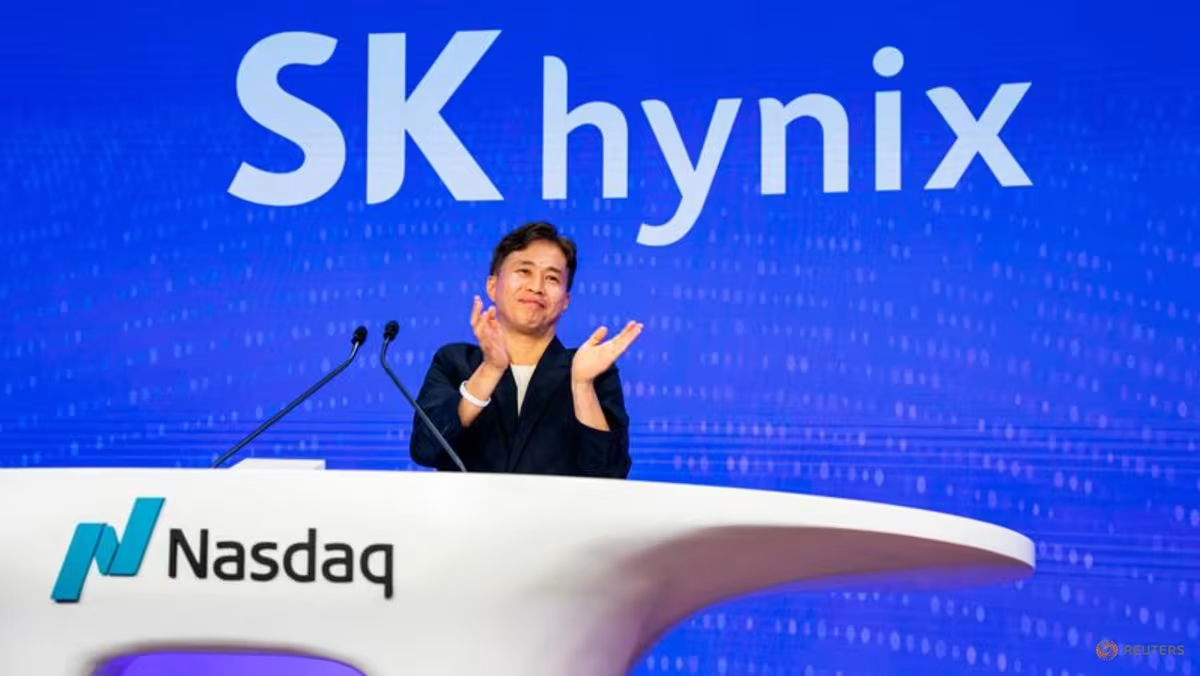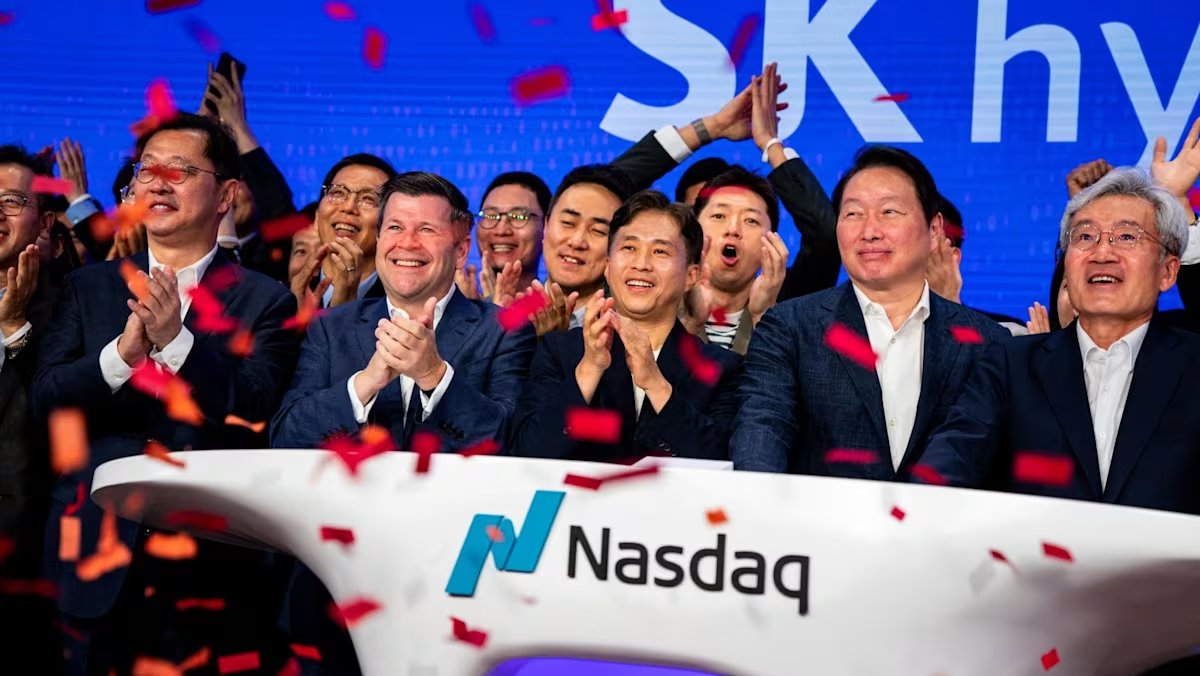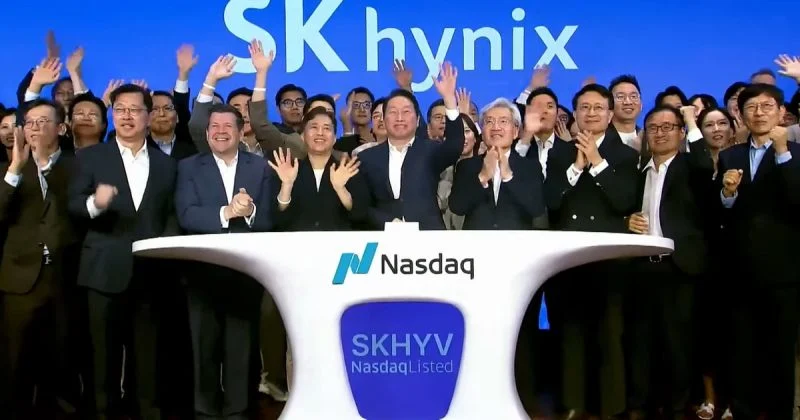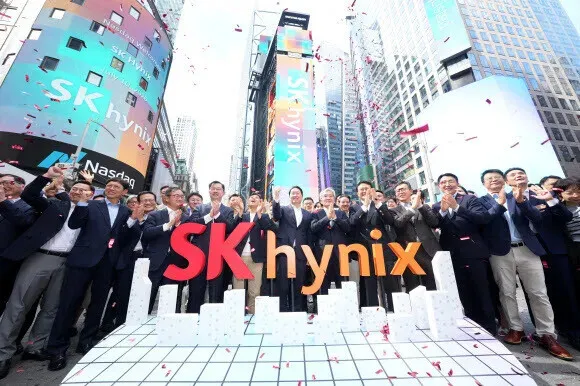
Chey Tae-won (center), the chairman of the board of SK Group, and other executives from the Korean conglomerate pose for a photo marking SK Hynix’s listing on the NASDAQ in Times Square, New York, on July 10, 2026. (Yonhap)
SK Hynix has jumped headfirst into the global competition to expand memory capacity for the artificial intelligence era, using the US$26.5 billion earned from its record initial public offering last week on the US’ tech-heavy NASDAQ stock market. Forecasts of a prolonged shortage in memory supply have ignited a global race among semiconductor giants to aggressively expand their output capacities. Micron of the US is building chip facilities in Japan while Samsung Electronics has accelerated the pace of its expansion by moving up the launch of production at its chip cluster in the southern Seoul suburb of Yongin, Gyeonggi Province, by about two years.On Friday, SK Hynix’s American IPO raised US$26.5 billion, the largest in history by a foreign company on a US stock market via American depositary receipts, or ADRs. This broke the previous mark of US$25 billion by China’s e-commerce titan Alibaba through its 2014 listing on the New York Stock Exchange.For the IPO, SK Hynix issued 17.79 million new shares, comprising 2.5% of its total outstanding. Set after a book-building process with domestic institutional investors, the US$149 offering price of the ADRs represented about a 3% premium on the closing price of the company’s common stock in Korea, which on Thursday reached 2.18 million won (US$1,450) per share.SK Hynix will invest most of its IPO funds in memory production, including the first-stage construction of its chip cluster in Yongin, building and expanding an advanced packaging fab in Cheongju, North Chungcheong Province, and purchasing extreme ultraviolet lithography equipment. The funds will be paid out on Tuesday.This decision is based on domestic and external forecasts for the industry saying that the memory chip shortage will last far longer than initially thought. In an interview with CNBC and Bloomberg TV on Friday, SK Group Chairman Chey Tae-won said the company has pledged to double production capacity within the next five years, but added, “All my customers said that, ‘Well, that’s not enough, man, and, well, we need more.’“ “The demand is enormous, exponentially,” he said, adding that he “[doesn’t] really see” signs of shrinking high-bandwidth memory demand. Kwak Noh-jung, the CEO and president of SK Hynix, also predicted memory chip demand would exceed his company’s output capacity through 2030 and beyond, suggesting that the pace of expansion is failing to keep up with demand. The company also hinted at the potential for more investment in the US. In addition to a cutting-edge packaging plant under construction in Indiana, Chey said finding a suitable location in the US would lead to more investment.Competitors are also rushing to expand semiconductor output. Samsung Electronics recently moved up the start of construction of the first fab in its Yongin cluster to 2029. Of the six fabs being built in the area for 360 trillion won, this moves up the original start date for the first (2030-31) by up to two years.In addition, Samsung Electronics and SK Hynix each plan to invest 400 trillion won to build four memory fabs in southwestern Korea. Micron recently announced raising its investment from US$200 billion to US$250 billion to base 40% of its DRAM output in the US by 2035. The American chipmaker is also investing 1.5 trillion yen to build a next-generation DRAM and HBM plant in Hiroshima, Japan, that will go online in the second half of 2028.Chinese memory maker ChangXin Memory Technologies, aka CXMT, plans to double its wafer output capacity by building a factory in Shanghai in the second half of this year. Taiwan’s TSMC, the world’s largest dedicated chip foundry, will also boost its investment in the US to build a wafer fab, packaging plant and R&D center.Given the megaboom in chip demand, expanding memory capacity has become a race against time, as securing sufficient production volume will be key to securing market dominance. Because it takes several years to go from groundbreaking to mass production at advanced memory plants, missing the investment window could mean losing out on surging demand.“Competitiveness used to stem from technological gaps but today, companies also need output capacity to secure a leading market position,” said one source in the industry. On Sunday, Kim Yong-beom, the Blue House director of national policy, also emphasized the time-sensitivity of investments in semiconductors in a Facebook post. “The key to a national strategy in the AI era lies in developing both technology and production capacity,” he said. “The country’s top priority should be supplying time.”By Bae Ji-hyun, staff reporterPlease direct questions or comments to [english@hani.co.kr]