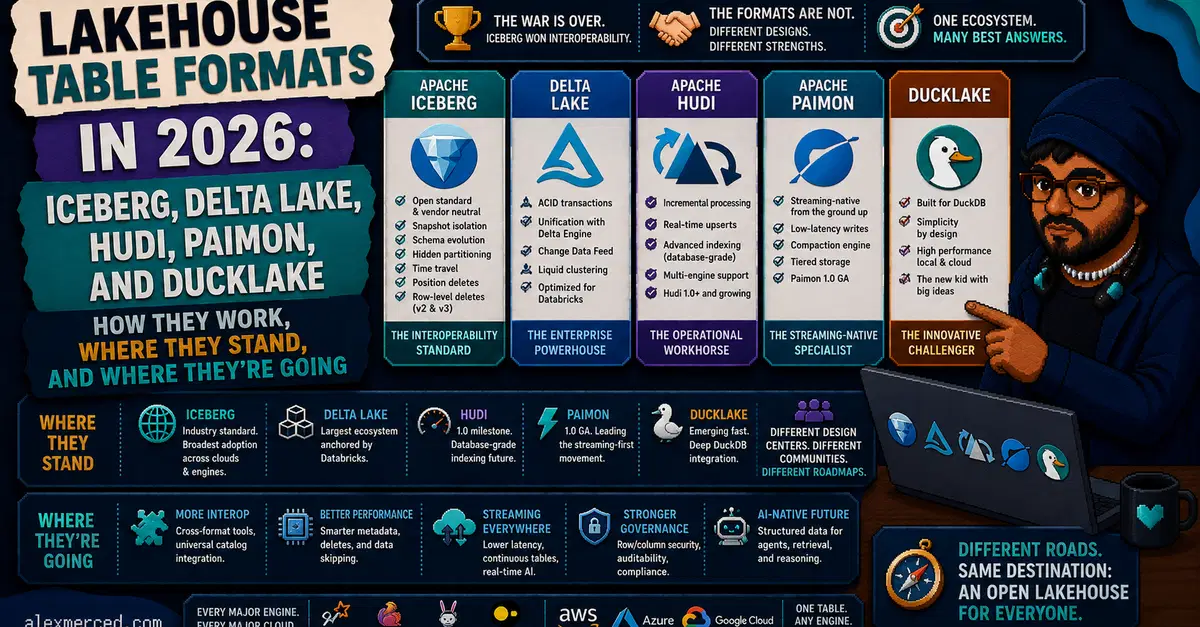
The table format war is over, and the table formats are not. Both halves of that sentence are true, both matter, and the tension between them is exactly why this article needs to exist.
The war ended in the sense that the industry converged on Apache Iceberg as its interoperability standard: every major cloud ships managed Iceberg services, Snowflake and Databricks both read and write it natively, DuckDB gained full Iceberg write support, and even PostgreSQL can now query Iceberg tables directly through open extensions. When your fiercest competitors all implement the same format, the standards question is settled. But the formats did not consolidate into one, because they were never solving identical problems. Delta Lake anchors the largest single-vendor ecosystem in data. Apache Hudi crossed its 1.0 milestone with database-grade indexing ambitions. Apache Paimon shipped 1.0 and owns the streaming-native design space. DuckLake arrived from the DuckDB world and asked the most interesting architectural question of the bunch. Each has a design center, a community, a roadmap, and workloads where it is genuinely the best answer.
So this is the detailed breakdown, current as of July 2026: how each of the five formats actually works, mechanically, what state each is in right now, releases, ecosystem, governance, where each roadmap points, and the honest pros and cons that vendor comparisons sand off. I have written a full series of deep dives on Iceberg specifically, and I will lean on those where depth exceeds this article's budget. My standing bias is declared as always: I work at Dremio, I co-authored the O'Reilly books on Iceberg and Polaris, and my conviction about open standards is on record. What I owe you in exchange is fairness to the other four, and I intend to pay it.