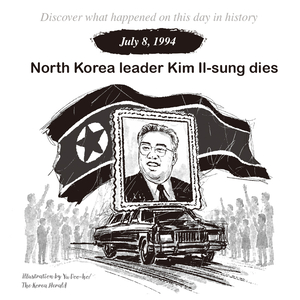
LEE KYONG-HEE The night of July 7, 1994. Three helicopters took off from Pyongyang, flying through a torrential downpour to Kim Il-sung’s villa in the Myohyang Mountains some 160 kilometers northeastward. US military intelligence intercepted a terse message from the site: “The doctors are not here yet.”Later accounts claim that Kim felt sick with a sudden heart attack, doctors were dispatched, two helicopters crashed in the storm, and with no medical help arriving in time, the man who founded and ruled North Korea as a demigod for nearly half a century died. A solemn news anchor announced the Great Leader’s demise on state television 34 hours later, at noon on July 9.These are the circumstances of Kim Il-sung’s mysterious final hour, as depicted by Fyodor Tertitskiy in his latest book, “Pyongyang on the Brink: Sixteen Crises that Shaped North Korea.” The Russian-born historian revisits North Korea’s history through counterfactual exploration, offering “what-if” scenarios at 16 critical turning points, starting with the creation of the Democratic People’s Republic of Korea in 1948 in the Soviet-occupied northern half of the Korean Peninsula.In the episode of Kim Il-sung’s death, the author spotlights one overlooked detail. The helicopters were to carry one more passenger. Kim Jong-il had insisted on flying to his father’s side, but relentless pleading from his wife, Ko Yong-hui, and his guards kept him from boarding.What if the son and heir apparent had ignored their pleas and defied the monsoon storm to demonstrate his loyalty? “We now know such a gesture could have killed him,” Tertitskiy observes. “And history might have taken a dramatically different course.”The gruesome likelihood of both the Great Leader and the Dear Leader perishing that fateful night aside, Kim Il-sung’s abrupt death shocked the South and eventually changed the trajectory of the peninsula. On the brink of another war after the North disclosed its nuclear ambition in 1993, the two Koreas were preparing for what would be the first-ever summit between their leaders just 17 days away, mediated by former US President Jimmy Carter.With tensions mounting, Carter accepted Kim’s invitation to visit Pyongyang. He crossed the DMZ on June 15 and met with Kim the following day to explore ways of freezing the North’s nuclear program. Intent on improving relations with Washington, Kim proposed a swap: he would dismantle his nuclear program in exchange for new reactors to produce electricity. After the Soviet Bloc collapsed and Seoul normalized relations with Moscow and Beijing, he obviously believed that by doing so, his regime could survive in the changing world.Kim appeared prepared to bargain away his nuclear program. Picking up on his idea, American and North Korean delegates continued negotiations and signed the Agreed Framework in Geneva on Oct. 21, 1994. North Korea would be provided with two proliferation-resistant reactors and supplied heavy fuel oil pending their completion, while freezing operations at its nuclear facilities suspected of producing weapons-grade plutonium.An international consortium, called the Korean Peninsula Energy Development Organization, was formed to implement the agreement. With South Korea and Japan participating as providers of financing and technology, KEDO was the first multilateral organization in Northeast Asia.President Bill Clinton, who had mulled over striking the North’s nuclear facility at Yongbyon, praised the agreement as “good for the United States, good for our allies and good for the world.” Clinton’s engagement policy appeared to succeed as Kim Jong-il was willing to take several reconciliatory steps, including limiting his missile launches, accepting a continued US military presence on the peninsula and normalizing relations with the United States.When US Secretary of State Madeleine Albright visited Pyongyang in October that year, Kim staged a massive, choreographed spectacle attended by 200,000 North Koreans. As a human card section displayed the missile shot up earlier that year, he said to Albright, “That was our first missile launch — and our last.” He also told her, “If there is no confrontation, there is no significance to weapons.”Now, fast-forward to 2018, past the Bush administration bent on its deep-seated distrust and enmity toward Pyongyang and the Obama administration singularly relying on “strategic patience.” In the meantime, the North continued to stockpile nuclear bombs and advance its missile technology. Kim Jong-un, with his increased leverage, accomplished his grandfather’s and father’s dreams — a summit with the American leader. But, ironically, his encounters with US President Donald Trump have yielded little beyond dramatic optics.By abandoning the long-standing goals of denuclearization and peaceful unification, the third-generation dictator of the Kim dynasty is driving North Korea toward yet another precipice. How Kim and his country will emerge from the current crisis is entirely unpredictable. Despite his lingering frustrations over his earlier summits with Trump, as described in his “beautiful” letters to the US leader, Kim has not slammed the door to another meeting with him.Given Trump’s unconventional negotiating style, which has often complicated difficult international disputes, Seoul should present a clear roadmap to ensure that any renewed Washington-Pyongyang dialogue is both sustainable and productive.More than three decades after Kim Il-sung’s sudden death altered the course of the first nuclear crisis, the Korean Peninsula once again stands at a crossroads. Choice, rather than fate, will determine what comes next.- - -Lee Kyong-heeLee Kyong-hee is a former editor-in-chief of The Korea Herald. The views expressed here are the writer's own. -- Ed.
[Lee Kyong-hee] North Korean nuclear arms: A long, tangled history
The night of July 7, 1994. Three helicopters took off from Pyongyang, flying through a torrential downpour to Kim Il-sung’s villa in the Myohyang Mountains some
879 words~4 min read